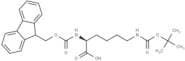
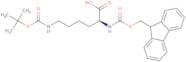
CAS 71989-26-9
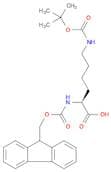
:Fmoc-Lys(Boc)-OH
Beschreibung:
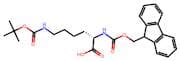
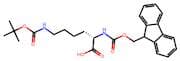
Fmoc-Lys(Boc)-OH, auch bekannt als Fmoc-Lysin(Boc)-OH, ist eine geschützte Aminosäure, die häufig in der Peptidsynthese verwendet wird. Sie weist einen Lysinrest mit zwei Schutzgruppen auf: die Fmoc-Gruppe (9-Fluorenylmethoxycarbonyl), die zum Schutz der Aminogruppe verwendet wird, und die Boc-Gruppe (tert-Butyloxycarbonyl), die die Seitenkettenaminogruppe von Lysin schützt. Diese Verbindung ist typischerweise ein weißer bis off-white fester Stoff und ist in organischen Lösungsmitteln wie Dimethylformamid (DMF) und Dimethylsulfoxid (DMSO) löslich, jedoch weniger löslich in Wasser. Das Vorhandensein dieser Schutzgruppen ermöglicht eine selektive Deprotektion während der Peptidsynthese, was den Aufbau komplexer Peptidsequenzen erleichtert. Fmoc-Lys(Boc)-OH wird aufgrund seiner Stabilität und Handhabungsfreundlichkeit häufig in der Festphasenpeptidsynthese (SPPS) eingesetzt. Seine molekulare Struktur umfasst eine primäre Amin, eine Carbonsäure und zwei voluminöse Schutzgruppen, die zu seiner einzigartigen Reaktivität und Kompatibilität in verschiedenen synthetischen Wegen beitragen.
Formel:C26H32N2O6
InChl:InChI=1S/C26H32N2O6/c1-26(2,3)34-24(31)27-15-9-8-14-22(23(29)30)28-25(32)33-16-21-19-12-6-4-10-17(19)18-11-5-7-13-20(18)21/h4-7,10-13,21-22H,8-9,14-16H2,1-3H3,(H,27,31)(H,28,32)(H,29,30)/t22-/m0/s1
InChI Key:InChIKey=UMRUUWFGLGNQLI-QFIPXVFZSA-N
SMILES:C(OC(N[C@@H](CCCCNC(OC(C)(C)C)=O)C(O)=O)=O)C1C=2C(C=3C1=CC=CC3)=CC=CC2
Synonyme:- (2S)-2-(9H-Fluoren-9-ylmethoxycarbonylamino)-6-[(2-methylpropan-2-yl)oxycarbonylamino]hexanoic acid
- (2S)-6-(tert-Butoxycarbonylamino)-2-[[[(9H-fluoren-9-yl)methoxy]carbonyl]amino]hexanoic acid
- (S)-2-[[[(9H-Fluoren-9-yl)methoxy]carbonyl]amino]-6-(tert-butoxycarbonylamino)hexanoic acid
- (S)-6-[(tert-Butoxycarbonyl)amino]-2-[[[(9H-fluoren-9-yl)methoxy]carbonyl]amino]hexanoic acid
- <span class="text-smallcaps">L</span>-Lysine, N<sup>6</sup>-[(1,1-dimethylethoxy)carbonyl]-N<sup>2</sup>-[(9H-fluoren-9-ylmethoxy)carbonyl]-
- Fmoc-L-Lys(Boc)-OH
- N-Alpha-Fmoc-Nepsilon-Boc-L-Lysine
- N-α-(Fmoc)-N-ε-(t-boc)-<span class="text-smallcaps">L</span>-Lysine-OH
- N-α-Fluorenylmethoxycarbonyl-N-ε-tert-butoxycarbonyl-<span class="text-smallcaps">L</span>-lysine
- N<sup>6</sup>-[(1,1-Dimethylethoxy)carbonyl]-N<sup>2</sup>-[(9H-fluoren-9-ylmethoxy)carbonyl]-<span class="text-smallcaps">L</span>-lysine
- N<sup>α</sup>-(9-Fluorenylmethoxycarbonyl)-N<sup>ε</sup>-(tert-butoxycarbonyl)lysine
- NSC 334302
- Nalpha-(9-Fluorenylmethoxycarbonyl)-Nepsilon-(Tert-Butoxycarbonyl)-L-Lysine
- Fmoc-Lys(Boc)-OH
- L-Lysine, N6-[(1,1-dimethylethoxy)carbonyl]-N2-[(9H-fluoren-9-ylmethoxy)carbonyl]-
- Nα-(9-Fluorenylmethoxycarbonyl)-Nε-(tert-butoxycarbonyl)lysine
- N-α-(Fmoc)-N-ε-(t-boc)-L-Lysine-OH
- Weitere Synonyme anzeigen
Sortieren nach
Reinheit (%)
0
100
|
0
|
50
|
90
|
95
|
100
11 Produkte.
Nε-(tert-Butoxycarbonyl)-Nα-[(9H-fluoren-9-ylmethoxy)carbonyl]-L-lysine
CAS:Formel:C26H32N2O6Reinheit:>98.0%(T)(HPLC)Farbe und Form:White to Almost white powder to crystalMolekulargewicht:468.55Fmoc-Lys(Boc)-OH
CAS:Bachem ID: 4003151.
Formel:C26H32N2O6Reinheit:99.7%Farbe und Form:WhiteMolekulargewicht:468.55Fmoc-Lys(Boc)-OH
CAS:Formel:C26H32N2O6Reinheit:≥ 99.0%Farbe und Form:White powderMolekulargewicht:468.54Fmoc-Lys(Boc)-OH
CAS:Fmoc-Lys(Boc)-OHFormel:C26H32N2O6Reinheit:97%Farbe und Form: white powderMolekulargewicht:468.54g/molFmoc-Lys(Boc)-OH
CAS:Fmoc-Lys(Boc)-OH (N-α-(Fmoc)-N-ε-(t-boc)-L-Lysine-OH) is a lysine derivative that acts as a reactive linker.Formel:C26H32N2O6Reinheit:99.88% - 99.89%Farbe und Form:SolidMolekulargewicht:468.54Fmoc-Lys(Boc)-OH
CAS:Fmoc-Lys(Boc)-OH is a monoclonal antibody that reacts with lysine residues. It is synthesized by reacting a solid phase support with an aliphatic hydrocarbon. The reactive functional group on the hydrocarbon terminates in an amine and forms an amide linkage to the amino terminus of the peptide. The hydroxyl terminus of the peptide is then reacted with a trifluoroacetic acid (TFA) ester of lysine in the presence of base. This reaction produces a TFA salt of Fmoc-Lys(Boc)-OH, which can be purified by high salt precipitation or reversed to produce Fmoc-Lys(Boc)-OH by treatment with base. Fmoc-Lys(Boc)-OH has been used as a reagent for chemical conjugation to fluorophores and other molecules such as biotin, avidin, streptFormel:C26H32N2O6Reinheit:Min. 98.0 Area-%Molekulargewicht:468.54 g/molFmoc-Lys(Boc)-OH
CAS:Fmoc-Lys(Boc)-OH is a synthetic amino acid that has been used to synthesize polypeptides. It is prepared by the reaction of naphthalene, trifluoroacetic acid and copper (II) acetate in an acidic environment. The synthesis of Fmoc-Lys(Boc)-OH involves the use of a high salt and coordination geometry for the copper complex. This amino acid can be used as a cancer drug, because it inhibits NS3 protease, which is an enzyme that promotes tumor growth. Fmoc-Lys(Boc)-OH also binds to carbohydrate receptors on cancer cells and inhibits uptake of these cells by macrophages.Formel:C26H32N2O6Reinheit:Min. 98 Area-%Farbe und Form:White PowderMolekulargewicht:468.54 g/molFmoc-Lys(Boc)-OH
CAS:M03419 - Fmoc-Lys(Boc)-OH
Formel:C26H32N2O6Reinheit:98%Farbe und Form:Solid, Powder or Crystalline Powder or Solid or ChunksMolekulargewicht:468.55Na-FMOC-Ne-BOC-L-Lysine (FMOC-Lys(BOC)-OH) extrapure, 98%
CAS:Formel:C26H32N2O6Reinheit:min. 98%Farbe und Form:White to off-white, Crystalline powderMolekulargewicht:468.54
![Nε-(tert-Butoxycarbonyl)-Nα-[(9H-fluoren-9-ylmethoxy)carbonyl]-L-lysine](/_next/image/?url=https%3A%2Fstatic.cymitquimica.com%2Fproducts%2F3B%2Fthumb%2FB3072.jpg&w=3840&q=75)