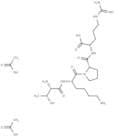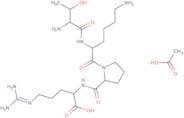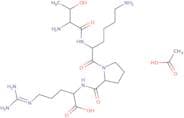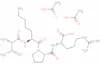
CAS 72103-53-8
:Tuftsinacetat
Beschreibung:
Tuftsinacetat, mit der CAS-Nummer 72103-53-8, ist ein synthetisches Peptid, das aus dem natürlichen Immunmodulator Tuftsin abgeleitet ist, der ein Fragment des Moleküls der Immunglobulin G (IgG) ist. Diese Verbindung ist bekannt für ihre immunstimulierenden Eigenschaften, die die Aktivität von Makrophagen erhöhen und die Immunantwort fördern. Tuftsinacetat zeichnet sich typischerweise durch seine Fähigkeit aus, Immunfunktionen zu modulieren, was es in der Immunologie und potenziellen therapeutischen Anwendungen von Interesse macht. Es wird häufig auf seine Rolle bei der Verbesserung der Phagozytose und der Zytokinproduktion untersucht, was in verschiedenen medizinischen Bedingungen, einschließlich Infektionen und Krebs, von Vorteil sein kann. Die Acetatform weist darauf hin, dass es sich um ein Salz oder Ester handelt, das aus Essigsäure abgeleitet ist, was seine Löslichkeit und Stabilität beeinflussen kann. Insgesamt stellt Tuftsinacetat ein bedeutendes Forschungsfeld in der Entwicklung von Immuntherapien und dem Verständnis der Modulation des Immunsystems dar.
Formel:C23H44N8O8
InChl:InChI=1/C21H40N8O6.C2H4O2/c1-12(30)16(23)18(32)27-13(6-2-3-9-22)19(33)29-11-5-8-15(29)17(31)28-14(20(34)35)7-4-10-26-21(24)25;1-2(3)4/h12-16,30H,2-11,22-23H2,1H3,(H,27,32)(H,28,31)(H,34,35)(H4,24,25,26);1H3,(H,3,4)
SMILES:CC(C(C(=NC(CCCCN)C(=O)N1CCCC1C(=NC(CCCNC(=N)N)C(=O)O)O)O)N)O.CC(=O)O
Synonyme:- L-Arginine, N2-(1-(N2-L-threonyl-L-lysyl)-L-prolyl)-, diacetate (salt)4
- L-threonyl-L-lysyl-L-prolyl-N~5~-(diaminomethylidene)-L-ornithine acetate (1:2)
- threonyllysylprolyl-N~5~-(diaminomethylidene)ornithine acetate (1:1)
- Tuftsin Acetate Salt
- tuftsin acetate
- THR-LYS-PRO-ARG ACETATE SALT
- tuftsin acetate salt hydrate
- H-THR-LYS-PRO-ARG-OH ACETATE SALT
- H-THR-LYS-PRO-ARG-OH ACOH
- Tuftsin diacetate
- TUFTSIN
- Weitere Synonyme anzeigen
Sortieren nach
Reinheit (%)
0
100
|
0
|
50
|
90
|
95
|
100
3 Produkte.
Tuftsin diacetate
CAS:Tuftsin diacetate, Thr-Lys-Pro-Arg, activates macrophages/microglia; it's in immunoglobulin G's Fc and boosts immunity.Formel:C25H48N8O10Reinheit:98%Farbe und Form:SolidMolekulargewicht:620.7Tuftsin
CAS:Kontrolliertes ProduktTuftsin is a cyclic peptide that has been shown to have various biological properties, including anti-inflammatory and immunosuppressive activity. Tuftsin has been shown to inhibit the production of proinflammatory cytokines such as IL-10 by T cells in vitro. Tuftsin also inhibits the activation of toll-like receptors (TLR) and may have a role in inhibiting mycobacterial infection. This drug was found to be well tolerated in humans with congestive heart failure, and is currently being evaluated for its potential use as an adjunct therapy for inflammatory bowel disease. It has also been shown to be effective against opportunistic fungal infections, such as Candida albicans, Cryptococcus neoformans, and Aspergillus fumigatus. Tuftsin can be measured using analytical methods such as titration calorimetry or polymerase chain reaction (PCR).Formel:C21H40N8O6•2CH3COOH•4H2OReinheit:Min. 95%Molekulargewicht:692.75 g/molTuftsin diacetate
CAS:Kontrolliertes ProduktTuftsin diacetate is a synthetic peptide derivative, which is a modified form of the natural tetrapeptide tuftsin. This product originates from the enzymatic action on the Fc region of the gamma heavy chain of immunoglobulin G. Tuftsin diacetate functions by enhancing the phagocytic activity of macrophages and neutrophils, leading to an amplified immune response. Its mode of action involves binding to specific cell surface receptors, which stimulates these immune cells and promotes pathogen clearance.Formel:C23H44N8O8Reinheit:Min. 95%Molekulargewicht:560.6 g/mol