CAS 727356-19-6
:2-brom-6-(chloromethyl)pyridin
Beschreibung:
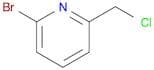
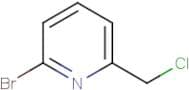
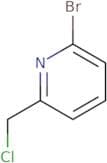
2-brom-6-(chloromethyl)pyridin ist eine heterocyclische organische Verbindung, die durch einen Pyridinring charakterisiert ist, der sowohl mit Brom- als auch mit Chloromethylgruppen substituiert ist. Die Anwesenheit des Bromatoms an der Position 2 und der Chloromethylgruppe an der Position 6 trägt zu seiner Reaktivität und potenziellen Anwendungen in der organischen Synthese bei. Diese Verbindung ist typischerweise eine farblose bis blassgelbe Flüssigkeit oder ein Feststoff, abhängig von ihrer Form und Reinheit. Sie ist in organischen Lösungsmitteln löslich, was sie in verschiedenen chemischen Reaktionen nützlich macht, insbesondere bei der Synthese komplexerer Moleküle. Die funktionellen Gruppen in 2-brom-6-(chloromethyl)pyridin können an nucleophilen Substitutionsreaktionen teilnehmen, was sie zu einem wertvollen Zwischenprodukt in der Herstellung von Arzneimitteln, Agrochemikalien und anderen Feinchemikalien macht. Sicherheitsvorkehrungen sollten beim Umgang mit dieser Verbindung beachtet werden, da sowohl Brom als auch Chlor Halogene sind, die Gesundheitsrisiken darstellen können. Geeignete Lagerungs- und Entsorgungsmethoden sind entscheidend, um mögliche Umweltauswirkungen zu mindern.
Formel:C6H5BrClN
InChl:InChI=1/C6H5BrClN/c7-6-3-1-2-5(4-8)9-6/h1-3H,4H2
SMILES:c1cc(CCl)nc(c1)Br
Synonyme:- Pyridine, 2-Bromo-6-(Chloromethyl)-
Sortieren nach
Reinheit (%)
0
100
|
0
|
50
|
90
|
95
|
100
4 Produkte.
2-Bromo-6-(chloromethyl)pyridine
CAS:Formel:C6H5BrClNReinheit:98%Farbe und Form:SolidMolekulargewicht:206.46762-Bromo-6-(chloromethyl)pyridine
CAS:2-Bromo-6-(chloromethyl)pyridineReinheit:97%Molekulargewicht:206.47g/mol2-Bromo-6-(chloromethyl)pyridine
CAS:2-Bromo-6-(chloromethyl)pyridine is a ligand that binds to transition metal ions. It has been shown to have a high affinity for thionyl, which is an endogenous substrate. The ligand has also been used in the immobilization of biomolecules, such as proteins and DNA. The ligand has been synthesized by reacting cyanuric chloride with 2-bromopyridine. This method is different from the traditional synthetic pathway, which typically involves reacting chloroform with methyl bromide in the presence of a base or acid. The synthesis of this ligand can be done using two methods: (1) reaction of histidine with hydroxylamine hydrochloride and methyl bromide; or (2) reaction of methylamine with ethyl chlorocarbonate and 1,4-diazabicyclo[2.2.2]octane.Formel:C6H5BrClNReinheit:Min. 95%Molekulargewicht:206.47 g/mol