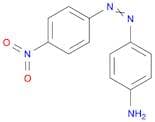
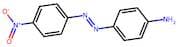
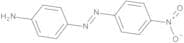
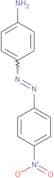
CAS 730-40-5
:4-Amino-4'-nitroazobenzol
- 4-(4-Nitrophenylazo)aniline
- 4-Amino-4′-nitroazobenzene
- 4-Nitro-4′-aminoazobenzene
- 4-[(4-Nitrophenyl)azo]benzenamine
- 4-[(E)-(4-nitrophenyl)diazenyl]aniline
- 4-[2-(4-Nitrophenyl)diazenyl]benzenamine
- Acetamine Orange GR
- Acetate Fast Orange G
- Acetate Fast Orange GR
- Acetoquinone Light Orange JRL
- Akasperse Orange RBA
- Altocyl Orange GR
- Amacel Orange GR
- Artisil Direct Orange 2R
- Artisil Orange 2R
- Atlantic Disperse Orange GRA
- Benzenamine, 4-((4-nitrophenyl)azo)-
- Benzenamine, 4-[2-(4-nitrophenyl)diazenyl]-
- Celliton Discharge Orange GRL
- Celliton Fast Orange GR
- Celliton Orange GR
- Celliton Orange GRA
- Celutate Orange GRH
- Cibacet Orange 2R
- Cibacete Orange 2RN
- Cilla Fast Orange GR
- Diacelliton Fast Orange GL
- Disperse Orange GR
- Disperse Orange Zh
- Dispersol Fast Orange G
- Dispersol Orange AG
- Durgacet Orange GR
- Eastman Orange GRN
- Eastone Orange 2R
- Eniacyl Orange GR
- Fenacet Orange G
- Interchem Acetate Orange GL
- Kayalon Fast Orange GR
- Microsetile Orange GR
- Miketon Fast Orange GR
- Nacelan Orange GR
- Neosetile Orange GR
- Nyloquinone Orange 2R
- Oracet Orange 2R
- Ostacet Orange P 2R
- Perliton Orange 6R
- Reliton Orange GR
- Serilic Orange GXD
- Setacyl Orange GR
- Setacyl Orange RE
- Silotras Orange TSGR
- Supracet Fast Orange G
- Synten Orange 2R
- Transetile Orange P-GR
- Vonteryl Orange GS
- p-(p-Nitrophenylazo)aniline
- p-Nitro-p′-aminoazobenzene
- C.I. 11005
- Weitere Synonyme anzeigen
4-(4-nitrophenylazo)aniline
CAS:Formel:C12H10N4O2Reinheit:95%Farbe und Form:SolidMolekulargewicht:242.23344-((4-Nitrophenyl)diazenyl)aniline
CAS:4-((4-Nitrophenyl)diazenyl)anilineReinheit:95%Molekulargewicht:242.24g/molDisperse Orange 3 (Technical Grade)
CAS:Kontrolliertes ProduktApplications Disperse Orange 3 is an azo disperse dye which is water insoluble. Disperse Orange 3 can be used to dye polyester and acetate fibers. Dyes and metabolites, Environmental Testing.
References Nishida, K., et al.: J. Soc. Dyers Colour., 105, 112 (1989); De Wael, K.: Sci. Justice, 52, 81 (2012)Formel:C12H10N4O2Farbe und Form:OrangeMolekulargewicht:242.23Disperse Orange 3
CAS:Disperse Orange 3 is a diazonium salt that has been used in the textile industry as a dye, but has also been used as a reagent for the synthesis of organic compounds. Disperse Orange 3 is synthesized by reacting an azobenzene with a fatty acid, which yields an unstable intermediate. The intermediate undergoes photochemical reactions when exposed to ultraviolet light or moisture. This reaction produces benzalkonium chloride and ft-ir spectroscopy, which confirms the identity of Disperse Orange 3. Disperse Orange 3 is used in biological treatment and binding constants experiments to measure the strength of interactions between molecules. It has clinical relevance in magnetic resonance spectroscopy because it can be used to probe molecular interactions with proteins or nucleic acids. It also has solubility data that can be used to determine its solubility in water and other solvents.
Disperse Orange 3 is soluble in supercritical carbon dioxide at high temperatures, but insoluble at room temperatureFormel:C12H10N4O2Reinheit:Min. 65%Farbe und Form:PowderMolekulargewicht:242.23 g/molDisperse orange 3
CAS:Disperse Orange 3 is a monoazo dye characterized by a dye content of 90%, along with dispersants and surfactants. It features two aromatic rings, one with an amino group and the other with a nitro group, displaying a distinct absorption peak at 415 nm.Formel:C12H10N4O2Farbe und Form:SolidMolekulargewicht:242.23