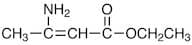
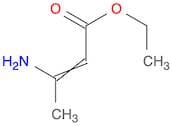
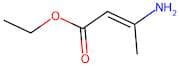
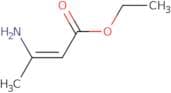
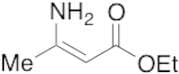
CAS 7318-00-5
:Ethylester der 3-Amino-2-butensäure
- 2-Butenoic acid, 3-amino-, ethyl ester
- 3-Amino-2-Butenoic Acid Ethyl Ester
- 3-Aminocrotonic Acid Ethyl Ester
- Beta-Aminocrotonic Acid Ethyl Ester
- Crotonic Acid, 3-Amino-, Ethyl Ester
- Crotonic acid, β-amino-, ethyl ester
- Ethyl (2e)-3-Amino-2-Butenoate
- Ethyl (2e)-3-Aminobut-2-Enoate
- Ethyl 3-Amino-2-Butenoate
- Ethyl 3-Aminobut-2-Enoate
- Ethyl Aminocrotonate
- Ethyl B-Iminobutyrate
- Ethyl Beta-Aminocrotonate
- Ethyl β-amino-β-methylacrylate
- Ethyl β-aminocrotonate
- NSC 1086
- ethyl (2Z)-3-aminobut-2-enoate
- ethyl (3E)-3-iminobutanoate
- Β-Aminocrotonic Acid, Ethyl Ester
- Weitere Synonyme anzeigen
Ethyl 3-Amino-2-butenoate
CAS:Formel:C6H11NO2Reinheit:>98.0%(GC)(T)Farbe und Form:White or Colorless to Light yellow powder to lump to clear liquidMolekulargewicht:129.163-Amino-2-butenoic acid ethyl ester
CAS:Formel:C6H11NO2Reinheit:98%Farbe und Form:SolidMolekulargewicht:129.1570Ethyl 3-aminocrotonate
CAS:Ethyl 3-aminocrotonateReinheit:99%Farbe und Form:LiquidMolekulargewicht:129.15704g/molEthyl 3-aminobut-2-enoate
CAS:Ethyl 3-aminobut-2-enoate is an organic compound that belongs to the class of amides. It can be prepared from the reaction of ethyl acetoacetate with ammonia and sodium ethoxide in a solvent such as ethanol or water. Ethyl 3-aminobut-2-enoate has been used as a substrate for the synthesis of felodipine, which is a drug used to treat high blood pressure. The molecule has efficient hydrogen bonding properties and can form acid conjugates with chloride ions and alcohols. This compound can also form intermolecular hydrogen bonds between different molecules to give crystalline structures with vibrational, rotational, and electronic spectra that have been studied using nmr spectroscopy and crystallography.Formel:C6H11NO2Reinheit:Min. 95%Farbe und Form:PowderMolekulargewicht:129.16 g/molEthyl 3-Aminocrotonate
CAS:Kontrolliertes ProduktApplications Ethyl 3-Aminocrotonate is used as a reagent to synthesize Nitrendipine (N490150), a calcium channel antagonist that is used to treat patients with hypertension. Ethyl 3-Aminocrotonate is also used as a reagent to synthesize (S)-Felodipine (F232370), a calcium entry blocker that has antihypertensive properties.
Not a dangerous good if item is equal to or less than 1g/ml and there is less than 100g/ml in the package
References Bailey, D., et al.: Clin. Invest. Med., 12, 357 (1989); Bean, B.: Proc. Nat. Acad. Sci., 81, 6388 (1984); Kwon, K., et al.: Tetrahedron, 67, 10222 (2011); Leenen, F. & Holiwell, D.: Am. J. Cardio., 69, 639 (1992); Meyer, H., et al.: Arz. Forsch., 33, 1528 (1983); Stoepel, K., et al.: Arz. Forsch., 31, 2056 (1980)Formel:C6H11NO2Farbe und Form:NeatMolekulargewicht:129.16