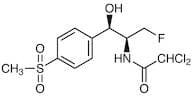
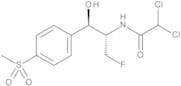
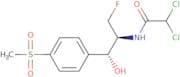
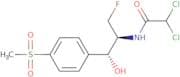
CAS 73231-34-2
:Florfenicol
Beschreibung:
Florfenicol ist ein synthetisches Antibiotikum, das zur Klasse der Phenicole gehört und hauptsächlich in der Tiermedizin zur Behandlung von bakteriellen Infektionen bei Tieren eingesetzt wird. Es ist wirksam gegen ein breites Spektrum von grampositiven und gramnegativen Bakterien, was es zu einem wertvollen therapeutischen Mittel macht. Florfenicol wirkt, indem es die bakterielle Proteinsynthese hemmt, indem es gezielt die 50S-ribosomale Untereinheit angreift, was die Produktion von essentiellen Proteinen stört, die für das Wachstum und die Fortpflanzung von Bakterien notwendig sind. Die Substanz zeichnet sich durch ihre relativ geringe Toxizität bei Tieren im Vergleich zu anderen Antibiotika aus, was ihren Einsatz bei Lebensmittelliefernden Tieren unter regulierten Bedingungen ermöglicht. Florfenicol wird typischerweise durch Injektion oder in Futtermittelzusammensetzungen verabreicht, und seine Pharmakokinetik zeigt eine gute Gewebedurchdringung, was vorteilhaft für die Behandlung systemischer Infektionen ist. Sein Einsatz unterliegt jedoch strengen Vorschriften aufgrund von Bedenken hinsichtlich der Antibiotikaresistenz und möglicher Rückstände in Lebensmitteln. Insgesamt stellt Florfenicol ein wichtiges Werkzeug in der Tiermedizin dar, das die Wirksamkeit gegen bakterielle Infektionen mit Sicherheits- und Regulierungsanforderungen in Einklang bringt.
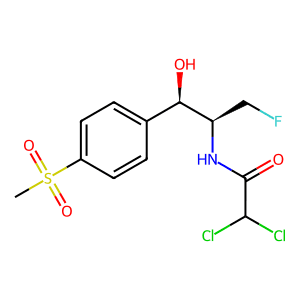
Formel:C12H14Cl2FNO4S
InChl:InChI=1/C12H14Cl2FNO2S/c1-19-8-4-2-7(3-5-8)10(17)9(6-15)16-12(18)11(13)14/h2-5,9-11,17H,6H2,1H3,(H,16,18)
InChI Key:InChIKey=AYIRNRDRBQJXIF-NXEZZACHSA-N
SMILES:[C@@H]([C@H](NC(C(Cl)Cl)=O)CF)(O)C1=CC=C(S(C)(=O)=O)C=C1
Synonyme:- 2,2-Dichloro-N-[(1R,2S)-3-fluoro-1-hydroxy-1-(4-methylsulfonylphenyl)propan-2-yl]acetamide
- 2,2-Dichloro-N-[(1S,2R)-1-(fluoromethyl)-2-hydroxy-2-[4-(methylsulfonyl)phenyl]ethyl]acetamide
- 2,2-dichloro-N-{(1R,2S)-3-fluoro-1-hydroxy-1-[4-(methylsulfonyl)phenyl]propan-2-yl}acetamide
- 2,2-dichloro-N-{1-(fluoromethyl)-2-hydroxy-2-[4-(methylsulfanyl)phenyl]ethyl}acetamide
- Acetamide, 2,2-dichloro-N-[(1S,2R)-1-(fluoromethyl)-2-hydroxy-2-[4-(methylsulfonyl)phenyl]ethyl]-
- Acetamide, 2,2-dichloro-N-[1-(fluoromethyl)-2-hydroxy-2-[4-(methylsulfonyl)phenyl]ethyl]-, [R-(R*,S*)]-
- Aquafen
- Aquaflor
- Flofenicol
- Flonicol
- Florfeniol
- Florgane
- Floron
- Nuflor
- Sch 25298
- Selectan
- Topazone
- Florfenicol
- [R-(R*,S*)]-2,2-DICHLORO-N-[1-(FLUOROMETHYL)-2-HYDROXY-2-[4-(METHYLSULFONYL)PHENYL]ETHYL]ACETAMIDE
- Fluorothiamphenicol
- [r-(r*, r*)]-n-[1-(fluoromethyl)-2-hydroxy-2-(4-(methylsulforyl)phenyl)-ethyl]-2,2-dichloroacetamide
- Sch-25298, Aquafen
- (r-(r*,s*))-methyleste
- 2,2-dichloro-n-(1-(fluoromethyl)-2-hydroxy-2-(4-(methylsulfonyl)phenyl)ethyl
- 2,2-Dichloro-N-(1-(fluoromethyl)-2-hydroxy-2-(4-(methylsulfonyl)phenyl)ethyl)acetamide
- Acetamide, 2,2-dichloro-N-(1S,2R)-1-(fluoromethyl)-2-hydroxy-2-4-(methylsulfonyl)phenylethyl-
- FLUPROFEN
- Aquafen, Nuflor, SCH-25298, [R-(R*,S*)]-2,2-Dichloro-N-[1-(fluoromethyl)-2-hydroxy-2-[4-(methylsulfonyl)phenyl]ethyl]acetamide
- 2,2-Dichloro-N-[(1R,2S)-3-fluoro-1-hydroxy-1-(4-methylsulfonylphenyl)propan-2-yl]acetamid
- Weitere Synonyme anzeigen
Sortieren nach
Reinheit (%)
0
100
|
0
|
50
|
90
|
95
|
100
14 Produkte.
Florfenicol
CAS:Formel:C12H14Cl2FNO4SReinheit:>98.0%(HPLC)(N)Farbe und Form:White to Light yellow powder to crystalMolekulargewicht:358.21Florfenicol, 98%
CAS:A bacteriostatic antibiotic similar to chloramphenicol which inhibits bacterial protein synthesis This Thermo Scientific Chemicals brand product was originally part of the Alfa Aesar product portfolio. Some documentation and label information may refer to the legacy brand. The original Alfa Aesar prFormel:C12H14Cl2FNO4SReinheit:98%Farbe und Form:White to pale cream, Powder or crystalline powderMolekulargewicht:358.21Acetamide, 2,2-dichloro-N-[(1S,2R)-1-(fluoromethyl)-2-hydroxy-2-[4-(methylsulfonyl)phenyl]ethyl]-
CAS:Formel:C12H14Cl2FNO4SReinheit:98%Farbe und Form:SolidMolekulargewicht:358.2133Florfenicol
CAS:Florfenicol treats bovine respiratory disease and foot rot in cattle, and catfish enteric septicemia.Formel:C12H14Cl2FNO4SReinheit:99.22% - 99.33%Farbe und Form:White Crystalline PowderMolekulargewicht:358.21Florfenicol
CAS:Formel:C12H14Cl2FNO4SReinheit:≥ 98.0% (dried basis)Farbe und Form:White to off-white powderMolekulargewicht:358.21Florfenicol
CAS:Kontrolliertes ProduktFormel:C12H14Cl2FNO4SFarbe und Form:NeatMolekulargewicht:358.21Florfenicol-d5
CAS:Formel:C12H9D5Cl2FNO4SFarbe und Form:White To Off-White SolidMolekulargewicht:363.24Florfenicol
CAS:Applications Florfenicol is a fluorinated derivative of thiamphenicol. Florfenicol inhibits bacterial protein synthesis by binding to ribosome 50S and 70S subunits. Florfenicol is used as an antibacterial.
References Kim, E and Aoki, T.: Microbiol. Immunol., 40, 665, (1996), Keyes, K.: Antimicrob. Agents Chemother., 44, 421 (2000)Formel:C12H14Cl2FNO4SFarbe und Form:YellowMolekulargewicht:358.21Florfenicol - Bio-X ™
CAS:Florfenicol is a broad-spectrum antibiotic used for the treatment of various bacteria infections. This drug is used in veterinary medicine and to treat animals with those infections. This drug works by inhibiting bacteria synthesis. It is a fluorinated synthetic analog of thiamphenicol.Formel:C12H14Cl2FNO4SReinheit:Min. 98 Area-%Farbe und Form:PowderMolekulargewicht:358.21 g/molFlorfenicol
CAS:Florfenicol is a broad-spectrum antibiotic that belongs to the group of florfenicol. It is used in veterinary medicine to treat bacterial infections in animals, including those caused by salmonella, streptococcus, and mycoplasma. Florfenicol has been shown to have an inhibitory effect on the growth of tetracycline-resistant bacteria. Florfenicol binds reversibly to the 23S ribosomal RNA in the 50S subunit of bacteria and inhibits protein synthesis. This binding prevents the formation of an antibiotic-inhibitor complex with the enzyme ribosome that is required for translation, inhibiting protein synthesis and cell division. The rate constant for this reaction has been determined using a combination of analytical methods, including chromatographic analysis and colloidal gold electrophoresis. Florfenicol also has anti-inflammatory properties due to its ability to inhibit prostaglandin synthesis.Formel:C12H14Cl2FNO4SReinheit:Min. 98 Area-%Farbe und Form:White PowderMolekulargewicht:358.21 g/mol