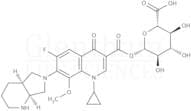
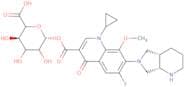
![(3R,6R)-6-[7-[(4aS,7aS)-1,2,3,4,4a,5,7,7a-octahydropyrrolo[3,4-b]pyridin-6-yl]-1-cyclopropyl-6-flu…](/_next/image/?url=https%3A%2Fstatic.cymitquimica.com%2Fcas-image%2Fthumb-webp%2F363658-3r-6r-6-7-4as-7as-12344a-577a-octahydropyrrolo-34-b-pyridin-6-yl-1-cyclopropyl-6-fluoro-8-methoxy-4-oxo-quinoline-3-carbonyl-oxy-345-trihydroxy-tetrahydropyran-2-carboxylic-acid.webp&w=3840&q=75)
CAS 733002-61-4
:(3R,6R)-6-[7-[(4aS,7aS)-1,2,3,4,4a,5,7,7a-octahydropyrrolo[3,4-b]pyridin-6-yl]-1-cyclopropyl-6-fluor-8-methoxy-4-oxo-chinolin-3-carbonyl]oxy-3,4,5-trihydroxy-tetrahydropyran-2-carbonsäure
Beschreibung:
Die chemische Substanz mit dem Namen "(3R,6R)-6-[7-[(4aS,7aS)-1,2,3,4,4a,5,7,7a-octahydropyrrolo[3,4-b]pyridin-6-yl]-1-cyclopropyl-6-fluor-8-methoxy-4-oxo-chinolin-3-carbonyl]oxy-3,4,5-trihydroxy-tetrahydropyran-2-carbonsäure" und der CAS-Nummer "733002-61-4" ist eine komplexe organische Verbindung, die durch ihre komplizierte molekulare Struktur gekennzeichnet ist, die mehrere funktionelle Gruppen wie Hydroxyl-, Carbonyl- und Methoxygruppen umfasst. Diese Verbindung weist einen Chinolinkern auf, der für seine biologische Aktivität bekannt ist, sowie eine Tetrahydropyran-Einheit, die zu ihrer Stereochemie und potenziellen Wechselwirkungen in biologischen Systemen beiträgt. Das Vorhandensein von Fluor- und Cyclopropylgruppen deutet auf eine erhöhte Lipophilie und möglicherweise verbesserte pharmakokinetische Eigenschaften hin. Ihre Stereochemie, die durch die Bezeichnungen (3R,6R) und (4aS,7aS) angezeigt wird, impliziert spezifische dreidimensionale Anordnungen, die ihre biologische Aktivität und Wechselwirkungen mit Zielproteinen oder -enzymen erheblich beeinflussen können. Insgesamt könnte diese Verbindung potenzielle Anwendungen in der medizinischen Chemie haben, insbesondere bei der Entwicklung von Therapeutika, die auf spezifische biologische Wege abzielen.
Formel:C27H32FN3O10
InChl:InChI=1/C27H32FN3O10/c1-39-23-17-13(7-15(28)18(23)30-8-11-3-2-6-29-16(11)10-30)19(32)14(9-31(17)12-4-5-12)26(38)41-27-22(35)20(33)21(34)24(40-27)25(36)37/h7,9,11-12,16,20-22,24,27,29,33-35H,2-6,8,10H2,1H3,(H,36,37)/t11-,16+,20?,21+,22?,24?,27+/m0/s1
Sortieren nach
Reinheit (%)
0
100
|
0
|
50
|
90
|
95
|
100
5 Produkte.
Moxifloxacin Acyl Glucuronide
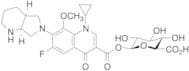
CAS:Formel:C27H32FN3O10Farbe und Form:Off-White SolidMolekulargewicht:577.56rac cis-Moxifloxacin Acyl-b-D-glucuronide (>85%)
CAS:Kontrolliertes ProduktApplications A metabolite of Moxifloxacin (M745000).
References Steinijans, V., et al.: J. Clin. Pharmacol. Ther., 29, 323 (1991), Haria, M., et al.: Drugs, 51, 585 (1996), Pickerill, K., et al.: Pharmacotherapy, 20, 417(2000),Formel:C27H32FN3O10Reinheit:>85%Farbe und Form:NeatMolekulargewicht:577.56rac cis-Moxifloxacin-d4 Acyl-β-D-glucuronide
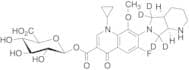
CAS:Kontrolliertes ProduktApplications A labelled metabolite of Moxifloxacin (M745000).
References Steinijans, V., et al.: J. Clin. Pharmacol. Ther., 29, 323 (1991), Haria, M., et al.: Drugs, 51, 585 (1996), Pickerill, K., et al.: Pharmacotherapy, 20, 417(2000),Formel:C27H28D4FN3O10Farbe und Form:NeatMolekulargewicht:581.58rac cis-Moxifloxacin acyl-b-D-glucuronide
CAS:Moxifloxacin is a fluoroquinolone antibiotic that inhibits bacterial DNA gyrase and topoisomerase IV, which are enzymes that maintain the integrity of bacterial DNA. Moxifloxacin forms an acyl-b-D-glucuronide metabolite (rac) which has a lower risk of drug resistance than moxifloxacin itself. Rac-moxifloxacin acyl-b-D-glucuronide also has a higher affinity for bacterial 16S ribosomal RNA, leading to better inhibition of protein synthesis and cell death. This drug is synthesized by modification of sugar moieties on the racemic compound with glycals to form oligosaccharides and polysaccharides. It is then methylated with a methyl group from S-adenosyl methionine (SAM). The resulting product is purified by crystallization or column chromatography to remove impurities. Rac cisFormel:C27H32FN3O10Reinheit:Min. 95%Farbe und Form:SolidMolekulargewicht:577.56 g/mol