


CAS 73319-13-8
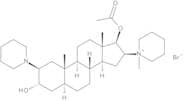
:[acetat von (2S,3S,5S,8R,9S,10S,13S,14S,16S,17R)-17-hydroxy-10,13-dimethyl-16-(1-methylpiperidin-1-ium-1-yl)-2-(1-piperidyl)-2,3,4,5,6,7,8,9,11,12,14,15,16,17-tetradecahydro-1H-cyclopenta[a]phenanthren-3-yl] bromid
Beschreibung:
Die chemische Substanz mit dem Namen "[acetat von (2S,3S,5S,8R,9S,10S,13S,14S,16S,17R)-17-hydroxy-10,13-dimethyl-16-(1-methylpiperidin-1-ium-1-yl)-2-(1-piperidyl)-2,3,4,5,6,7,8,9,11,12,14,15,16,17-tetradecahydro-1H-cyclopenta[a]phenanthren-3-yl] bromid" und der CAS-Nummer 73319-13-8 ist eine komplexe organische Verbindung, die durch ihre Mehrringstruktur gekennzeichnet ist, die einen Cyclopenta[a]phenanthren-Kern umfasst. Diese Verbindung weist mehrere Stereozentren auf, was spezifische räumliche Anordnungen ihrer Atome anzeigt, die ihre biologische Aktivität und Wechselwirkungen erheblich beeinflussen können. Das Vorhandensein funktioneller Gruppen wie Hydroxyl (-OH) und Acetat (-OCOCH3) deutet auf eine potenzielle Löslichkeit in polaren Lösungsmitteln und Reaktivität in verschiedenen chemischen Umgebungen hin. Darüber hinaus deutet die Einbeziehung von Piperidin- und Piperidinium-Moieties auf potenzielle pharmakologische Eigenschaften hin, da diese Strukturen häufig mit biologischer Aktivität assoziiert sind. Das Bromid-Gegenion kann die Löslichkeit und Stabilität in bestimmten Formulierungen verbessern. Insgesamt deutet die komplexe Struktur dieser Verbindung und ihre funktionellen Gruppen darauf hin, dass sie Anwendungen in der medizinischen Chemie oder Pharmakologie haben könnte, obwohl spezifische biologische Aktivitäten weitere Untersuchungen erfordern würden.
Formel:C32H55BrN2O3
InChl:InChI=1/C32H55N2O3.BrH/c1-22(35)37-29-19-23-11-12-24-25(32(23,3)21-27(29)33-15-7-5-8-16-33)13-14-31(2)26(24)20-28(30(31)36)34(4)17-9-6-10-18-34;/h23-30,36H,5-21H2,1-4H3;1H/q+1;/p-1/t23-,24+,25-,26-,27-,28-,29-,30-,31-,32-;/m0./s1
Sortieren nach
Reinheit (%)
0
100
|
0
|
50
|
90
|
95
|
100
5 Produkte.
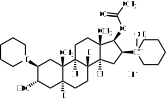
Vecuronium Bromide Related Compound F (Piperidinium,1-[(2β,3α,5α,16β,17β)-17-acetyloxy-3-hydroxy-2-(1-piperidinyl)androstan-16-yl]-1-methyl bromide)
CAS:Compounds containing an unfused pyridine ring in the structure, nesoiFormel:C32H55BrN2O3Farbe und Form:White Off-White PowderMolekulargewicht:594.33961Vecuronium Bromide EP Impurity C Bromide (Vecuronium Bromide USP Related Compound F)
CAS:Formel:C32H55N2O3·BrMolekulargewicht:515.80 79.903-Desacetyl Vecuronium Bromide
CAS:Impurity Vecuronium Bromide EP Impurity C
Stability Unstable in Aqueous Solution
Applications 3-Desacetyl Vecuronium Bromide (Vecuronium Bromide EP Impurity C) is a metabolite of Vecuronium (V102500), in human plasma.
References Wang, S., et al.: Clin. Pharmacol. Ther., 53, 410 (1993), Bertilsson, L., et al.: Clin. Pharmacokinet., 29, 192 (1995), Aklillu, E., et al.: J. Pharmacol. Exp. Ther., 278, 441 (1996),Formel:C32H55N2O3·BrFarbe und Form:NeatMolekulargewicht:595.69471-[(2b,3a,5a,16b,17b)-17-Acetyloxy-3-hydroxy-2-(1-piperidinyl)androstan-16-yl]-1-methylpiperidinium bromide
CAS:1-[(2b,3a,5a,16b,17b)-17-Acetyloxy-3-hydroxy-2-(1-piperidinyl)androstan-16-yl]-1-methylpiperidinium bromide is a drug that has been shown to have an inhibitory effect on the neuromuscular system. It is used in clinical doses as a muscle relaxant and anesthetic. The drug binds to the acetylcholine receptor at the neuromuscular junction and blocks nerve impulses by inhibiting acetylcholine release. 1-[(2b,3a,5a,16b,17b)-17-Acetyloxy-3-hydroxy-2-(1-piperidinyl)androstan-16-yl]-1-methylpiperidinium bromide has a long half life and accumulates in the body with repeated administration. This accumulation can lead toFormel:C32H55BrN2O3Reinheit:Min. 95%Molekulargewicht:595.69 g/mol




![1-[(2b,3a,5a,16b,17b)-17-Acetyloxy-3-hydroxy-2-(1-piperidinyl)androstan-16-yl]-1-methylpiperidiniu…](/_next/image/?url=https%3A%2Fstatic.cymitquimica.com%2Fproducts%2F3D%2Fthumb%2FFA21131.jpg&w=3840&q=75)


