CAS 73554-84-4
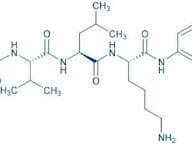
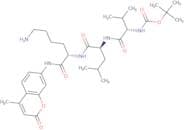
:tert-(Butyloxycarbonyl)-L-valyl-L-leucyl-L-lysin-7-amino-4-methylcoumarin
Beschreibung:
tert-(Butyloxycarbonyl)-L-valyl-L-leucyl-L-lysin-7-amino-4-methylcoumarin, allgemein als Peptidderivat bezeichnet, zeichnet sich durch seine komplexe Struktur aus, die eine tert-butyloxycarbonyl (Boc) Schutzgruppe umfasst, die häufig in der Peptidsynthese verwendet wird, um Aminogruppen zu schützen. Das Vorhandensein von L-Valin, L-Leucin und L-Lysin weist darauf hin, dass es sich um ein synthetisches Peptid handelt, das aus diesen Aminosäuren besteht, was zu seiner biologischen Aktivität und potenziellen Anwendungen in der Arzneimittelentwicklung beiträgt. Die 7-Amino-4-methylcoumarin-Einheit dient als fluoreszierendes Etikett, was diese Verbindung in biochemischen Tests und Studien über Peptidinteraktionen nützlich macht. Diese Verbindung ist typischerweise in organischen Lösungsmitteln löslich und kann spezifische Reaktivität basierend auf ihren funktionellen Gruppen aufweisen. Ihre Stabilität und Reaktivität können durch Umweltbedingungen wie pH und Temperatur beeinflusst werden. Insgesamt ist diese Substanz in den Bereichen der medizinischen Chemie und Biochemie von Bedeutung, insbesondere bei der Entwicklung von peptidbasierten Therapeutika und fluoreszierenden Sonden.
Formel:C32H49N5O7
InChl:InChI=1S/C32H49N5O7/c1-18(2)15-24(36-30(41)27(19(3)4)37-31(42)44-32(6,7)8)29(40)35-23(11-9-10-14-33)28(39)34-21-12-13-22-20(5)16-26(38)43-25(22)17-21/h12-13,16-19,23-24,27H,9-11,14-15,33H2,1-8H3,(H,34,39)(H,35,40)(H,36,41)(H,37,42)/t23-,24-,27-/m0/s1
InChI Key:InChIKey=KVLPXRKIIFWZLM-DPZBCOQUSA-N
SMILES:CC=1C=2C(=CC(NC([C@@H](NC([C@@H](NC([C@@H](NC(OC(C)(C)C)=O)[C@@H](C)C)=O)CC(C)C)=O)CCCCN)=O)=CC2)OC(=O)C1
Synonyme:- 7: PN: WO2004106541 PAGE: 15 claimed protein
- <span class="text-smallcaps">L</smallcap>-Lysinamide, N-[(1,1-dimethylethoxy)carbonyl]-<smallcap>L</smallcap>-valyl-<smallcap>L</span>-leucyl-N-(4-methyl-2-oxo-2H-1-benzopyran-7-yl)-
- Boc-Val-Leu-Lys-AMC
- Boc-Val-Leu-Lys-Amc Acetate
- N-(tert-butoxycarbonyl)-L-valyl-L-leucyl-N-(4-methyl-2-oxo-2H-chromen-7-yl)-L-lysinamide
- N-[(1,1-Dimethylethoxy)carbonyl]-<span class="text-smallcaps">L</smallcap>-valyl-<smallcap>L</smallcap>-leucyl-N-(4-methyl-2-oxo-2H-1-benzopyran-7-yl)-<smallcap>L</span>-lysinamide
- tert-(Butyloxycarbonyl)-<span class="text-smallcaps">L</smallcap>-valyl-<smallcap>L</smallcap>-leucyl-<smallcap>L</span>-lysine-7-amino-4-methylcoumarin
- tert-(Butyloxycarbonyl)-L-valyl-L-leucyl-L-lysine-7-amino-4-methylcoumarin
- N-[(1,1-Dimethylethoxy)carbonyl]-L-valyl-L-leucyl-N-(4-methyl-2-oxo-2H-1-benzopyran-7-yl)-L-lysinamide
- L-Lysinamide, N-[(1,1-dimethylethoxy)carbonyl]-L-valyl-L-leucyl-N-(4-methyl-2-oxo-2H-1-benzopyran-7-yl)-
Sortieren nach
Reinheit (%)
0
100
|
0
|
50
|
90
|
95
|
100
3 Produkte.
Boc-Val-Leu-Lys-AMC
CAS:A sensitive, fluorogenic, and specific substrate for the quantitative measurement of plasmin. Boc-VLK-AMC is also cleaved by acrosin from the ascidian Halocynthia roretzi, by porcine calpain isozymes I and II, and by papain.Formel:C32H49N5O7Reinheit:97.7%Farbe und Form:White LyophilisateMolekulargewicht:615.77Boc-Val-Leu-Lys-AMC
CAS:Boc-Val-Leu-Lys-AMC is a research tool that has been shown to activate ion channels and increase the permeability of cell membranes. This compound also binds to receptors on cells, which may be due to its ability to bind with antibodies. Boc-Val-Leu-Lys-AMC has been used as an inhibitor in protein interactions and pharmacology studies, as well as for the study of ion channels in cell biology.Formel:C32H49N5O7Reinheit:Min. 95%Molekulargewicht:615.76 g/molBoc-Val-Leu-Lys-AMC acetate salt
CAS:Boc-Val-Leu-Lys-AMC acetate salt is a protease inhibitor that binds to the active site of trypsin and inhibits its proteolytic activity. It has been shown to protect neuronal cells from death caused by amyloid beta (Aβ) peptide. Boc-Val-Leu-Lys-AMC acetate salt also inhibits the secretion of proinflammatory cytokines and reduces the permeability of mitochondrial membranes in human neutrophils. This drug is stable in acidic environments, with a pH optimum of 2.0, but is sensitive to alkaline conditions with a pH optimum of 8.5. Boc-Val-Leu-Lys-AMC acetate salt has been shown to bind to casein, which may result in high values on sephadex g100 chromatography.Formel:C32H49N5O7•C2H4O2Reinheit:Min. 98 Area-%Farbe und Form:PowderMolekulargewicht:675.81 g/mol