CAS 73590-06-4
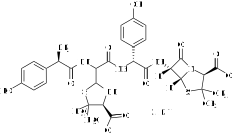
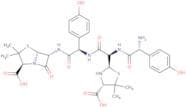
:Glycinamid, (2R)-2-(4-hydroxyphenyl)glycyl-(2S)-2-[(2R,4S)-4-carboxy-5,5-dimethyl-2-thiazolidinyl]glycyl-N-[(2S,5R,6R)-2-carboxy-3,3-dimethyl-7-oxo-4-thia-1-azabicyclo[3.2.0]hept-6-yl]-2-(4-hydroxyphenyl)-, (2R)-
Beschreibung:
Glycinamid, mit der CAS-Nummer 73590-06-4, ist eine komplexe organische Verbindung, die durch ihre multifunktionale Struktur gekennzeichnet ist, die Aminosäuren und Thiazolidinderivate umfasst. Diese Substanz weist ein Glycin-Rückgrat auf, das eine Aminosäure ist, die für ihre einfache Struktur und ihre Rolle als Baustein in Proteinen bekannt ist. Die Anwesenheit einer 4-Hydroxyphenylgruppe deutet auf ein Potenzial für Wasserstoffbrückenbindungen und Interaktionen mit biologischen Zielen hin, was ihre Löslichkeit und Reaktivität verbessert. Darüber hinaus trägt der Thiazolidinring zu ihrer Stereochemie bei und kann ihre biologische Aktivität beeinflussen, insbesondere in pharmazeutischen Anwendungen. Die komplexe Struktur der Glycinamid deutet auf ein Potenzial für verschiedene Interaktionen in biologischen Systemen hin, was sie in der medizinischen Chemie von Interesse macht. Ihre Eigenschaften, wie Löslichkeit, Stabilität und Reaktivität, werden durch die vorhandenen funktionellen Gruppen beeinflusst, die ihr Verhalten in verschiedenen Umgebungen beeinflussen können. Insgesamt ist Glycinamid eine bemerkenswerte Verbindung im Bereich der organischen Chemie und Biochemie, mit Implikationen für das Design und die Entwicklung von Arzneimitteln.
Formel:C32H38N6O10S2
InChl:InChI=1S/C32H38N6O10S2/c1-31(2)21(29(45)46)37-26(49-31)19(35-23(41)17(33)13-5-9-15(39)10-6-13)25(43)34-18(14-7-11-16(40)12-8-14)24(42)36-20-27(44)38-22(30(47)48)32(3,4)50-28(20)38/h5-12,17-22,26,28,37,39-40H,33H2,1-4H3,(H,34,43)(H,35,41)(H,36,42)(H,45,46)(H,47,48)/t17-,18-,19-,20-,21+,22+,26-,28-/m1/s1
InChI Key:InChIKey=GERXQFMVSQUXHT-BOUYBQKTSA-N
SMILES:N(C([C@H](NC([C@@H](NC([C@H](N)C1=CC=C(O)C=C1)=O)[C@@]2(N[C@@H](C(O)=O)C(C)(C)S2)[H])=O)C3=CC=C(O)C=C3)=O)[C@H]4[C@@]5(N([C@@H](C(O)=O)C(C)(C)S5)C4=O)[H]
Synonyme:- Glycinamide, (2R)-2-(4-hydroxyphenyl)glycyl-(2S)-2-[(2R,4S)-4-carboxy-5,5-dimethyl-2-thiazolidinyl]glycyl-N-[(2S,5R,6R)-2-carboxy-3,3-dimethyl-7-oxo-4-thia-1-azabicyclo[3.2.0]hept-6-yl]-2-(4-hydroxyphenyl)-, (2R)-
- Amoxicillin dimer
- Glycinamide, D-2-(4-hydroxyphenyl)glycyl-L-2-(4-carboxy-5,5-dimethyl-2-thiazolidinyl)glycyl-N-(2-carboxy-3,3-dimethyl-7-oxo-4-thia-1-azabicyclo[3.2.0]hept-6-yl)-D-2-(4-hydroxyphenyl)-, [2(2R-trans),3[2S-(2α,5α,6β)]]-
Sortieren nach
Reinheit (%)
0
100
|
0
|
50
|
90
|
95
|
100
3 Produkte.
Amoxicillin EP Impurity J Disodium Salt (Amoxicillin USP Related Compound J Disodium Salt, Amoxicillin Dimer Impurity Disodium Salt) (Mixture of Diastereomers)
CAS:Formel:C32H38N6O10S2·2NaMolekulargewicht:728.79 2*22.99Amoxicillin related compound J
CAS:Amoxicillin related compound J is a synthetic beta-lactam antibiotic that is synthesized by the reaction of amoxicillin sodium and potassium clavulanate. It has antimicrobial activity against Gram-positive bacteria, Gram-negative bacteria, and anaerobic bacteria. This drug binds to penicillin binding proteins in bacterial cell walls, inhibiting the formation of an enzyme-inhibitor complex with bacterial cell wall synthesis. This inhibits protein synthesis and cell division. Amoxicillin related compound J has been shown to be effective for the treatment of infectious diseases caused by ampicillin-resistant Staphylococcus aureus, Streptococcus pyogenes, and Chlamydia pneumoniae.Formel:C32H38N6O10S2Reinheit:90%Farbe und Form:PowderMolekulargewicht:730.81 g/molAmoxicillin dimer sodium
CAS:Please enquire for more information about Amoxicillin dimer sodium including the price, delivery time and more detailed product information at the technical inquiry form on this pageFormel:C32H38N6O10S2•(Na)xReinheit:90%