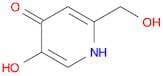
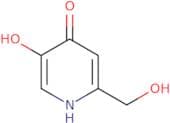
CAS 736088-02-1
:5-Hydroxy-2-(hydroxymethyl)pyridin-4(1H)-on
Beschreibung:
5-Hydroxy-2-(hydroxymethyl)pyridin-4(1H)-on, mit der CAS-Nummer 736088-02-1, ist eine chemische Verbindung, die durch ihre Pyridinringstruktur gekennzeichnet ist, die einen sechsgliedrigen aromatischen Ring mit einem Stickstoffatom enthält. Diese Verbindung weist zwei Hydroxylgruppen auf, eine an der Position 5 und eine an der Position 2, was zu ihrem Potenzial als Chelatbildner und ihrer biologischen Aktivität beiträgt. Die Anwesenheit der Hydroxymethylgruppe an der Position 2 erhöht ihre Löslichkeit und Reaktivität. Sie wird häufig wegen ihrer potenziellen Anwendungen in der medizinischen Chemie untersucht, insbesondere bei der Entwicklung von Arzneimitteln aufgrund ihrer Fähigkeit, mit Metallionen und biologischen Systemen zu interagieren. Die Verbindung kann antioxidative Eigenschaften aufweisen und wurde hinsichtlich ihrer Rolle in verschiedenen biochemischen Wegen untersucht. Wie bei vielen Pyridingerivaten ist es wichtig, ihre Stabilität, Löslichkeit in verschiedenen Lösungsmitteln und Reaktivität unter verschiedenen Bedingungen zu berücksichtigen, wenn man ihre praktischen Anwendungen in Forschung und Industrie bewertet.
Formel:C6H7NO3
InChl:InChI=1/C6H7NO3/c8-3-4-1-5(9)6(10)2-7-4/h1-2,8,10H,3H2,(H,7,9)
SMILES:c1c(CO)[nH]cc(c1=O)O
Sortieren nach
Reinheit (%)
0
100
|
0
|
50
|
90
|
95
|
100
3 Produkte.
6-(Hydroxymethyl)pyridine-3,4-diol
CAS:6-(Hydroxymethyl)pyridine-3,4-diol is a ligand that binds to the opioid receptor and is used as a tool for studying opioid receptors. The ligand has been shown to bind specifically to the mu-, delta-, and kappa-opioid receptors in rat brain membranes and is an agonist for these receptor types. 6-(Hydroxymethyl)pyridine-3,4-diol has also been shown to be an antagonist for the nociceptin receptor. This compound has been analyzed using quantum chemistry tools to determine its electronic structure and geometry. The energies of these molecules have been calculated using quantum chemistry calculations. Geometric parameters were optimized by minimizing the energy of the molecule using molecular mechanics calculations. Parameters such as solvation, complex formation, and chelate constants have also been determined with quantum chemistry calculations. The binding constants are then analyzed with quantum chemistry methods to optimize the parameters of structures in order to find those structures withFormel:C6H7NO3Reinheit:Min. 95%Molekulargewicht:141.12 g/mol