CAS 7400-54-6
:4-chlor-N-(2-hydroxyethyl)benzamid
Beschreibung:
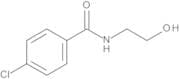
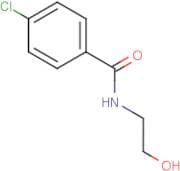
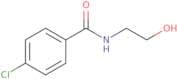
4-chlor-N-(2-hydroxyethyl)benzamid ist eine organische Verbindung, die durch ihre aromatische Struktur gekennzeichnet ist, die eine benzamidgruppe enthält, die mit einer chlorguppe und einer hydroxyethylgruppe substituiert ist. Die Anwesenheit des Chlor-Substituenten führt ein Halogen ein, das die Reaktivität und Löslichkeit der Verbindung beeinflussen kann. Die Hydroxyethylgruppe trägt zu den polaren Eigenschaften der Verbindung bei und verbessert ihre Löslichkeit in polaren Lösungsmitteln. Diese Verbindung wird typischerweise in verschiedenen chemischen Synthesen verwendet und kann als Zwischenprodukt in der Herstellung von Arzneimitteln oder Agrochemikalien dienen. Ihre molekulare Struktur deutet auf potenzielle Wasserstoffbindungsfähigkeiten hin, die durch die Hydroxylgruppe entstehen, was ihre physikalischen Eigenschaften wie Schmelz- und Siedepunkte beeinflussen kann. Darüber hinaus kann die Verbindung biologische Aktivität zeigen, was sie in der medizinischen Chemie von Interesse macht. Sicherheitsdaten sollten für den Umgang und die Lagerung konsultiert werden, da die Anwesenheit von Chlor bestimmte Gefahren darstellen kann. Insgesamt ist 4-chlor-N-(2-hydroxyethyl)benzamid eine vielseitige Verbindung mit Anwendungen sowohl in der Forschung als auch in der Industrie.
Formel:C9H10ClNO2
InChl:InChI=1/C9H10ClNO2/c10-8-3-1-7(2-4-8)9(13)11-5-6-12/h1-4,12H,5-6H2,(H,11,13)
SMILES:c1cc(ccc1C(=O)NCCO)Cl
Sortieren nach
Reinheit (%)
0
100
|
0
|
50
|
90
|
95
|
100
6 Produkte.
4-Chloro-N-(2-hydroxyethyl)benzamide
CAS:Kontrolliertes ProduktFormel:C9H10ClNO2Farbe und Form:NeatMolekulargewicht:199.634-Chloro-N-(2-hydroxyethyl)benzamide
CAS:4-Chloro-N-(2-hydroxyethyl)benzamideReinheit:95%Molekulargewicht:199.63g/mol4-Chloro-N-(2-hydroxyethyl)benzamide
CAS:4-Chloro-N-(2-hydroxyethyl)benzamide (4CBEA) is a dopamine uptake inhibitor that has been shown to inhibit the uptake of noradrenaline. It also inhibits apoptotic cell death in human liver cells, which may be due to its ability to induce cell cycle arrest and apoptosis. 4CBEA has been shown to have clinical efficacy in patients with Parkinson's disease, although it should not be used in conjunction with levodopa or other drugs that act on dopaminergic neurons. The affinity of 4CBEA for dopamine uptake sites is weaker than its affinity for noradrenaline uptake sites. It has been shown that 4CBEA binds to the amide group of proteins such as flavin adenine dinucleotide (FAD) and water molecule. Oxidases are enzymes that catalyze the oxidation of organic molecules and can lead to a decrease in the activity of 4CBEA, but thisFormel:C9H10ClNO2Reinheit:Min. 95%Molekulargewicht:199.63 g/mol