CAS 74003-63-7
:3-Methylchinoxalin-2-carbonsäure
Beschreibung:
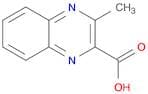
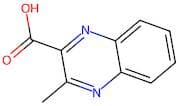
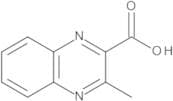
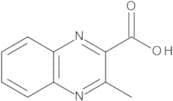
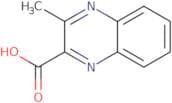
3-Methylchinoxalin-2-carbonsäure ist eine organische Verbindung, die durch ihre Quinoxalinstruktur gekennzeichnet ist, die aus einem fusionierten bicyclischen System mit zwei Stickstoffatomen besteht. Diese Verbindung weist eine Carbonsäurefunktion (-COOH) an der Position 2 und eine Methylgruppe (-CH3) an der Position 3 des Quinoxalingrings auf. Sie ist typischerweise ein kristalliner Feststoff, der in polaren Lösungsmitteln löslich ist, aufgrund der Anwesenheit der Carbonsäuregruppe. Die Verbindung zeigt verschiedene chemische Eigenschaften, einschließlich der Fähigkeit, an Säure-Base-Reaktionen teilzunehmen und Ester oder Amide zu bilden. Sie kann auch biologische Aktivität zeigen, was sie für die pharmazeutische Forschung von Interesse macht. Die Anwesenheit von Stickstoffatomen im Ring kann ihre elektronischen Eigenschaften beeinflussen und möglicherweise ihre Reaktivität und Wechselwirkungen mit anderen Molekülen beeinflussen. Insgesamt ist 3-Methylchinoxalin-2-carbonsäure eine vielseitige Verbindung mit Anwendungen in der organischen Synthese und der medizinischen Chemie.
Formel:C10H8N2O2
InChl:InChI=1/C10H8N2O2/c1-6-9(10(13)14)12-8-5-3-2-4-7(8)11-6/h2-5H,1H3,(H,13,14)
SMILES:Cc1c(C(=O)O)nc2ccccc2n1
Synonyme:- 2-Quinoxalinecarboxylic Acid, 3-Methyl-
- 3-Methylquinoxaline-2-carboxylic Acid
Sortieren nach
Reinheit (%)
0
100
|
0
|
50
|
90
|
95
|
100
11 Produkte.
3-methylquinoxaline-2-carboxylic acid
CAS:Formel:C10H8N2O2Reinheit:95%Farbe und Form:SolidMolekulargewicht:188.18273-Methylquinoxaline-2-carboxylic acid
CAS:3-Methylquinoxaline-2-carboxylic acidFormel:C10H8N2O2Reinheit:95%Farbe und Form: beige solidMolekulargewicht:188.18g/mol3-Methyl-2-quinoxalinecarboxylic acid (Standard)
CAS:3-Methyl-2-quinoxalinecarboxylic acid (Standard) is the standard substance of 3-Methyl-2-quinoxalinecarboxylic acid, and it is applicable for quantitative analysis, quality control, and related research in biochemical experiments. 3-Methyl-2-quinoxalinecarboxylic acid has a wide range of applications in life science related research.Formel:C10H8N2O2Farbe und Form:SolidMolekulargewicht:188.183-Methyl-quinoxaline-2-carboxylic acid
CAS:Formel:C10H8N2O2Farbe und Form:NeatMolekulargewicht:188.183-Methylquinoxaline-2-carboxylic Acid-d4
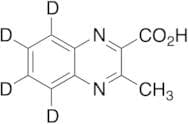
CAS:Kontrolliertes ProduktApplications Isotope labelled metabolite of Carbadox (C175825) and Olaquindox (O515000).
References Ferrando, R., et al.: Toxicology, 1975, 3, 369 (1975), Rutalj, M., et al.: Food Addit. Contam., 13, 879 (1996)Formel:C10H4D4N2O2Farbe und Form:NeatMolekulargewicht:192.213-Methylquinoxaline-2-carboxylic Acid
CAS:Kontrolliertes ProduktApplications A metabolite of Carbadox and Olaquindox.
References Ferrando, R., et al.: Toxicology, 1975, 3, 369 (1975), Rutalj, M., et al.: Food Addit. Contam., 13, 879 (1996)Formel:C10H8N2O2Farbe und Form:Light Yellow To Dark RedMolekulargewicht:188.183-Methylquinoxaline-2-carboxylic acid
CAS:3-Methylquinoxaline-2-carboxylic acid is a polymerase chain reaction (PCR) reagent that can be used to detect nucleic acids. The detection sensitivity of the lc-ms/ms method is 0.1 pmol, and the matrix effect is negligible. There are no genotoxic effects, while significant cytotoxicity has been observed at concentrations of 10 µg/mL or greater. The monoclonal antibody used for immunodetection reacts with nitrite ion, which can be detected by the 3-methylquinoxaline-2-carboxylic acid assay. This reagent can also be used for sample preparation in DNA sequencing reactions.Formel:C10H8N2O2Reinheit:Min. 97 Area-%Farbe und Form:PowderMolekulargewicht:188.18 g/mol3-Methyl-quinoxaline-2-carboxylic acid
CAS:Formel:C10H8N2O2Reinheit:97%Farbe und Form:SolidMolekulargewicht:188.186