CAS 742103-27-1
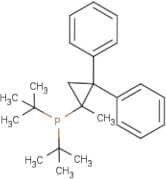
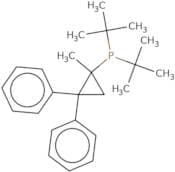
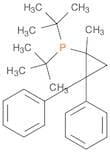
:Phosphin, bis(1,1-dimethylethyl)(1-methyl-2,2-diphenylcyclopropyl)-
Beschreibung:
Phosphin, bis(1,1-dimethyl-ethyl)(1-methyl-2,2-diphenylcyclopropyl), identifiziert durch die CAS-Nummer 742103-27-1, ist eine organophosphorverbindung, die durch ihre einzigartige molekulare Struktur gekennzeichnet ist, die eine Phosphingruppe umfasst, die an voluminöse organische Substituenten gebunden ist. Diese Verbindung zeigt typischerweise Eigenschaften, die mit Phosphinen assoziiert sind, wie z.B. ein farbloses Gas oder eine farblose Flüssigkeit bei Raumtemperatur, mit einem charakteristischen Geruch, der an Knoblauch oder Fisch erinnert. Ihre voluminösen Substituenten tragen zu ihrer sterischen Hinderung bei, was ihre Reaktivität und Stabilität beeinflussen kann. Phosphine sind bekannt für ihre Fähigkeit, als Liganden in der Koordinationschemie zu wirken, und diese spezielle Verbindung kann aufgrund der Anwesenheit der Diphenylcyclopropylgruppe interessante elektronische Eigenschaften aufweisen. Darüber hinaus könnte die Löslichkeit der Verbindung in organischen Lösungsmitteln und ihre potenziellen Anwendungen in der organischen Synthese oder Katalyse von Interesse sein. Es sollten jedoch spezifische Sicherheits- und Handhabungsrichtlinien befolgt werden, da Phosphine giftig und entzündlich sein können. Konsultieren Sie immer die Sicherheitsdatenblätter (SDB) für detaillierte Informationen zur Handhabung und zu Gefahren.
Formel:C24H33P
Synonyme:- Di-t-butyl(2,2-diphenyl-1-methylcyclopropyl)phosphinecBRIDP
- Mo-Phos
- ®
- cBRIDP
- cBRIDP[R]
- Di-t-butyl(2,2-diphenyl-1-methyl-1-cyclopropyl)phosphine
- cBRIDP(regR)
- Phosphine,bis(1,1-dimethylethyl)(1-methyl-2,2-diphenylcyclopropyl)-
Sortieren nach
Reinheit (%)
0
100
|
0
|
50
|
90
|
95
|
100
3 Produkte.
Di-tert-butyl(1-methyl-2,2-diphenylcyclopropyl)phosphine
CAS:Di-tert-butyl(1-methyl-2,2-diphenylcyclopropyl)phosphineFormel:C24H33PReinheit:95%Farbe und Form: pale yellow solidMolekulargewicht:352.49g/molcBRIDP
CAS:The cBRIDP is an efficient method for the synthesis of propargylamines. It involves a cross-coupling reaction between aryl chlorides and magnesium, which can be carried out in situ. The cBRIDP is more environmentally friendly than traditional methods because it does not require the use of N-methylmorpholine N-oxide (NMMO), which is toxic and carcinogenic. Aryl chlorides are used as starting materials in this method, and these are easily available from many sources. The cBRIDP has been shown to have high yields and is selective for aromatic hydrocarbons. This process also produces light emission during reductive elimination, making it desirable for chemiluminescent applications such as agrochemical detection or medical imaging.Formel:C24H33PReinheit:Min. 95 Area-%Farbe und Form:PowderMolekulargewicht:352.5 g/molPhosphine,bis(1,1-dimethylethyl)(1-methyl-2,2-diphenylcyclopropyl)-
CAS:Formel:C24H33PReinheit:95%;RGFarbe und Form:SolidMolekulargewicht:352.4926