


CAS 744-46-7
:N-Benzoylglycyl-L-arginin
Beschreibung:
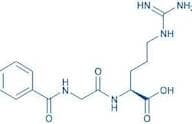
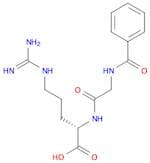
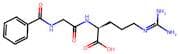
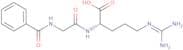
N-Benzoylglycyl-L-arginin, mit der CAS-Nummer 744-46-7, ist ein synthetisches Peptidderivat, das die Aminosäure Arginin mit einer Benzoylgruppe und Glycin kombiniert. Diese Verbindung zeichnet sich durch ihre strukturellen Merkmale aus, zu denen eine Benzoylgruppe gehört, die ihre Lipophilie erhöht und potenziell ihre biologische Aktivität und Löslichkeit beeinflusst. Die Anwesenheit des Arginin-Restes trägt zu ihrer Basizität und Fähigkeit zur Bildung von Wasserstoffbrücken bei, was entscheidend für Interaktionen mit biologischen Zielen sein kann. N-Benzoylglycyl-L-arginin wird häufig auf seine potenziellen Anwendungen in der Biochemie und Pharmakologie untersucht, insbesondere in Bezug auf seine Rolle bei der Peptidsynthese und als Substrat für verschiedene enzymatische Reaktionen. Zu seinen Eigenschaften kann eine moderate Stabilität unter physiologischen Bedingungen gehören, aber es kann anfällig für Hydrolyse sein, insbesondere in Gegenwart von proteolytischen Enzymen. Insgesamt dient diese Verbindung als wichtiges Modell zum Verständnis von Peptidinteraktionen und -modifikationen in der biochemischen Forschung.
Formel:C15H21N5O4
InChl:InChI=1S/C15H21N5O4/c16-15(17)18-8-4-7-11(14(23)24)20-12(21)9-19-13(22)10-5-2-1-3-6-10/h1-3,5-6,11H,4,7-9H2,(H,19,22)(H,20,21)(H,23,24)(H4,16,17,18)/t11-/m0/s1
InChI Key:InChIKey=GFLCPYUSPYXNBV-NSHDSACASA-N
SMILES:C(NCC(N[C@@H](CCCNC(=N)N)C(O)=O)=O)(=O)C1=CC=CC=C1
Synonyme:- (2S)-2-[(2-Benzamidoacetyl)amino]-5-(diaminomethylideneazaniumyl)pentanoate
- <span class="text-smallcaps">L</span>-Arginine, N-benzoylglycyl-
- <span class="text-smallcaps">L</span>-Arginine, N<sup>2</sup>-(N-benzoylglycyl)-
- Arginine, N<sup>2</sup>-hippuroyl-
- Arginine, N<sup>2</sup>-hippuroyl-, <span class="text-smallcaps">L</span>-
- Hippuryl-Arg-OH
- N-Benzoylglycyl-<span class="text-smallcaps">L</span>-arginine
- N-benzoylglycyl-N~5~-(diaminomethylidene)-L-ornithine
- N-benzoylglycyl-N~5~-(diaminomethylidene)ornithine
- N-α-Benzoylglycyl-<span class="text-smallcaps">L</span>-arginine
- N<sup>2</sup>-Hippuroyl-<span class="text-smallcaps">L</span>-arginine
- NSC 89637
- N-Benzoylglycyl-L-arginine
- L-Arginine, N-benzoylglycyl-
- Arginine, N2-hippuroyl-
- L-Arginine, N2-(N-benzoylglycyl)-
- Weitere Synonyme anzeigen
Sortieren nach
Reinheit (%)
0
100
|
0
|
50
|
90
|
95
|
100
5 Produkte.
Hippuryl-Arg-OH
CAS:Hip-Arg, substrate for carboxypeptidase B and carboxypeptidase N.Formel:C15H21N5O4Reinheit:> 99%Farbe und Form:White PowderMolekulargewicht:335.36Hippuryl-Arg-OH
CAS:Hippuryl-arginine is a peptide hormone that is released by the hypothalamus and stimulates the pituitary gland to release other hormones. It has been shown to increase chemotactic activity in human serum, although it has no effect on carboxypeptidase or soybean trypsin activity. Hippuryl-arginine binds with basic proteins, such as albumin and immunoglobulins, and increases their enzymatic activities. This hormone also inhibits enzymes such as carboxy terminal phosphatases and aminopeptidases that are responsible for degrading amino acids. Activation of hippuryl-arginine may be due to its carboxy terminal group, which is susceptible to cleavage by proteolytic enzymes.Formel:C15H21N5O4Reinheit:(%) Min. 97%Farbe und Form:PowderMolekulargewicht:335.36 g/molBz-Gly-Arg [Hippuryl-Arginine]
CAS:Bz-Gly-Arg is a basic protein that belongs to the class of peptide hormones. It is activated by hydrolysis and has been shown to be highly active in human serum. Bz-Gly-Arg inhibits creatine kinase, which is an enzyme that breaks down ATP and creatine phosphate to produce creatinine and ADP. This inhibition leads to a decrease in ATP levels, which can lead to cell death. The kinetic properties of Bz-Gly-Arg have been studied using sephadex G-100 chromatography and found the optimum pH for this protein is neutral. The polymerase chain reaction has also been used to study the sequence of amino acids in this protein, showing it contains amide bonds as well as peptides and biochemicals.>>END>>
Formel:C15H21N5O4Reinheit:Min. 95%Molekulargewicht:335.36 g/molRef: 3D-SGR-3059
Ausgelaufenes produkt




![Bz-Gly-Arg [Hippuryl-Arginine]](/_next/image/?url=https%3A%2Fstatic.cymitquimica.com%2Fproducts%2F3D%2Fthumb%2FSGR-3059.jpg&w=3840&q=75)