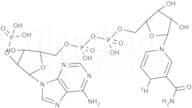
![[[(2R,3S,4S,5R)-5-(6-aminopurin-9-yl)-3-hydroxy-4-phosphonooxy-tetrahydrofuran-2-yl]methoxy-hydrox…](/_next/image/?url=https%3A%2Fstatic.cymitquimica.com%2Fcas-image%2Fthumb-webp%2F414170-2r-3s-4s-5r-5-6-aminopurin-9-yl-3-hydroxy-4-phosphonooxy-tetrahydrofuran-2-yl-methoxy-hydroxy-phosphoryl-2r-3r-4s-5r-5-4r-3-carbamoyl-4-deuterio-4h-pyridin-1-yl-34-dihydroxy-tetrahydrofuran-2-yl-methyl-hydrogen-phosphate.webp&w=3840&q=75)
CAS 74784-45-5
:[[(2R,3S,4S,5R)-5-(6-aminopurin-9-yl)-3-hydroxy-4-phosphonooxy-tetrahydrofuran-2-yl]methoxy-hydroxy-phosphoryl] [(2R,3R,4S,5R)-5-[(4R)-3-carbamoyl-4-deuterio-4H-pyridin-1-yl]-3,4-dihydroxy-tetrahydrofuran-2-yl]methylhydrogenphosphat
Beschreibung:
Die chemische Substanz mit dem Namen "[[(2R,3S,4S,5R)-5-(6-aminopurin-9-yl)-3-hydroxy-4-phosphonooxy-tetrahydrofuran-2-yl]methoxy-hydroxy-phosphoryl] [(2R,3R,4S,5R)-5-[(4R)-3-carbamoyl-4-deuterio-4H-pyridin-1-yl]-3,4-dihydroxy-tetrahydrofuran-2-yl]methylhydrogenphosphat" und der CAS-Nummer "74784-45-5" ist ein komplexes organisches Molekül, das durch seine komplizierte Stereochemie und funktionelle Gruppen gekennzeichnet ist. Es weist ein Tetrahydrofuran-Rückgrat auf, das ein fünfgliedriger cyclischer Ether ist, und enthält mehrere Hydroxylgruppen (-OH), Phosphonooxy und Phosphoryl-Funktionalitäten, was auf seine potenzielle Rolle in biochemischen Prozessen hinweist, möglicherweise in Verbindung mit Nukleotiden oder Nukleosiden. Das Vorhandensein einer Aminopurin-Gruppe deutet darauf hin, dass es mit biologischen Systemen interagieren könnte, was potenziell den Stoffwechsel von Nukleinsäuren oder Signalwegen beeinflusst. Die Chiralität des Verbindungsstoffs, die durch seine spezifischen R- und S-Konfigurationen angezeigt wird, impliziert, dass es einzigartige biologische Aktivitäten oder Wechselwirkungen basierend auf seiner Stereochemie aufweisen könnte. Insgesamt dürfte diese Substanz aufgrund ihrer strukturellen Komplexität und potenziellen biologischen Relevanz von Interesse in der medizinischen Chemie und Biochemie sein.
Formel:C21H29DN7O17P3
InChl:InChI=1/C21H30N7O17P3/c22-17-12-19(25-7-24-17)28(8-26-12)21-16(44-46(33,34)35)14(30)11(43-21)6-41-48(38,39)45-47(36,37)40-5-10-13(29)15(31)20(42-10)27-3-1-2-9(4-27)18(23)32/h1,3-4,7-8,10-11,13-16,20-21,29-31H,2,5-6H2,(H2,23,32)(H,36,37)(H,38,39)(H2,22,24,25)(H2,33,34,35)/t10-,11-,13+,14+,15+,16+,20-,21-/m1/s1/i2D/t2-,10-,11-,13+,14+,15+,16+,20-,21-
Sortieren nach
Reinheit (%)
0
100
|
0
|
50
|
90
|
95
|
100
3 Produkte.
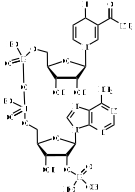
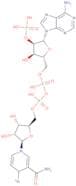
b-Nicotinamide-D adenine dinucleotide reduced form
CAS:Kontrolliertes ProduktNicotinamide-adenine dinucleotide (NADH) is a coenzyme that plays an essential role in cellular metabolism. NADH has been shown to have neuroprotective effects by improving cerebellar perfusion and reducing the severity of granule cell death in the cerebellum of experimental animals. It also inhibits synaptic activity and improves Purkinje cell survival. NADH is found in granules cells, which are located in the cerebellar cortex. These cells release this molecule when activated by an action potential, which leads to increased calcium levels inside neurons and subsequent neurotransmitter release. The major form of NADH found in these cells is NADH-NAD+ oxidoreductase (EC 1.6.5.3). The activity of this enzyme can be inhibited by a number of compounds, including nicotinamide adenine dinucleotide reduced form (NADH-NAD+ reductase), which may have therapeutic value for treating Parkinson'sFormel:C21H29N7O17P3DReinheit:Min. 95%Molekulargewicht:746.43 g/mol