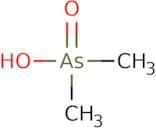
CAS 75-60-5
:Dimethylarsinsäure
Beschreibung:
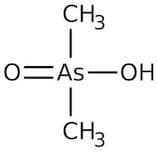
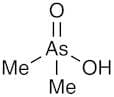
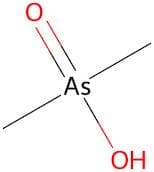
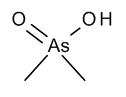
Dimethylarsinsäure (DMAA) ist eine organoarsenische Verbindung, die durch ihre zwei Methylgruppen, die an ein Arsenatom gebunden sind, sowie eine carboxylische funktionelle Gruppe gekennzeichnet ist. Sie wird typischerweise als farblose bis blassgelbe Flüssigkeit oder Feststoff angetroffen, abhängig von ihrer Form und Reinheit. DMAA ist in Wasser und polaren organischen Lösungsmitteln löslich, was seine Verwendung in verschiedenen Anwendungen erleichtert, einschließlich als Reagenz in der organischen Synthese und in Studien zum Arsenstoffwechsel. Die Verbindung ist von Interesse aufgrund ihrer potenziellen Toxizität und Umweltwirkung, da Arsen ein bekanntes Karzinogen ist. In biologischen Systemen kann Dimethylarsinsäure metabolischen Transformationen unterliegen, die zur Bildung anderer Arsenarten führen. Ihre Präsenz in der Umwelt, insbesondere in kontaminierten Wasserquellen, wirft Bedenken hinsichtlich der menschlichen Gesundheit und ökologischer Auswirkungen auf. Sicherheitsmaßnahmen sind beim Umgang mit DMAA unerlässlich, da eine Exposition zu nachteiligen Gesundheitseffekten führen kann. Insgesamt dient Dimethylarsinsäure als bedeutende Verbindung sowohl in der chemischen Forschung als auch in Umweltstudien im Zusammenhang mit Arsenverbindungen.
Formel:C2H7AsO2
InChl:InChI=1/C2H7AsO2/c1-3(2,4)5/h1-2H3,(H,4,5)
InChI Key:InChIKey=OGGXGZAMXPVRFZ-UHFFFAOYSA-N
SMILES:[As](C)(C)(=O)O
Synonyme:- Acide dimethylarsinique
- Acido Dimetilarsinico
- Ansar 138
- Arsan
- Arsine oxide, hydroxydimethyl-
- Arsinic Acid, Dimethyl-
- Arsinic acid, As,As-dimethyl-
- As,As-Dimethylarsinic acid
- Dimethylarsenic acid
- Dimethylarsinic acid
- Dimethylarsinsaure
- Dimethylarsonic acid
- Hydroxydimethylarsine oxide
- Kakodylsaeure
- Nsc 103115
- Nsc 71157
- Nsc 71158
- Phytar
- Silvisar 510
- Sylvicor
- Cacodylic acid
- agentblue
- Cacodylie acid
- Ansar
- DIMETHYLHYDROXYARSINE OXIDE
- Acide cacodylique
- Agent blue
- RAD-E-CATE 35(R)
- SILVISAR(R)
- alkargen
- acidecacodylique(french)
- PHYTAR(R)
- ANSAR(R)
- acidedimethylarsinique
- acidedimethylarsenique(french)
- Weitere Synonyme anzeigen
Sortieren nach
Reinheit (%)
0
100
|
0
|
50
|
90
|
95
|
100
6 Produkte.
Cacodylic acid, 98%
CAS:A useful arsenic acid for proteomics research. It a good substitute for phosphate in applications to avoid phosphates. Cacodylic Acid is useful for some DNA applications and is also popular in microscopy. This Thermo Scientific Chemicals brand product was originally part of the Alfa Aesar productFormel:C2H7AsO2Reinheit:98%Farbe und Form:White, Crystals or powder or crystalline powderMolekulargewicht:138.00Dimethylarsinic acid (Cacodylic acid), 98%
CAS:Dimethylarsinic acid (Cacodylic acid), 98%
Formel:(CH3)2AsOOHReinheit:98%Farbe und Form:white pwdr.Molekulargewicht:138.00Cacodylic Acid
CAS:Applications Cacodylic acid is used for dermatologic treatment in cronic eczema, anemia and as a tonic.
Not a dangerous good if item is equal to or less than 1g/ml and there is less than 100g/ml in the package
References Mandal, B., et al.: Talanta, 58, 201 (2002), Naranmandura, H., et al.: Chem. Res. Toxicol., 20, 616 (2007), Naranmandura, H., et al.: Toxicol. Appl. Pharmacol., 227, 390 (2008), Violin, J., et al.: J. Biol. Chem., 283, 2949 (2008),Formel:C2H7AsO2Farbe und Form:NeatMolekulargewicht:138.00Cacodylic acid
CAS:Cacodylic acid is a white to brown crystalline powder that is soluble in water. It has been used as an analytical reagent, polymerase chain reaction (PCR) inhibitor, and skin cancer treatment. Cacodylic acid inhibits the activity of the bacterial enzyme activities in humans and other mammals. The mechanism of action of cacodylic acid is not completely understood but it appears that it binds to inorganic iron and blocks its availability for use by bacterial enzymes such as dihydropteroate synthase, which is required for DNA synthesis. This leads to cell death. Cacodylic acid has also been shown to inhibit the growth of human HL-60 cells in vitro, suggesting that it may have carcinogenic potential.Formel:C2H7AsO2Reinheit:Min. 95%Farbe und Form:PowderMolekulargewicht:138 g/mol