CAS 75-66-1
:tert-Butylmercaptan
Beschreibung:
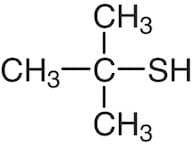
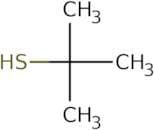
tert-Butylmercaptan, auch bekannt als tert-Butylthiol, ist eine organische Verbindung mit der chemischen Formel C4H10S und einer CAS-Nummer von 75-66-1. Es zeichnet sich durch einen starken, unangenehmen Geruch aus, der oft als ähnlich dem von fauligem Kohl oder Knoblauch beschrieben wird, was es nützlich als Duftstoff im Erdgas zur Lecksuche macht. Diese Verbindung ist bei Raumtemperatur eine farblose Flüssigkeit und in organischen Lösungsmitteln löslich, hat jedoch eine begrenzte Löslichkeit in Wasser. tert-Butylmercaptan ist bekannt für seine Reaktivität, insbesondere aufgrund der Anwesenheit der Thiolgruppe (-SH), die an verschiedenen chemischen Reaktionen teilnehmen kann, einschließlich Oxidations- und Substitutionsreaktionen. Es wird in der Synthese anderer Chemikalien, als Aromastoff in der Lebensmittelindustrie und in der Herstellung bestimmter Arzneimittel verwendet. Sicherheitsvorkehrungen sind beim Umgang mit dieser Verbindung erforderlich, da sie die Haut, die Augen und das Atmungssystem reizen kann. Eine ordnungsgemäße Lagerung in einem kühlen, gut belüfteten Bereich wird ebenfalls empfohlen, um die Exposition zu minimieren.
Formel:C4H10S
InChl:InChI=1S/C4H10S/c1-4(2,3)5/h5H,1-3H3
InChI Key:InChIKey=WMXCDAVJEZZYLT-UHFFFAOYSA-N
SMILES:C(C)(C)(C)S
Synonyme:- 1,1-Dimethylethanethiol
- 2-Isobutanethiol
- 2-Methyl-2-Propanthiol
- 2-Methyl-2-propanethiol
- 2-Methyl-2-propenthiol
- 2-Methylpropan-2-thiol
- 2-Methylpropane-2-thiol
- 2-Metilpropano-2-Tiol
- Propane-2-Thiol, 2-Methyl-
- Propanethiol, 2-methyl-
- Tertiary-Butyl Mercaptan
- t-Butanethiol
- t-Butylmercaptan
- t-Butylthiol
- tert-Butanethiol
- tert-Butyl mercaptan
- tert-Butylthiol
- Weitere Synonyme anzeigen
Sortieren nach
Reinheit (%)
0
100
|
0
|
50
|
90
|
95
|
100
4 Produkte.
tert-Butyl Mercaptan
CAS:Formel:C4H10SReinheit:>98.0%(GC)Farbe und Form:Colorless clear liquidMolekulargewicht:90.182-Methyl-2-propanethiol
CAS:2-Methyl-2-propanethiol is an electron acceptor and a reagent that can be used for the synthesis of organic compounds. It is soluble in polar solvents, but insoluble in nonpolar solvents. 2-Methyl-2-propanethiol has been shown to react with thiols at concentrations below its optimum concentration. The reaction mechanism is believed to involve adsorption and intramolecular hydrogen transfer. The adsorption process occurs on the surface of the substrate and the intramolecular hydrogen transfer occurs through an intermolecular hydrogen bond with the substrate's hydroxyl group or disulfide bond. When 2-methyl-2-propanethiol reacts with a thiol, it forms a mercaptan group called p2 that contains two substituents, one on each carbon atom. This reaction produces a disulfide bond as well as an electrochemical detector signal known as "activated."Formel:C4H10SReinheit:Min. 98%Farbe und Form:Clear LiquidMolekulargewicht:90.19 g/mol