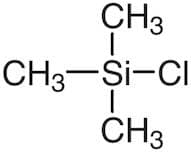
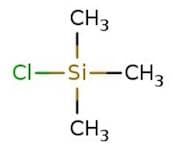
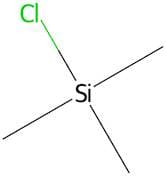
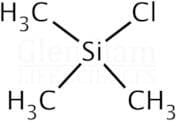
CAS 75-77-4
:Chlortrimethylsilan
- Chlortrimethylsilan
- Clorotrimetilsilano
- KA 31 (silane)
- Ka 31
- Ls 260
- Monochlorotrimethylsilane
- Monochlorotrimethylsilicon
- Nsc 15750
- Silane, chlorotrimethyl-
- TMS chloride
- TMSCl
- Tmcs
- Trimethylchlorosilane
- Trimethylchlorsosilane
- Trimethylsilane chloride
- Trimethylsilicon chloride
- Trimethylsilyl chloride
- Tsl 8031
- Weitere Synonyme anzeigen
Chlorotrimethylsilane
CAS:Formel:C3H9ClSiReinheit:>98.0%(GC)Farbe und Form:Colorless to Light yellow to Light orange clear liquidMolekulargewicht:108.64Chlorotrimethylsilane, 98%
CAS:Chlorotrimethylsilane is used to silanize laboratory glassware, which makes the surfaces more lipophilic. It is used in the production of trimethylsilyl halides, pseudohalides and various organic silicon compounds. It is also used to produce hexamethyldisilane by reduction. This Thermo Scientific ChFormel:C3H9ClSiReinheit:98%Farbe und Form:Clear colorless to pale yellow, LiquidMolekulargewicht:108.64Trimethylchlorosilane, min. 97%
CAS:Trimethylchlorosilane, min. 97%
Formel:(CH3)3SiClReinheit:min. 97%Farbe und Form:colorless to pale yellow liq.Molekulargewicht:108.65Chlorotrimethylsilane
CAS:ChlorotrimethylsilaneFormel:C3H9ClSiReinheit:99%Farbe und Form: clear colourless liquidMolekulargewicht:108.64206g/molChlorotrimethylsilane
CAS:Formel:C3H9ClSiReinheit:≥ 98%Farbe und Form:Clear, colourless to pale yellow liquidMolekulargewicht:108.64Chlorotrimethylsilane
CAS:Stability Moisture Sensitive
Applications Chlorotrimethylsilane have been used in the preparation of volatile derivatives of a wide range of compounds for GC analysis. Chlorotrimethylsilane has been used for silylation and as a protection group in the process of various organic synthesis.
E0
References Casimiro, M., et al.: Org. Lett., 15, 2378 (2013); Lifchits, O., et al.: J. Am. Chem. Soc., 135, 6677 (2013);Formel:C3H9ClSiFarbe und Form:NeatMolekulargewicht:108.64TRIMETHYLCHLOROSILANE CYLINDER
CAS:Trimethylsilyl Blocking Agent
Used as a protecting group for reactive hydrogens in alcohols, amines, thiols, and carboxylic acids. Organosilanes are hydrogen-like, can be introduced in high yield, and can be removed under selective conditions. They are stable over a wide range of reaction conditions and can be removed in the presence of other functional groups, including other protecting groups. The tolerance of silylated alcohols to chemical transformations summary is presented in Table 1 of the Silicon-Based Blocking Agents brochure.
Alkyl Silane - Conventional Surface Bonding
Aliphatic, fluorinated aliphatic or substituted aromatic hydrocarbon substituents are the hydrophobic entities which enable silanes to induce surface hydrophobicity. The organic substitution of the silane must be non-polar. The hydrophobic effect of the organic substitution can be related to the free energy of transfer of hydrocarbon molecules from an aqueous phase to a homogeneous hydrocarbon phase. A successful hydrophobic coating must eliminate or mitigate hydrogen bonding and shield polar surfaces from interaction with water by creating a non-polar interphase. Although silane and silicone derived coatings are in general the most hydrophobic, they maintain a high degree of permeability to water vapor. This allows coatings to breathe and reduce deterioration at the coating interface associated with entrapped water. Since ions are not transported through non-polar silane and silicone coatings, they offer protection to composite structures ranging from pigmented coatings to rebar reinforced concrete. A selection guide for hydrophobic silanes can be found on pages 22-31 of the Hydrophobicity, Hydrophilicity and Silane Surface Modification brochure.
Trimethylchorosilane; Chlorotrimethylsilane; Trimethylsilyl chloride; TMCS
Viscosity: 0.47 cStΔHcomb: -2,989 kJ/molΔHform: -354 kJ/molΔHvap: 27.6 kJ/molDipole moment: 2.09 debyeSurface tension: 17.8 mN/mSpecific heat: 1.76 J/g/°CCoefficient of thermal expansion: 1.2 x 10⁻³Vapor pressure, 20 °: 190 mmVapor pressure, 50 °C: 591 mmCritical temperature: 224.6 °CCritical pressure: 31.6 atmMost economical and broadly used silylation reagentEnhances Claisen rearrangementEnhances the deprotection of tBOC-protected amino acidsEnhances ethylene glycol ketalization reactionCatalyzes the formation of chlorohydrin esters from diolsReviewed as water scavenger in reactions of carbonyl compoundsFacilitates Michael additionsReacts in presence of HCl acceptorWill silylate strong acids with expulsion of HClHigh purity grade available, SIT8510.1Protects hindered alcohols with Mg/DMFNafion SAC-13 has been shown to be a recyclable catalyst for the trimethylsilylation of primary, secondary, and tertiary alcohols in excellent yields and short reaction timesSummary of selective deprotection conditions is provided in Table 7 through Table 20 of the Silicon-Based Blocking Agents brochureFormel:C3H9ClSiReinheit:97%Farbe und Form:Straw LiquidMolekulargewicht:108.64Ref: 3H-SIT8510.0
drNachfragencylNachfragen3kgNachfragen15kgNachfragen25gNachfragen170kgNachfragen750gNachfragenTRIMETHYLCHLOROSILANE, 99+%
CAS:Formel:C3H9ClSiReinheit:99%Farbe und Form:Straw LiquidMolekulargewicht:108.64Trimethylchlorosilane
CAS:Trimethylchlorosilane is a model system for the study of chloride ion transport across lipid membranes. It has been shown that this molecule can form a disulfide bond with glutathione and may have synergistic effects with other drugs, such as metronidazole, to treat bowel disease. Trimethylchlorosilane can also be used in analytical methods for measuring chloride ions in wastewater and other samples. The x-ray crystal structures of trimethylchlorosilane anhydrous sodium salt have been determined at room temperature. The hydrogen fluoride molecule binds to the pyrazole ring and the chlorine atom forms a covalent bond with the hydroxyl group on one of the water molecules. The reaction solution is heated to produce trimethylchlorosilane, which is then cooled to room temperature again, during which time it crystallizes out of solution.Formel:C3H9ClSiReinheit:Min. 95%Farbe und Form:Clear LiquidMolekulargewicht:108.64 g/molTrimethyl Chlorosilane (TMCS) extrapure, 99%
CAS:Formel:C3H9CISiReinheit:min. 99%Farbe und Form:Clear, Colourless to pale yellow, LiquidMolekulargewicht:108.64Trimethyl Chlorosilane (TMCS) extrapure, 98%
CAS:Formel:C3H9ClSiReinheit:min. 98%Farbe und Form:Clear, Colourless to pale yellow, LiquidMolekulargewicht:108.64Trimethyl Chlorosilane (TMCS) 1M Solution in THF
CAS:Formel:C3H9ClSiFarbe und Form:Clear, Colourless, LiquidMolekulargewicht:108.64