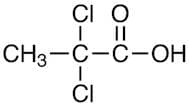
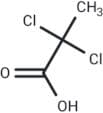
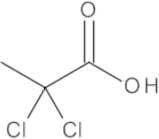
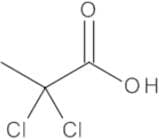
CAS 75-99-0
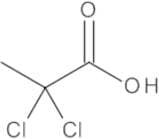
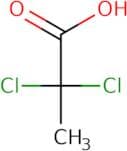
:Dalapon
- 2,2-Dichloropropanoate
- 2,2-Dichloropropanoic acid
- 2,2-Dichlorpropionsaure
- 2,2-Dpa
- Acide 2,2-dichloropropionique
- Acido 2,2-Dicloropropionico
- Alatex
- Basinex P
- DPA
- Dalapon
- Dalapon 740
- Dalascam
- Nsc 56352
- Propanoic acid, 2,2-dichloro-
- Propionic Acid, 2,2-Dichloro-
- Proprop
- S 1315
- S 95
- S 95 (herbicide)
- Tripon
- α,α-Dichloropropanoic acid
- Weitere Synonyme anzeigen
2,2-Dichloropropionic Acid
CAS:Formel:C3H4Cl2O2Reinheit:>95.0%(GC)(T)Farbe und Form:Colorless to Light yellow clear liquidMolekulargewicht:142.96Dalapon
CAS:Dalapon is a herbicide for controlling perennial grasses on crops like sugarcane and beets, with exposure limits and health risks.Formel:C3H4Cl2O2Farbe und Form:Liquid As A HerbicideMolekulargewicht:142.97Haloacetic Acids Mixture 929 1000-3000 µg/mL in Methyl tert-butyl ether
CAS:Formel:C2H3BrO2Farbe und Form:MixtureMolekulargewicht:138.95Dalapon 1000 µg/mL in Methyl-tert-butyl ether
CAS:Kontrolliertes ProduktFormel:C3H4Cl2O2Farbe und Form:Single SolutionMolekulargewicht:142.97EPA Method 552 Halogenated Acetic Mixture 100 µg/mL in Methyl tert-butyl ether
CAS:Formel:C2H3BrO2Farbe und Form:MixtureMolekulargewicht:138.95Haloacetic acid mixture for HJ 758-2015 various concentrations in Methyl tert-butyl ether
CAS:Kontrolliertes ProduktFarbe und Form:Mixture2,2-Dichloropropionic Acid
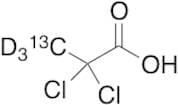
CAS:Formel:C3H4Cl2O2Reinheit:95.0%Farbe und Form:LiquidMolekulargewicht:142.962,2-Dichloropropanoic Acid-13CD3
CAS:Kontrolliertes ProduktStability Hygroscopic
Applications 2,2-Dichloropropanoic Acid-13CD3 is the isotope labelled analog of 2,2-Dichloropropanoic Acid (D436810); a pesticide.
Not a dangerous good if item is equal to or less than 1g/ml and there is less than 100g/ml in the package
References Halfon, E., et al.: Chemosphere, 33, 1543 (1996); Karadag, E., et al.: Polymers for Advanced Technologies, 11, 59 (2000)Formel:CC2D3HCl2O2Farbe und Form:NeatMolekulargewicht:146.982,2-Dichloropropanoic Acid (>90%)
CAS:Kontrolliertes ProduktFormel:C3H4Cl2O2Reinheit:~90%Farbe und Form:NeatMolekulargewicht:142.972,2-Dichloropropanoic Acid
CAS:2,2-Dichloropropanoic Acid is a metabolite of propionic acid that is used in the treatment of autoimmune diseases. It has been shown to inhibit the enzyme activities of calcium pantothenate, polymerase chain, and protease in vitro. 2,2-Dichloropropanoic Acid has also been shown to be effective against bacteria such as Escherichia coli and Klebsiella pneumoniae in animal studies. The optimum concentration for 2,2-dichloropropanoic acid is not yet determined but it has been shown to have no acute toxic effects in rats.
Formel:C3H4Cl2O2Reinheit:Min. 95%Farbe und Form:Clear LiquidMolekulargewicht:142.97 g/mol