CAS 7518-17-4
:4-Epianhydrotetracyclin
Beschreibung:
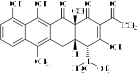
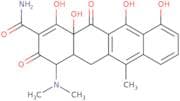
4-Epianhydrotetracyclin ist ein halbsynthetisches Derivat von Tetracyclin, einem Breitbandantibiotikum. Es zeichnet sich durch seine tetracyclische Struktur aus, die für seine biologische Aktivität entscheidend ist. Diese Verbindung zeigt antibakterielle Eigenschaften, indem sie die Proteinsynthese in Bakterien hemmt, was sie gegen eine Vielzahl von grampositiven und gramnegativen Organismen wirksam macht. Die chemische Formel von 4-Epianhydrotetracyclin umfasst mehrere funktionelle Gruppen, die zu seiner Löslichkeit und Reaktivität beitragen. Es wird typischerweise in seiner Hydrochlorid-Salzform verabreicht, um Stabilität und Bioverfügbarkeit zu erhöhen. Die Substanz ist bekannt für ihre moderate bis hohe Stabilität unter sauren Bedingungen, kann jedoch in alkalischen Umgebungen abgebaut werden. Darüber hinaus wurde sie auf ihre potenziellen Anwendungen über den Antibiotikaeinsatz hinaus untersucht, einschließlich entzündungshemmender und krebsbekämpfender Eigenschaften. Wie andere Tetracycline kann es Nebenwirkungen wie gastrointestinale Störungen und Lichtempfindlichkeit verursachen. Eine ordnungsgemäße Handhabung und Lagerung sind entscheidend, um seine Wirksamkeit und Sicherheitsprofil zu erhalten.
Formel:C22H22N2O7
InChl:InChI=1S/C22H22N2O7/c1-8-9-5-4-6-12(25)13(9)17(26)14-10(8)7-11-16(24(2)3)18(27)15(21(23)30)20(29)22(11,31)19(14)28/h4-6,11,16,25-27,31H,7H2,1-3H3,(H2,23,30)/t11-,16+,22-/m0/s1
InChI Key:InChIKey=CXCVEERYMJZMMM-WPINSWFRSA-N
SMILES:O[C@]12[C@]([C@@H](N(C)C)C(O)=C(C(N)=O)C1=O)(CC=3C(C2=O)=C(O)C=4C(C3C)=CC=CC4O)[H]
Synonyme:- (4R)-Anhydrotetracycline
- (4R,4aS,12aS)-4-(Dimethylamino)-1,4,4a,5,12,12a-hexahydro-3,10,11,12a-tetrahydroxy-6-methyl-1,12-dioxo-2-naphthacenecarboxamide
- (4R,4aS,12aS)-4-(Dimethylamino)-3,10,11,12a-tetrahydroxy-6-methyl-1,12-dioxo-1,4,4a,5,12,12a-hexahydrotetracene-2-carboxamide
- (4R,4aS,12aS)-4-(dimethylamino)-3,10,11,12a-tetrahydroxy-6-methyl-1,12-dioxo-4a,5-dihydro-4H-tetracene-2-carboxamide
- 2-Naphthacenecarboxamide, 4-(dimethylamino)-1,4,4a,5,12,12a-hexahydro-3,10,11,12a-tetrahydroxy-6-methyl-1,12-dioxo-, 4-epimer
- 2-Naphthacenecarboxamide, 4-(dimethylamino)-1,4,4a,5,12,12a-hexahydro-3,10,11,12a-tetrahydroxy-6-methyl-1,12-dioxo-, [4R-(4α,4aβ,12aβ)]-
- 2-naphthacenecarboxamide, 4-(dimethylamino)-1,4,4a,5,12,12a-hexahydro-3,10,11,12a-tetrahydroxy-6-methyl-1,12-dioxo-, (4R,4aS,12aS)-
- 4-Epianhydrotetracycline
- 4-epi-5a,6-Anhydrotetracycline
- 4-epi-Anhydrotetracycline
- Anhydro-4-epitetracycline
- Anhydroepitetracycline
- Epianhydrotetracycline
- Weitere Synonyme anzeigen
Sortieren nach
Reinheit (%)
0
100
|
0
|
50
|
90
|
95
|
100
4 Produkte.
Tetracycline EP Impurity D (Chlortetracycline EP Impurity I, Lymecycline EP Impurity D, 4-Epianhydrotetracycline)
CAS:Formel:C22H22N2O7Molekulargewicht:426.434-Epianhydrotetracycline
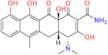
CAS:4-Epianhydrotetracycline is a chemical compound that is a derivative of tetracycline, a well-known antibiotic. It is primarily a byproduct arising from the chemical degradation of tetracycline antibiotics, occurring under acidic or basic conditions. The source of this compound is the structural transformation of tetracycline, resulting in an altered molecular configuration.
Formel:C22H22N2O7Reinheit:Min. 95%Molekulargewicht:426.4 g/mol4-Epianhydrotetracycline hydrochloride hydrate
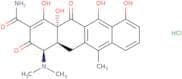
CAS:4-Epianhydrotetracycline hydrochloride hydrate is a chemical compound that inhibits the activation of protein kinase C (PKC) and blocks the apoptosis pathway. It has been shown to induce apoptosis in prostate cancer cells and also inhibits the proliferation of human microvessel endothelial cells. 4-Epianhydrotetracycline hydrochloride hydrate is stable in both human serum and wastewater, which makes it an ideal drug for treating many types of cancers. It is also used in pharmaceutical drugs as a cytochalasin, which are used to treat angina pectoris by reducing oxygen uptake by erythrocytes, thereby inhibiting oxidative phosphorylation. 4-Epianhydrotetracycline hydrochloride hydrate prevents mitochondrial cytochrome c release, thus blocking the apoptotic pathway in cells. This chemical compound may act as a regulatory molecule that affects energy metabolism and epidermal growth factor (EGF)Formel:C22H23ClN2O7Reinheit:Min. 95%Molekulargewicht:462.88 g/mol