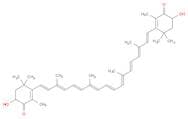
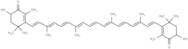
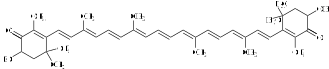
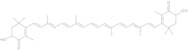
CAS 7542-45-2
:3,3'-dihydro-β,β-carotin-4,4'-dion
Beschreibung:
3,3'-dihydro-β,β-carotin-4,4'-dion, mit der CAS-Nummer 7542-45-2, ist ein Carotinoid-Derivat, das durch seine lebendige orange-rote Farbe gekennzeichnet ist, die für viele Carotinoide typisch ist. Diese Verbindung weist eine Polyenstruktur mit konjugierten Doppelbindungen auf, die zu ihren starken Lichtabsorptionseigenschaften beiträgt, insbesondere im sichtbaren Spektrum. Es handelt sich um eine Diketone, was auf das Vorhandensein von zwei Carbonylgruppen (C=O) hinweist, die ihre Reaktivität und Stabilität beeinflussen können. Das Vorhandensein dieser funktionellen Gruppen kann auch ihre antioxidativen Eigenschaften beeinflussen, was sie in verschiedenen biologischen und ernährungswissenschaftlichen Studien von Interesse macht. In Bezug auf die Löslichkeit sind Carotinoide im Allgemeinen in organischen Lösungsmitteln besser löslich als in Wasser, was mit dieser Verbindung übereinstimmt. Ihre potenziellen Anwendungen reichen von Lebensmittelfarben bis hin zu Nahrungsergänzungsmitteln, angesichts der Rolle von Carotinoiden für die menschliche Gesundheit, insbesondere für das Sehen und den Hautschutz. Spezifische Details zur Stabilität und Reaktivität würden jedoch von Umweltbedingungen wie pH, Temperatur und Lichteinwirkung abhängen.
Formel:C40H52O4
InChl:InChI=1/C40H52O4/c1-27(17-13-19-29(3)21-23-33-31(5)37(43)35(41)25-39(33,7)8)15-11-12-16-28(2)18-14-20-30(4)22-24-34-32(6)38(44)36(42)26-40(34,9)10/h11-24,35-36,41-42H,25-26H2,1-10H3/b12-11+,17-13+,18-14+,23-21+,24-22+,27-15-,28-16+,29-19+,30-20+
InChI Key:InChIKey=MQZIGYBFDRPAKN-QISQUURKNA-N
SMILES:C(=C/C(=C/C=C/C(=C/C=C/C=C(/C=C/C=C(/C=C/C=1C(C)(C)CC(O)C(=O)C1C)\C)\C)/C)/C)\C=2C(C)(C)CC(O)C(=O)C2C
Synonyme:- (13Cis)-3,3'-Dihydroxy-Beta,Beta-Carotene-4,4'-Dione
- 3,3'-Dihydro-beta,beta-carotene-4,4'-dione
- 3,3′-Dihydroxy-β,β-carotene-4,4′-dione
- Beta,Beta-Carotene-4,4'-Dione
- β,β-Carotene-4,4′-dione, 3,3′-dihydroxy-
- β-Carotene-4,4′-dione, 3,3′-dihydroxy-
Sortieren nach
Reinheit (%)
0
100
|
0
|
50
|
90
|
95
|
100
8 Produkte.
Astaxanthin Esters from Haematococcus pluvialis
CAS:Edible preparations, not canned or frozen, not containing cane and/or beet sugar, nesoiFormel:C40H52O4(FreeAstaxanthin)Farbe und Form:Dark Red Oily LiquidMolekulargewicht:596.38656Astaxanthin (Synthetic) (3,3'-dihydroxy-β,β-Carotene-4,4'-dione)
CAS:Other, including mixtures of coloring matter of two or more of the subheading 3204.11 to 3204.19, nesoiFormel:C40H52O4Farbe und Form:Dark Violet PowderMolekulargewicht:596.386563,3'-Dihydroxy-β,β-carotene-4,4'-dione
CAS:Formel:C40H52O4Reinheit:97%Farbe und Form:SolidMolekulargewicht:596.8385(rac./meso)-Astaxanthin
CAS:(rac./meso)-Astaxanthin (AstaREAL; AstaXin) is a carotenoid pigment primarily found in marine animals such as shrimp and salmon. It serves as an effective fat-soluble antioxidant.Formel:C40H52O4Farbe und Form:SolidMolekulargewicht:596.84(rac./meso)-Astaxanthin
CAS:Kontrolliertes ProduktApplications (rac./meso)-Astaxanthin is a carotenoid pigment responsible for the red colour in many fish and birds such as salmon and flamingoes.
References Storebakken, T., et al.: Aquaculture, 65, 279 (1987); Fox, D. L., et al.: Comp. Biochem. Physiol. B, 6, 1 (1962)Formel:C40H52O4Farbe und Form:NeatMolekulargewicht:596.84rac-Astaxanthin
CAS:rac-Astaxanthin is a synthetic version of a naturally occurring carotenoid, which is sourced primarily from marine organisms such as microalgae, yeast, and crustaceans. Its mode of action involves functioning as a potent antioxidant, mitigating oxidative stress by neutralizing free radicals and reactive oxygen species at the cellular level.Formel:C40H52O4Reinheit:Min. 95%Molekulargewicht:596.8 g/mol