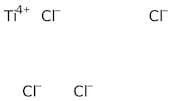
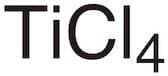
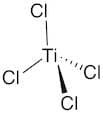
CAS 7550-45-0
:Titantetrachlorid
- Tc 36
- Tetrachlorotitanium
- Tetrachlorure de titane
- Tetracloruro De Titanio
- Titan(Iv)-Chlorid
- Titanium (Iv) Tetrachloride
- Titanium Tetrachloride
- Titanium chloride
- Titanium chloride (TiCl4)
- Titanium chloride (TiCl<sub>4</sub>)
- Titanium chloride (TiCl<sub>4</sub>) (T-4)-
- Titanium tatrachloride
- Titanium(IV) chloride
- Titantetrachlorid
- Titanium
- Titanium chloride (TiCl4) (T-4)-
- Titaniumchloridemin
- titanium(4+) tetrachloride
- Weitere Synonyme anzeigen
Titanium(IV) chloride, 1M soln. in dichloromethane
CAS:Activates pyrrolidines for improved conversion, via a modified Bouveault reaction, to the corresponding ,-dimethylamines This Thermo Scientific Chemicals brand product was originally part of the Alfa Aesar product portfolio. Some documentation and label information may refer to the legacy brand. TheFormel:Cl4TiFarbe und Form:Colorless to pale yellow to dark brown, LiquidMolekulargewicht:189.67Titanium(IV) Chloride (ca. 19% in Toluene, ca. 1.0mol/L)
CAS:Formel:TiCl4Farbe und Form:Light yellow to Yellow to Orange clear liquidMolekulargewicht:189.67Titanium(IV) Chloride (14% in Dichloromethane, ca. 1.0mol/L)
CAS:Formel:TiCl4Farbe und Form:Colorless to Yellow to Orange clear liquidMolekulargewicht:189.67Titanium(IV) Chloride - (14% in Dichloromethane, ca. 1.0mol/L)
CAS:Titanium chloride is a chemical compound with the formula TiCl4. It is soluble in many organic solvents, and it reacts with water to form an acidic solution of hydrochloric acid. Titanium chloride is used as a catalyst for the synthesis of polymers such as poly(trifluoroethylene) and poly(vinyl chloride). This compound also has been used in clinical studies to treat chronic bronchitis. The reaction mechanism of titanium chloride is not clear, but it has been suggested that it may involve a Friedel-Crafts type reaction or an electrochemical process. The transport properties of titanium chloride are not well studied, but fluorescence spectrometry indicates that the molecule contains cationic moieties and carbonyl groups. Titanium chloride can be synthesized by a two-step process: first, iron oxide (FeO) is reacted with trifluoroacetic acid (TFA), followed by addition of TiCl4. The coordination geometry around titaniumFormel:TiCl4Reinheit:Min. 95%Farbe und Form:Colorless PowderMolekulargewicht:189.68 g/molTITANIUM TETRACHLORIDE, 99%
CAS:ALD Material
Atomic layer deposition (ALD) is a chemically self-limiting deposition technique that is based on the sequential use of a gaseous chemical process. A thin film (as fine as -0.1 Å per cycle) results from repeating the deposition sequence as many times as needed to reach a certain thickness. The major characteristic of the films is the resulting conformality and the controlled deposition manner. Precursor selection is key in ALD processes, namely finding molecules which will have enough reactivity to produce the desired films yet are stable enough to be handled and safely delivered to the reaction chamber.
Titanium tetrachloride; Titanium IVv chloride
ΔHform: -198.4 kcal/molFormel:Cl4TiFarbe und Form:Straw LiquidMolekulargewicht:189.71Titanium (IV) tetrachloride 1M in toluene
CAS:Formel:Cl4TiReinheit:99%Farbe und Form:LiquidMolekulargewicht:189.67Titanium Tetrachloride 1M in Dichloromethane
CAS:Formel:TiCl4Farbe und Form:Clear, Colourless to dark yellow to brown to dark orange, LiquidMolekulargewicht:189.68Titanium Tetrachloride 1M in Toluene
CAS:Formel:TiCl4Farbe und Form:Clear, Orange to orange red, LiquidMolekulargewicht:189.68Titanium(IV) chloride - 99.0% min
CAS:Titanium chloride is a chemical compound with the formula TiCl4. Titanium chloride is a yellowish-white solid that is insoluble in water but soluble in many organic solvents and oils. It has been used to produce titanium metal from its ores, and as an agent for the production of TiO2. Titanium chloride can be produced by reacting titanium tetrachloride with hydrochloric acid. The reaction mechanism involves an acidic hydrogen atom attacking the chloride ligand, which leads to the formation of a new cationic polymerization and carbonyl group. Titanium(IV) chloride can also be synthesized by treating titanium metal with trifluoroacetic acid followed by electrochemical impedance spectroscopy (EIS).
Formel:TiCl4Reinheit:Min. 95%Molekulargewicht:189.68 g/molRef: 3D-FT160346
Ausgelaufenes produktTitanium(IV) chloride, (99.99+%-Ti) PURATREM
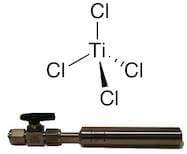
CAS:Formel:TiCl4Reinheit:(99.99+%-Ti)Farbe und Form:pale yellow liq.Molekulargewicht:189.73Titanium(IV) chloride, 99%, 22-1150, contained in 50 ml Swagelok® cylinder (96-1070) for CVD/ALD
CAS:Formel:TiCl4Reinheit:99%Farbe und Form:pale yellow liq.Molekulargewicht:189.73Titanium(IV) chloride, 99%
CAS:Titanium(IV) chloride, 99%
Formel:TiCl4Reinheit:99%Farbe und Form:pale yellow liq.Molekulargewicht:189.73