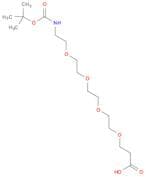
CAS 756525-91-4
:1-(1,1-Dimethylethyl) 5,8,11,14-tetraoxa-2-azaheptadecandioat
Beschreibung:
1-(1,1-Dimethylethyl) 5,8,11,14-tetraoxa-2-azaheptadecandioat, identifiziert durch seine CAS-Nummer 756525-91-4, ist eine chemische Verbindung, die durch ihre komplexe Struktur gekennzeichnet ist, die sowohl Ether- als auch Amidfunktionen umfasst. Diese Verbindung weist eine lange Kohlenstoffkette auf, die zu ihren hydrophoben Eigenschaften beiträgt, während die Anwesenheit mehrerer Sauerstoffatome in Form von Etherbindungen polare Eigenschaften verleiht, die ihre Löslichkeit in polaren Lösungsmitteln erhöhen. Das "aza" in ihrem Namen weist auf das Vorhandensein eines Stickstoffatoms innerhalb der Kohlenstoffkette hin, was ihre Reaktivität und potenzielle biologische Aktivität beeinflussen kann. Die tert-Butylgruppe (1,1-Dimethylethyl) fügt sterisches Volumen hinzu, was die Wechselwirkungen der Verbindung mit anderen Molekülen beeinflussen kann. Insgesamt kann diese Verbindung einzigartige Eigenschaften aufweisen, die in verschiedenen Anwendungen von Interesse sein könnten, einschließlich Pharmazeutika, Agrochemikalien oder Materialwissenschaften, obwohl spezifische Anwendungen von weiteren Forschungen zu ihrem Verhalten und ihren Wechselwirkungen in verschiedenen Umgebungen abhängen würden.
Formel:C16H31NO8
InChl:InChI=1S/C16H31NO8/c1-16(2,3)25-15(20)17-5-7-22-9-11-24-13-12-23-10-8-21-6-4-14(18)19/h4-13H2,1-3H3,(H,17,20)(H,18,19)
InChI Key:InChIKey=YEIYIPDFZMLJQH-UHFFFAOYSA-N
SMILES:O(C(NCCOCCOCCOCCOCCC(O)=O)=O)C(C)(C)C
Synonyme:- 1-(1,1-Dimethylethyl) 5,8,11,14-tetraoxa-2-azaheptadecanedioate
- 15-(Boc-amino)-4,7,10,13-tetraoxapentadecanoic acid
- 2,2-Dimethyl-4-oxo-3,8,11,14,17-pentaoxa-5-azaicosan-20-oic acid
- 3-[2-[2-[2-[2-(tert-Butoxycarbonylamino)ethoxy]ethoxy]ethoxy]ethoxy]propanoic acid
- 5,8,11,14-Tetraoxa-2-azaheptadecanedioic acid, 1-(1,1-dimethylethyl) ester
- Boc-15-Amino-4,7,10,13-Tetraoxapentadecanoic Acid
- N-(tert-Butyloxycarbonyl)-15-amino-4,7,10,13-tetraoxapentanedecanoic acid
- Triethylene glycol 2-(Boc-amino)ethyl ether 2-carboxyethyl ether
Sortieren nach
Reinheit (%)
0
100
|
0
|
50
|
90
|
95
|
100
7 Produkte.
(Boc-amino)-PEG4-carboxylic Acid
CAS:Formel:C16H31NO8Reinheit:>98.0%(T)(HPLC)Farbe und Form:Colorless to Light yellow clear liquidMolekulargewicht:365.425,8,11,14-Tetraoxa-2-azaheptadecanedioic acid 1-(1,1-dimethylethyl) ester
CAS:Formel:C16H31NO8Reinheit:97%Farbe und Form:LiquidMolekulargewicht:365.4192Ref: IN-DA0038G9
100gNachfragen500gNachfragen100mg25,00€250mg34,00€500mg57,00€1g70,00€5g198,00€10g281,00€25g647,00€t-Boc-N-amido-PEG4-acid
CAS:t-Boc-N-amido-PEG4-acidFormel:C16H31NO8Reinheit:By hplc: 99.7% (Typical Value in Batch COA)Farbe und Form: oilMolekulargewicht:365.42g/molBoc-NH-PEG4-CH2CH2COOH
CAS:Boc-NH-PEG4-CH2CH2COOH is used as a cleavable linker in PROTACs and ADCs.Formel:C16H31NO8Farbe und Form:SolidMolekulargewicht:365.422,2-Dimethyl-4-oxo-3,8,11,14,17-pentaoxa-5-azaicosan-20-oic acid
CAS:Formel:C16H31NO8Reinheit:95%Farbe und Form:Liquid, OilMolekulargewicht:365.423t-Boc-N-Amido-dPEG®4-Acid
CAS:t-Boc-N-Amido-dPEG®4-Acid is a PEG compound with two different functional groups (also known as heterobifunctional). Unlike homobifunctional PEG compounds (same functional group on both ends), this type of compounds are more versatile as have two different anchor points. t-Boc-N-Amido-dPEG®4-Acid is used as a linker and spacer to add a PEG moiety, via pegylation (a bioconjugation technique) to proteins, peptides, oligonucleotides, small molecules and nanoparticles.
Reinheit:Min. 95%Molekulargewicht:365.42 g/molBoc-15-amino-4,7,10,13-tetraoxapentadecanoic acid
CAS:Boc-15-amino-4,7,10,13-tetraoxapentadecanoic acid is a PEG compound with two different functional groups (also known as heterobifunctional). Unlike homobifunctional PEG compounds (same functional group on both ends), this type of compounds are more versatile as have two different anchor points. Boc-15-amino-4,7,10,13-tetraoxapentadecanoic acid is used as a linker and spacer to add a PEG moiety, via pegylation (a bioconjugation technique) to proteins, peptides, oligonucleotides, small molecules and nanoparticles.Formel:C16H31NO8Reinheit:Min. 95%Molekulargewicht:365.42 g/mol