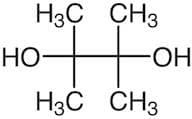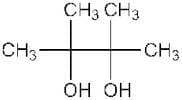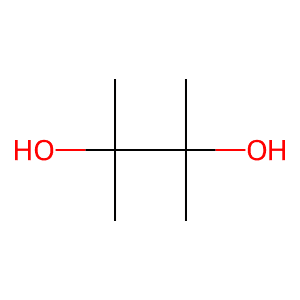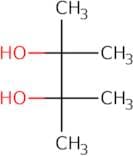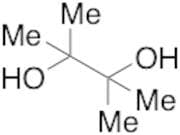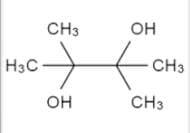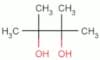
CAS 76-09-5
:Pinacol
- 1,1,2,2-Tetramethylethane-1,2-diol
- 1,1,2,2-Tetramethylethylene glycol
- 2,3-Butanediol, 2,3-dimethyl-
- 2,3-Dihydroxy-2,3-dimethylbutane
- 2,3-Dimethyl-2,3-butanediol
- 2,3-Dimethyl-2,3-dihydroxybutane
- 2,3-Dimethylbutane-2,3-diol
- Nsc 25943
- Pinacone
- Pinakol
- Tetramethylethylene glycol
- Weitere Synonyme anzeigen
Pinacol
CAS:Formel:C6H14O2Reinheit:>98.0%(GC)Farbe und Form:White to Almost white powder to lumpMolekulargewicht:118.18Pinacol, 99%
CAS:Pinacol is used in the preparation of synthetic intermediates like pinacolborane, bis(pinacolato)diboron and pinacolchloroborane by reaction with boron trichloride. Further, it plays an important role as an intermediate for biologically active compounds like antiviral, antibacterial, antifungal andFormel:C6H14O2Reinheit:99%Farbe und Form:White, Crystals or fused solid or chunksMolekulargewicht:118.18Ref: IN-DA0035HM
5g20,00€1kg75,00€25g28,00€5kg187,00€100g28,00€10kg361,00€250g38,00€25kgNachfragen500g56,00€Pinacol
CAS:Formel:C6H14O2Reinheit:≥ 99.0%Farbe und Form:White to off-white crystalsMolekulargewicht:118.182,3-Dimethylbutane-2,3-diol
CAS:2,3-Dimethylbutane-2,3-diolFormel:C6H14O2Reinheit:98%Farbe und Form: colourless to off white crystalsMolekulargewicht:118.17g/molPinacol
CAS:Pinacol is a product of the reaction between dimethyl fumarate and pinacol. It is used as a fluorescence probe in the titration calorimetry, which is a technique used to determine the free energy change and enthalpy change of chemical reactions. Pinacol can be used to study the reaction mechanism of various organic compounds, such as halides, ketones, amines, alcohols and esters. Pinacol can also be used for analytical chemistry and flow systems. The hydroxyl group on pinacol reacts with halides and other electron-deficient compounds to form an intramolecular hydrogen bond that stabilizes the molecule. This reaction leads to the formation of an asymmetric synthesis that has a high yield.
Formel:C6H14O2Reinheit:Min. 95%Farbe und Form:White PowderMolekulargewicht:118.17 g/molPinacol
CAS:Kontrolliertes ProduktApplications Pinacol is used in the synthesis of organic reagents such as alkenylphenylphosphonates and alkenylboronates.
References Peng, A. et al.: J. Fluor. Chem., 151, 58 (2013); Mazzacano, T. et al.: J. Am. Chem. Soc., 135, 17258 (2013);Formel:C6H14O2Farbe und Form:NeatMolekulargewicht:118.17Pinacol pure, 98%
CAS:Formel:C6H14O2Reinheit:min. 98%Farbe und Form:White, Crystalline compound, Clear, ColourlessMolekulargewicht:118.18