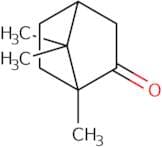
CAS 76-22-2
:(±)-Kampfer
Beschreibung:
(±)-Kampfer, mit der CAS-Nummer 76-22-2, ist ein bicyclischer Monoterpen-Keton, der aus dem Holz des Kampferbaums (Cinnamomum camphora) gewonnen wird und auch aus anderen Quellen synthetisiert werden kann. Es erscheint als weißes kristallines Feststoff mit einem charakteristischen aromatischen Geruch. Kampfer ist bekannt für sein ausgeprägtes Kühlempfinden und wird in verschiedenen Anwendungen eingesetzt, einschließlich medizinischer, kulinarischer und kosmetischer Produkte. Es weist einen Schmelzpunkt um Raumtemperatur auf und ist in organischen Lösungsmitteln löslich, hat jedoch eine begrenzte Löslichkeit in Wasser. Die Verbindung besitzt sowohl schmerzlindernde als auch entzündungshemmende Eigenschaften, was sie zu einem häufigen Bestandteil in topischen Salben und Einreibungen macht. Darüber hinaus wurde (±)-Kampfer in der traditionellen Medizin verwendet und ist bekannt für sein Potenzial als natürlicher Insektenschutzmittel. Seine chirale Natur bedeutet, dass es in zwei enantiomeren Formen existiert, aber die racemische Mischung wird häufig in kommerziellen Anwendungen verwendet. Sicherheitsüberlegungen umfassen mögliche Hautreizungen und Toxizität bei hohen Dosen, was eine sorgfältige Handhabung erfordert.
Formel:C10H16O
InChl:InChI=1S/C10H16O/c1-9(2)7-4-5-10(9,3)8(11)6-7/h7H,4-6H2,1-3H3
InChI Key:InChIKey=DSSYKIVIOFKYAU-UHFFFAOYSA-N
SMILES:CC12C(C)(C)C(CC1=O)CC2
Synonyme:- 1,7,7-Trimethyl-bicyclo [2,2,1] heptanone-2
- 1,7,7-Trimethylbicyclo(2.2.1)heptan-2-one
- 1,7,7-Trimethylbicyclo[2.2.1]-2-heptanone
- 1,7,7-Trimethylnorcamphor
- 2-Bornanone
- 2-Camphanone
- <span class="text-smallcaps">DL</span>-Camphor
- Alphanon
- Bicyclo[2.2.1]heptan-2-one, 1,7,7-trimethyl-
- Bornan-2-Ona
- Bornan-2-One
- Bornan-2-One, Dl-
- Bornan-2-on
- Bornane-2-One
- Borneo camphor
- Campher
- DL-Camphor
- Hcxl 8899
- Racemic camphor
- Root bark oil
- Spirit of camphor
- Camphor
- Synthetic camphor
- Weitere Synonyme anzeigen
Sortieren nach
Reinheit (%)
0
100
|
0
|
50
|
90
|
95
|
100
Camphor
CAS:1,7,7-Trimethylbicyclo[2.2.1]heptan-2-oneFormel:C10H16OReinheit:96%Molekulargewicht:152.23DL-Camphor
CAS:Alicyclic ketoneFormel:C10H16OReinheit:≥ 90.0 % (GC)Farbe und Form:PowderMolekulargewicht:152.24(±)-Camphor
CAS:Applications (±)-Camphor, has a strong aromatic odor. It is toxic to insects so it can be used as repellent. Camphor can also be used as a plasticizer for nitrocellulose, as a moth repellent, and as an antimicrobial substance.This compound is a contaminant of emerging concern (CECs)EC Number: 200-945-0
Not a dangerous good if item is equal to or less than 1g/ml and there is less than 100g/ml in the package
References Abdelgaleil, S.A.M. Appl. Entomol. Zool., 45, 425 (2010); Tabanca, N. et al.: J. Agric. Food. Chem., 49, 4300 (2001);Formel:C10H16OFarbe und Form:NeatMolekulargewicht:152.23Camphor
CAS:Camphor is a natural compound that has been shown to be an effective antimicrobial agent. Camphor has been shown to inhibit the growth of bacteria by binding to the bacterial membrane, inhibiting electron transport and leading to a decrease in mitochondrial membrane potential. Camphor also inhibits the growth of cancer cells in experimental models. Camphor can be used as an antimicrobial in wastewater treatment and as an insect repellent for skin protection. Camphor is also used in x-ray crystallography to determine structures of proteins and other organic molecules with high electron density such as benzalkonium chloride.Formel:C10H16OReinheit:Min. 95%Farbe und Form:Colorless Clear LiquidMolekulargewicht:152.23 g/molCamphor pure, 95%
CAS:Formel:C10H16OReinheit:min. 95.0%Farbe und Form:White, Crystalline compound with characteristic odour, Clear, ColourlessMolekulargewicht:152.2