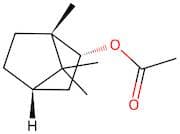
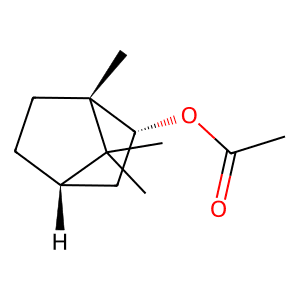
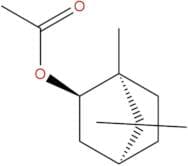
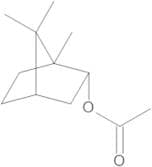
CAS 76-49-3
:(±)-Bornylacetat
Beschreibung:
(±)-Bornylacetat ist eine organische Verbindung, die als Ester klassifiziert ist, speziell abgeleitet von Bornylalkohol und Essigsäure. Es handelt sich um eine farblose bis blassgelbe Flüssigkeit mit einem charakteristischen angenehmen, kiefernartigen Aroma, das es in der Duft- und Geschmacksindustrie beliebt macht. Die Verbindung hat einen relativ niedrigen Siedepunkt und ist in organischen Lösungsmitteln löslich, aber nur leicht in Wasser löslich. Ihre chemische Formel ist C12H20O2, und sie weist eine bicyclische Struktur auf, die typisch für Terpene ist und zu ihrem charakteristischen Duft beiträgt. (±)-Bornylacetat wird häufig in Parfums, Kosmetika und Lebensmittelaromen aufgrund seiner aromatischen Eigenschaften verwendet. Darüber hinaus zeigt es einige antimikrobielle und insektenabweisende Aktivitäten, was es in verschiedenen Anwendungen über den Duft hinaus interessant macht. Als chirale Verbindung existiert es in zwei enantiomeren Formen, aber das racemische Gemisch wird allgemein als (±)-Bornylacetat bezeichnet. Sicherheitsdaten zeigen, dass es mit Vorsicht behandelt werden sollte, da es bei Kontakt mit Haut oder Augen Reizungen verursachen kann.
Formel:C12H20O2
InChl:InChI=1/C12H20O2/c1-8(13)14-10-7-9-5-6-12(10,4)11(9,2)3/h9-10H,5-7H2,1-4H3/t9-,10+,12+/s2
InChI Key:InChIKey=KGEKLUUHTZCSIP-QJUVKGSQNA-N
SMILES:C[C@@]12[C@H](OC(C)=O)C[C@@](C1(C)C)(CC2)[H]
Synonyme:- 1,7,7-Trimethylbicyclo(2.2.1)heptan-2-ol acetate
- 1,7,7-Trimethylbicyclo(2.2.1)heptan-2-yl acetate, endo-
- 2-Camphanol acetate
- 2-Camphanyl acetate
- Acetate de endo-1,7,7-trimethylbicyclo[2.2.1]hept-2-yle
- Acetate, 1,7,7-Trimethyl-Bicyclo(2.2.1)Hept-2-Yl, Endo-
- Acetato De Endo-1,7,7-Trimetilbiciclo[2.2.1]Hept-2-Ilo
- Ai3-00665
- Bicyclo(2.2.1)heptan-2-ol, 1,7,7-trimethyl-, 2-acetate, (1R,2S,4R)-rel-
- Bicyclo(2.2.1)heptan-2-ol, 1,7,7-trimethyl-, acetate, (1R,2S,4R)-rel-
- Bicyclo(2.2.1)heptan-2-ol, 1,7,7-trimethyl-, acetate, endo-
- Borneol, acetate
- Borneol, acetate (8CI)
- Borneyl acetate
- Bornyl acetic ester
- Bornyl acetic ether
- Bornyl ethanoate
- Endo-1,7,7-trimethylbicyclo[2.2.1]hept-2-yl aceatate
- FEMA No. 2159
- Nsc 407158
- dl-Bornyl acetate
- endo-1,7,7-Trimethylbicyclo(2.2.1)hept-2-yl acetate
- endo-1,7,7-Trimethylbicyclo[2.2.1]hept-2-ylacetat
- endo-2-Camphanyl ethanoate
- endo-Bornyl acetate
- Weitere Synonyme anzeigen
Sortieren nach
Reinheit (%)
0
100
|
0
|
50
|
90
|
95
|
100
10 Produkte.
Bicyclo[2.2.1]heptan-2-ol,1,7,7-trimethyl-, 2-acetate, (1R,2S,4R)-rel-
CAS:Formel:C12H20O2Reinheit:97%Molekulargewicht:196.2860Bornyl acetate
CAS:Bornyl acetate (Isobornyl acetate) has an anti-inflammatory effect. It is the volatile ingredient in some Chinese traditional herbs and numerous conifer oils.Formel:C12H20O2Reinheit:99.19%Farbe und Form:LiquidMolekulargewicht:196.29Bornyl acetate
CAS:Formel:C12H20O2Reinheit:≥ 90.0%Farbe und Form:Clear, colourless to pale yellow liquidMolekulargewicht:196.29Bornyl Acetate (Mixture of Diastereomers)
CAS:Applications Bornyl Acetate (Mixture of Diastereomers) is a monoterpene ester, and also the main, natural constituent of valerian root oil. Bornyl acetate also has analgesic and anti-inflammatory properties.
References Buchbauer, G., et al.: Die Pharm., 47, 620 (1992); Oh, H., et al.: Appl. Micro., 15, 777 (1967); Wu, X., et al.: J. Chinese Med. Mat., 27, 438 (2004)Formel:C12H20O2Farbe und Form:NeatMolekulargewicht:196.29(+/-)-Bornyl acetate
CAS:(-)Bornyl acetate is a natural product that has been shown to have antimicrobial properties. It is extracted from plants such as the Boronia and has been shown to inhibit the growth of bacteria. (-)Bornyl acetate interacts with hydroxyl groups on proteins, inhibiting their function. This interaction leads to the production of reactive oxygen species, which causes cellular damage and death. Bornyl acetate also can interact with other sites on proteins, including the nitro group, which may lead to reduced nitric oxide production and decreased inflammatory response. The compound class of (-)bornyl acetate includes alkanoic acids and fatty acids. Molecular docking analysis has identified a number of possible binding sites for this molecule in protein structures. -Bornyl acetate is not active against viruses or fungi.br>br> Bornyl acetate has been shown to be an anti-inflammatory agent that inhibits prostaglandin synthesis and exhibits anti-infective properties.br>brFormel:C12H20O2Reinheit:Min. 95%Farbe und Form:Clear LiquidMolekulargewicht:196.29 g/mol
![Bicyclo[2.2.1]heptan-2-ol,1,7,7-trimethyl-, 2-acetate, (1R,2S,4R)-rel-](/_next/image/?url=https%3A%2Fstatic.cymitquimica.com%2Fproducts%2FIN%2Fthumb%2FDA0038GL.jpg&w=3840&q=75)