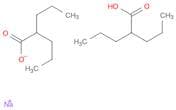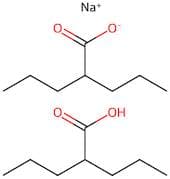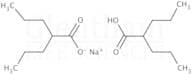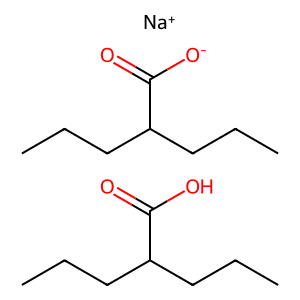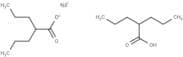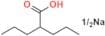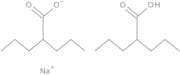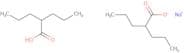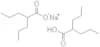
CAS 76584-70-8
:Natriumdivalproex
Beschreibung:
Natriumdivalproex ist ein Medikament, das hauptsächlich als Antikonvulsivum und Stimmungsstabilisator verwendet wird. Es ist ein Natriumsalz der Valproinsäure und wird häufig zur Behandlung von Epilepsie, bipolaren Störungen und zur Vorbeugung von Migränekopfschmerzen verschrieben. Die Verbindung zeichnet sich durch ihre Fähigkeit aus, die Verfügbarkeit von Gamma-Aminobuttersäure (GABA) im Gehirn zu erhöhen, was hilft, die neuronale Aktivität zu stabilisieren. Natriumdivalproex wird typischerweise oral verabreicht und ist bekannt für seine relativ hohe Bioverfügbarkeit. Es ist in Wasser löslich, was die Absorption im Magen-Darm-Trakt erleichtert. Die Substanz wird im Allgemeinen gut vertragen, kann jedoch Nebenwirkungen haben, einschließlich gastrointestinaler Störungen, Gewichtszunahme und potenzieller Lebertoxizität. Die Überwachung der Leberfunktion und der Blutwerte wird während der Behandlung häufig empfohlen. Darüber hinaus ist es wichtig, potenzielle Arzneimittelwechselwirkungen zu berücksichtigen, da Natriumdivalproex den Stoffwechsel anderer Medikamente beeinflussen kann. Insgesamt macht seine Wirksamkeit bei der Behandlung verschiedener neurologischer und psychiatrischer Erkrankungen es zu einem wertvollen therapeutischen Mittel.
Formel:C8H16O2Na
InChl:InChI=1S/C8H16O2.Na/c1-3-5-7(6-4-2)8(9)10;/h7H,3-6H2,1-2H3,(H,9,10);
InChI Key:InChIKey=RGZUPIWJTSGERU-UHFFFAOYSA-N
SMILES:C(CCC)(CCC)C(O)=O.[Na]
Synonyme:- Abbott 50711
- Depakote
- Depalept
- Divalproex Sodium
- Epival
- Pentanoic acid, 2-propyl-, sodium salt (2:1)
- Pentanoic acid, 2-propyl-, sodium salt, mixt. contg.
- Sodium 2-Propylpentanoate 2-Propylpentanoic Acid (1:1:1)
- Sodium hydrogen bis(2-propylpentanoate)
- Sodium hydrogen bis(2-propylvalerate)
- Sodium hydrogen divalproate
- Valdisoval
- Weitere Synonyme anzeigen
Sortieren nach
Reinheit (%)
0
100
|
0
|
50
|
90
|
95
|
100
10 Produkte.
Divalproex Sodium
CAS:Saturated acyclic monocarboxylic acids and their anhydrides, halides, peroxides etc, nesoiFormel:C8H16O2Farbe und Form:SolidMolekulargewicht:144.11503Pentanoic acid, 2-propyl-, sodium salt (2:1)
CAS:Formel:C16H31NaO4Reinheit:98%Farbe und Form:SolidMolekulargewicht:310.4047Sodium Hydrogen Bis(2-Propylpentanoate)
CAS:Sodium Hydrogen Bis(2-Propylpentanoate)Reinheit:98%Molekulargewicht:310.40g/molDivalproex Sodium
CAS:Divalproex Sodium (Valproate semisodium) binds to and inhibits gamma-aminobutyric acid (GABA) transaminase and its anticonvulsant activity may be exerted byFormel:C8H16O2·C8H15O2·NaReinheit:99.87%Farbe und Form:A White Powder With A Characteristic OdorMolekulargewicht:310.41Ref: TM-T6474
10mg39,00€25mg55,00€50mg79,00€100mg116,00€200mg188,00€500mg335,00€1mL*10mM (DMSO)55,00€Valproic Acid Semisodium Salt
CAS:Kontrolliertes ProduktApplications Antiepileptic; Anticonvulsant that also acts as a mood stabilizer for those with bipolar disorder.
References Chang, Z.L., et al.: Anal. Profiles Drug Subs., 8, 529 (1979), Della Paschoa, O.E., et al.: Br. J. Pharmacol., 125, 1610 (1998), Grimes, C.A., et al.: J. Neirochem., 73, 1384 (1999), Loscher, W., Prog. Neurobiol., 58, 31 (1999),Formel:C8H16O2·C8H15O2·NaFarbe und Form:NeatMolekulargewicht:310.4Valproic acid semisodium
CAS:Kontrolliertes ProduktValproic acid is a medication used to treat seizures and other conditions. Valproic acid has been shown to be effective in the treatment of metabolic disorders such as hyperammonemia, hypertriglyceridemia, and hypoglycemia. It also has been shown to be an effective treatment for bipolar disorder. Valproic acid does have side-effect profiles that include weight gain, nausea, vomiting, and hair loss. Side effects are more likely to develop when valproic acid is taken with other medications such as erythromycin or divalproex sodium. Valproic acid can cause hypersensitivity syndrome in some patients. In order to avoid this side effect, blood sampling should be done before starting treatment. Valproic acid is metabolized by the liver into the active form, divalproex sodium (divalproex), which then inhibits the enzyme histone deacetylase (HDAC). The inhibition of HDAC leads to an increase inFormel:C8H16O2•Na0Reinheit:Min. 95%Farbe und Form:White to off-white solid.Molekulargewicht:311.41 g/molRef: 3D-FV28660
Ausgelaufenes produkt