CAS 769-42-6
:Dimethylbarbitursäure
Beschreibung:
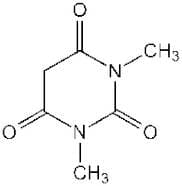
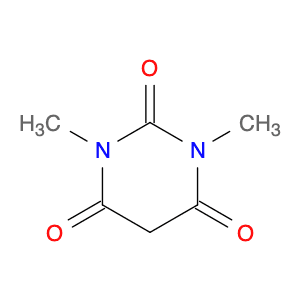
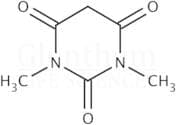
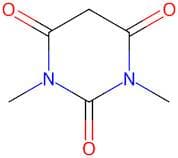
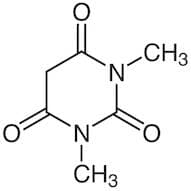
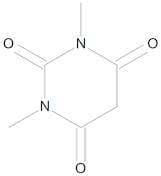
Dimethylbarbitursäure, mit der CAS-Nummer 769-42-6, ist eine chemische Verbindung, die zur Klasse der Barbiturate gehört, die Derivate der Barbitursäure sind. Sie zeichnet sich durch ihre Struktur aus, die zwei Methylgruppen umfasst, die an die Stickstoffatome des Barbitursäuregerüsts gebunden sind. Diese Verbindung ist typischerweise ein weißes kristallines Feststoff, das in Wasser löslich ist und aufgrund der Anwesenheit von Carbonsäure-Funktionalgruppen schwach saure Eigenschaften aufweist. Dimethylbarbitursäure ist bekannt für seine sedativen und hypnotischen Effekte, obwohl es in klinischen Anwendungen weniger häufig verwendet wird als andere Barbiturate. Seine pharmakologische Aktivität wird seiner Fähigkeit zugeschrieben, die Aktivität des Neurotransmitters Gamma-Aminobuttersäure (GABA) am GABA-A-Rezeptor zu modulieren, was zu einer Depression des zentralen Nervensystems führt. Darüber hinaus hat es Anwendungen in der biochemischen Forschung und als Zwischenprodukt in der organischen Synthese. Sicherheits- und Handhabungshinweise sind aufgrund seines Potenzials für Toxizität und Abhängigkeit unerlässlich.
Formel:C6H8N2O3
InChl:InChI=1/C6H8N2O3/c1-7-4(9)3-5(10)8(2)6(7)11/h3H2,1-2H3
InChI Key:InChIKey=VVSASNKOFCZVES-UHFFFAOYSA-N
SMILES:CN1C(=O)N(C)C(=O)CC1=O
Synonyme:- 1,3-Dimethyl-1,3-diazacyclohexane-2,4,6-trione
- 1,3-Dimethyl-1,3-diazinane-2,4,6-trione
- 1,3-Dimethyl-2,4,6(1H,3H,5H)-pyrimidinetrione
- 1,3-Dimethyl-pyrimidine-2,4,6-trione
- 1,3-dimethylpyrimidine-2,4,6(1H,3H,5H)-trione
- 2,4,6(1H,3H,5H)-Pyrimidinetrione, 1,3-dimethyl-
- 6-Hydroxy-1,3-dimethyluracil
- Barbituric acid, 1,3-dimethyl-
- Dimethylbarbituric acid
- N,N'-Dimethylbarbituric acid
- N,N′-Dimethyl-2,4,6-pyrimidinetrione
- Nsc 61918
- 1,3-Dimethylbarbituric acid
- 1,3-Dimethylpyrimidine-2,4,6(1H,2H,5H)-trione
- 1,3-Dimethylhexahydropyrimidine-2,4,6-trione
- AKOS B029702
- 1,3-Dimethylbarbituric acid, 99% (dry wt.) water < 6%
- Hexahydro-1,3-dimethylpyrimidine-2,4,6-trione
- 1,3-dimethyl-4,6(1h,3h,5h)-pyrimidinetrione
- 1,3-Dimethyl-2,4,6-Trihydroxy-Pyrimidine
- 6(1h,3h,5h)-pyrimidinetrione,1,3-dimethyl-4
- Weitere Synonyme anzeigen
Sortieren nach
Reinheit (%)
0
100
|
0
|
50
|
90
|
95
|
100
12 Produkte.
1,3-Dimethylbarbituric acid, 99% (dry wt.), water <6%
CAS:1,3-Dimethylbarbituric acid is used as a catalyst in the Knoevenagel condensation of a series of aromatic aldehydes. It is also used in the synthesis of 5-aryl-6-(alkyl- or aryl-amino)-1,3-dimethylfuro [2,3-d]pyrimidine derivatives and enantioselective synthesis of isochromene pyrimidinedione deriva
Formel:C6H8N2O3Reinheit:99%Farbe und Form:White to cream or pale yellow, Crystals or powder or crystalline powderMolekulargewicht:156.141,3-Dimethylbarbituric acid
CAS:Formel:C6H8N2O3Reinheit:99%Farbe und Form:SolidMolekulargewicht:156.13931,3-Dimethylbarbituric acid
CAS:Formel:C6H8N2O3Reinheit:≥ 99.0%Farbe und Form:White to off-white crystalline powderMolekulargewicht:156.14Urapidil Impurity 4 (1,3-Dimethylbarbituric Acid)
CAS:Formel:C6H8N2O3Farbe und Form:White To Off-White SolidMolekulargewicht:156.141,3-Dimethylbarbituric Acid
CAS:Formel:C6H8N2O3Reinheit:>98.0%(GC)(T)Farbe und Form:White to Light yellow to Light orange powder to crystalMolekulargewicht:156.141,3-Dimethyl Barbituric Acid
CAS:Kontrolliertes ProduktApplications 1,3-Dimethyl Barbituric Acid (Urapidil Impurity 4) is a derivative of Barbituric acid (B118650). All of the barbituric acid derivatives which have been reported to have pronounced hypnotic activity are disubstituted in the 5-position.
References Gupta, K., et al.: Eur. J. Med. Chem., 17, 448 (1982), Weber, L., et al.: Curr. Med. Chem., 9, 2085 (2002), Skiles, J., et al.: Curr. Med. Chem., 11, 2911 (2004),Formel:C6H8N2O3Farbe und Form:NeatMolekulargewicht:156.141,3-Dimethyl-2,4,6(1H,3H,5H)-pyrimidinetrione
CAS:Kontrolliertes Produkt1,3-Dimethyl-2,4,6(1H,3H,5H)-pyrimidinetrione is a heterocyclic organic compound, which is synthesized via established chemical procedures involving catalytic methods or direct condensation reactions. This compound is well-known for its role in the biochemical field as a urease inhibitor. Urease, an enzyme that catalyzes the hydrolysis of urea, is targeted by this compound to potentially mitigate issues related to excessive ammonia production in agricultural and medical settings.In addition to its enzymatic inhibition properties, 1,3-Dimethyl-2,4,6(1H,3H,5H)-pyrimidinetrione serves as a pivotal intermediate in barbiturate synthesis. Barbiturates are psychoactive compounds used historically in medicine for their sedative and anesthetic properties. The compound's structure allows it to participate in the Knoevenagel condensation, facilitating the formation of complex molecules essential in pharmaceutical development. These multifunctional applications make it a valuable tool in various scientific research contexts, exploring both inhibitory mechanisms and synthetic pathways for drug discovery and development.Formel:C6H8N2O3Reinheit:Min. 98 Area-%Farbe und Form:PowderMolekulargewicht:156.14 g/mol