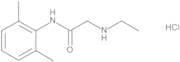
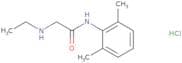
CAS 7729-94-4
:Unreines Lidocainhydrochlorid
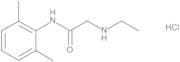
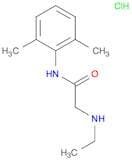
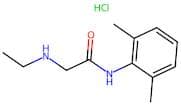
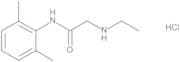
Norlidocaine Hydrochloride (N-(2,6-Dimethylphenyl)-2-(ethylamino)acetamide hydrochloride)
CAS:Cyclic amides and their derivatives, nesoiFormel:C12H18N2OHClFarbe und Form:White SolidMolekulargewicht:206.14191N-(2,6-Dimethylphenyl)-2-(ethylamino)acetamide hydrochloride
CAS:N-(2,6-Dimethylphenyl)-2-(ethylamino)acetamide hydrochlorideReinheit:98%Molekulargewicht:242.75g/molLidocaine EP Impurity D HCl
CAS:Formel:C12H18N2O·HClFarbe und Form:White To Off-White SolidMolekulargewicht:206.29 36.46Lidocaine EP Impurity D (as Hydrochloride)
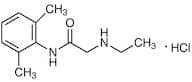
CAS:Kontrolliertes ProduktFormel:C12H18N2O·ClHFarbe und Form:White To Off-WhiteMolekulargewicht:242.75Norlidocaine Hydrochloride
CAS:Formel:C12H18N2O·HClReinheit:>98.0%(T)(HPLC)Farbe und Form:White to Almost white powder to crystalMolekulargewicht:242.75Nor Lidocaine-d6 Hydrochloride
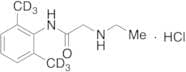
CAS:Kontrolliertes ProduktApplications Nor Lidocaine-d6 Hydrochloride is the labeled analogue of Nor Lidocaine Hydrochloride (N713500), a hydrochloride salt metabolite of Lidocaine (L397800), a local anesthetic; antiarrhythmic (class IB). Long-acting, membrane stabilizing agent against ventricular arrhythmia. Originally developed as a local anesthetic.
Not a dangerous good if item is equal to or less than 1g/ml and there is less than 100g/ml in the package
References Fukuda, S., et al.: Anesthesiology, 53, 106 (1980); Duce, R., et al.: J. Pharmacol. Exp. Ther., 179, 580 (1971); Kronberg, G.H., et al.: J. Med. Chem., 16, 739 (1973); Groningsson, K., et al.: Anal. Profiles Drug Subs., 14, 207 (1985); Davies, P.S., et al.: Drugs, 64, 937 (2004)Formel:C12H13D6ClN2OFarbe und Form:NeatMolekulargewicht:248.78Nor Lidocaine Hydrochloride
CAS:Kontrolliertes ProduktImpurity Lidocaine EP Impurity D (HCl)
Applications Nor Lidocaine Hydrochloride is a hydrochloride salt metabolite of Lidocaine (L397800), an Anesthetic (local); antiarrhythmic (class IB). Long-acting, membrane stabilizing agent against ventricular arrhythmia. Originally developed as a local anesthetic
Not a dangerous good if item is equal to or less than 1g/ml and there is less than 100g/ml in the package
References Fukuda, S., et al.: Anesthesiology, 53, 106 (1980), Duce, R., et al.: J. Pharmacol. Exp. Ther., 179, 580 (1971); Kronberg, G.H., et al.: J. Med. Chem., 16, 739 (1973); Groningsson, K., et al.: Anal. Profiles Drug Subs., 14, 207 (1985); Davies, P.S., et al.: Drugs, 64, 937 (2004);Formel:C12H18N2O·ClHFarbe und Form:White To Off-WhiteMolekulargewicht:242.75Nor Lidocaine-d6 Hydrochloride
CAS:Nor Lidocaine-d6 Hydrochloride is a chromatographic reference standard for the quantitative analysis of lidocaine. It has been extensively used in the metabolism studies of hepatic cytochrome P450, anova studies, and in vivo pharmacokinetic experiments with animals. The half-life values of lidocaine are dependent on the animal species being studied, but terminal half-life values are generally between 2.5 and 5 hours. Nor Lidocaine-d6 Hydrochloride can be used as a reference standard for high specificity liquid chromatography methods and HPLC techniques. In vitro studies have shown that Nor Lidocaine-d6 Hydrochloride is metabolized by the p450 system, which may be due to its hydrolysis by hydrochloric acid.Formel:C12H13D6ClN2OReinheit:Min. 95%Molekulargewicht:248.78 g/mol