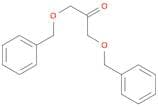
CAS 77356-14-0
:2-Propanon, 1,3-bis(phenylmethoxy)-
1,3-Bis(benzyloxy)propan-2-one
CAS:Formel:C17H18O3Reinheit:95%Farbe und Form:SolidMolekulargewicht:270.32301,3-Bis(benzyloxy)propan-2-one
CAS:Formel:C17H18O3Reinheit:95.0%Farbe und Form:Liquid, No data available.Molekulargewicht:270.3281,3-Bis(benzyloxy)propan-2-one
CAS:1,3-Bis(benzyloxy)propan-2-one is an efficient and stereoselective synthesis of epoxides. It is a chiral molecule that can be used in the synthesis of enantiomers. The reaction involves a nucleophile (such as an alcohol) and an electrophile (an epoxide). This reaction proceeds in two steps with the nucleophile attacking at the carbon atom adjacent to the carbonyl group. The first step is a nucleophilic addition to form a tetrahedral intermediate which collapses to give an intermediate with two new stereogenic centers. The second step is then a nucleophilic attack by water on one of these new stereogenic centers, leading to formation of the product and release of hydrogen gas. 1,3-Bis(benzyloxy)propan-2-one has been shown to be more efficient than other methods for synthesizing epoxides, such as using acid chlorides or ox
Formel:C17H18O3Reinheit:Min. 95%Molekulargewicht:270.32 g/molRef: 3D-CDA35614
Ausgelaufenes produkt