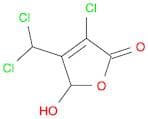
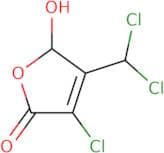
CAS 77439-76-0
:3-Chlor-4-(dichlormethyl)-5-hydroxy-2(5H)-furanon
Beschreibung:
3-Chlor-4-(dichlormethyl)-5-hydroxy-2(5H)-furanon, mit der CAS-Nummer 77439-76-0, ist eine synthetische organische Verbindung, die durch ihre Furanonstruktur gekennzeichnet ist, die einen Furanring mit verschiedenen Substituenten umfasst. Diese Verbindung weist ein Chloratom an der Position 3, eine Dichloromethylgruppe an der Position 4 und eine Hydroxylgruppe an der Position 5 des Furanonrings auf. Das Vorhandensein dieser funktionellen Gruppen trägt zu ihrer Reaktivität und potenziellen Anwendungen in verschiedenen chemischen Prozessen bei. Sie ist bekannt für ihre Rolle bei der Synthese anderer chemischer Entitäten und kann biologische Aktivität zeigen, was sie für die pharmazeutische Forschung von Interesse macht. Die Verbindung wird typischerweise mit Vorsicht behandelt, da ihre halogenierte Natur Toxizität und Umweltbedenken hervorrufen kann. Wie viele Furanone kann sie auch an Reaktionen wie nucleophilen Substitutionen oder Cycloadditionen teilnehmen, abhängig von den Reaktionsbedingungen und dem Vorhandensein anderer Reagenzien. Bei der Arbeit mit dieser Verbindung in Laborumgebungen sollten angemessene Sicherheitsmaßnahmen beachtet werden.
Formel:C5H3Cl3O3
InChl:InChI=1S/C5H3Cl3O3/c6-2-1(3(7)8)4(9)11-5(2)10/h3-4,9H
InChI Key:InChIKey=WNTRMRXAGJOLCU-UHFFFAOYSA-N
SMILES:C(Cl)(Cl)C1=C(Cl)C(=O)OC1O
Synonyme:- 2(5H)-Furanone, 3-chloro-4-(dichloromethyl)-5-hydroxy-
- 3-Chloro-4-(dichloromethyl)-5-hydroxy-2,5-dihydrofuran-2-one
- 3-chloro-4-(dichloromethyl)-5-hydroxy-*2(5H)-fura
- MX (bacterial mutagen)
- Mutagen X
- 3-Chloro-4-(dichloromethyl)-5-hydroxy-2(5H)-furanone
- MX
Sortieren nach
Reinheit (%)
0
100
|
0
|
50
|
90
|
95
|
100
3 Produkte.
3-Chloro-4-(dichloromethyl)-5-hydroxyfuran-2(5H)-one
CAS:Formel:C5H3Cl3O3Farbe und Form:LiquidMolekulargewicht:217.43453-Chloro-4-(dichloromethyl)-5-hydroxy-2(5H)-furanone
CAS:Kontrolliertes ProduktApplications Mutagen X (MX) is a chlorinated furanone that accounts for more of the mutagenic activity of drinking water than any other disinfection byproduct. DNA damages provoked by the six mutagens (furylframide, MX, 4-nitroquinoline N-oxide, sodium azide, 1-nitropyrene, and captan) used in the present study have been known to subject to the nucleotide excision repair system.
Not a dangerous good if item is equal to or less than 1g/ml and there is less than 100g/ml in the package
References Hakulinen, P., et al.: Toxicol. Lett., 151, 439 (2004), Richardson, S., et al.: Mutat. Res., 636, 178 (2007), Kim, J., et al.: Environ. Toxicol., 23, 319 (2008),Formel:C5H3Cl3O3Farbe und Form:NeatMolekulargewicht:217.433-Chloro-4-(dichloromethyl)-5-hydroxy-2(5H)-furanone
CAS:3-Chloro-4-(dichloromethyl)-5-hydroxy-2(5H)-furanone belongs to the class of polymerase chain inhibitors. It inhibits DNA synthesis by binding to the enzyme DNA polymerase and blocking the progression of DNA synthesis. 3-Chloro-4-(dichloromethyl)-5-hydroxy-2(5H)-furanone has significant cytotoxicity in mammalian cells and is genotoxic, which may be due to its mutagenicity. The mechanism of its mutagenicity is not known, but it has been shown that this compound reacts with effector proteins such as thiols and sulfhydryls. 3-Chloro-4-(dichloromethyl)-5-hydroxy-2(5H)-furanone can react with chlorine in water to form a chlorinated derivative that is more stable than the parent compound. This chemical stability has been usedFormel:C5H3Cl3O3Reinheit:(%) Min. 95%Farbe und Form:PowderMolekulargewicht:217.43 g/mol