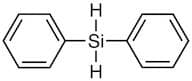
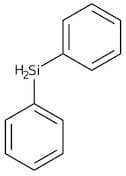
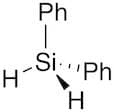
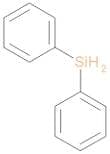
CAS 775-12-2
:Diphenylsilan
- 1,1′-Silylenebis[benzene]
- Benzene, 1,1'-silylenebis-
- Difenilsilano
- Diphenylsilan
- Nsc 33013
- Sid 4559.0
- Silane, diphenyl-
- Tsl 8224
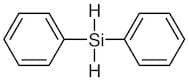
- Diphenylsilane
Diphenylsilane
CAS:Formel:C12H12SiReinheit:>97.0%(GC)Farbe und Form:Colorless to Almost colorless clear liquidMolekulargewicht:184.31Diphenylsilane, 97%
CAS:Thiocarbonyl derivatives of secondary alcohols are readily reduced by diphenylsilane in a radical chain process at room temperature using triethylborane-air as an initiator. An improved radical chain procedure for the deoxygenation of secondary and primary alcohols using diphenylsilane as hydrogen aFormel:C12H12SiReinheit:97%Farbe und Form:Clear colorless, LiquidMolekulargewicht:184.31Diphenylsilane, min. 97%
CAS:Diphenylsilane, min. 97%
Formel:(C6H5)2SiH2Reinheit:min. 97%Farbe und Form:colorless liq.Molekulargewicht:184.30Ref: IN-DA003PQ3
1kgNachfragen5kgNachfragen10kgNachfragen1g26,00€5g30,00€10g37,00€25g52,00€100g121,00€500g566,00€Diphenylsilane
CAS:Formel:C12H12SiReinheit:>98.0%(GC)Farbe und Form:Colorless to Light yellow clear liquidMolekulargewicht:184.31Diphenylsilane
CAS:S08050 - Diphenylsilane
Formel:C12H12SiReinheit:97%Farbe und Form:Liquid, Clear LiquidMolekulargewicht:184.313DIPHENYLSILANE
CAS:Dialkyl Silane Reducing Agent
Organosilanes are hydrocarbon-like and possess the ability to serve as both ionic and free-radical reducing agents. These reagents and their reaction by-products are safer and more easily handled and disposed than many other reducing agents. The metallic nature of silicon and its low electronegativity relative to hydrogen lead to polarization of the Si-H bond yielding a hydridic hydrogen and a milder reducing agent compared to aluminum-, boron-, and other metal-based hydrides. A summary of some key silane reductions are presented in Table 1 of the Silicon-Based Reducing Agents brochure.
Diphenylsilane; Dihydridodiphenylsilane
Converts amides to aldehydes in combination with Ti(OiPr)4Used in the preparation of silyl-substituted alkylidene complexes of tantalumUsed in the ionic reduction of enones to saturated ketonesUsed in the reductive cyclization of unsaturated ketonesReduces esters in the presence of zinc hydride catalystSilylates 1,2-diols in presence of tris(pentafluorophenyl)boraneReduces α-halo ketones in presence of Mo(0)Used in enantioselective reduction of iminesReduces thio esters to ethersSelective reduction of estersReduces esters to alcohols with Rh catalysisEmployed in the asymmetric reduction of methyl ketones and other ketonesReductively cleaves allyl acetatesExtensive review of silicon based reducing agents: Larson, G.; Fry, J. L. "Ionic and Organometallic-Catalyzed Organosilane Reductions", Wipf, P., Ed.; Wiley, 2007Formel:C12H12SiReinheit:97%Farbe und Form:LiquidMolekulargewicht:184.31