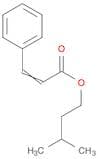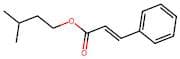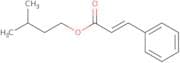
CAS 7779-65-9
:Isoamylcinnamat
Beschreibung:
Isoamylcinnamat, mit der CAS-Nummer 7779-65-9, ist eine organische Verbindung, die zur Klasse der Ester gehört. Sie entsteht aus der Reaktion von Isoamylalkohol und Zimtsäure. Diese Substanz zeichnet sich durch ihr angenehmes, fruchtiges Aroma aus, das oft als reminiscent von Bananen oder Birnen beschrieben wird, was sie zu einer beliebten Wahl in der Duft- und Aromabranche macht. Isoamylcinnamat ist typischerweise eine farblose bis blassgelbe Flüssigkeit mit einem relativ niedrigen Siedepunkt. Sie ist in organischen Lösungsmitteln löslich, hat jedoch eine begrenzte Löslichkeit in Wasser. Die Verbindung ist bekannt für ihre Stabilität unter normalen Bedingungen, obwohl sie in Gegenwart von starken Säuren oder Basen hydrolysiert werden kann. Isoamylcinnamat wird in verschiedenen Anwendungen eingesetzt, darunter Parfums, Kosmetika und Lebensmittelaromen, aufgrund ihres ansprechenden Duftprofils. Darüber hinaus könnte sie potenzielle Anwendungen im Bereich der Synthese von Naturstoffen und als Aromastoff in der Lebensmittelindustrie haben. Sicherheitsdaten sollten für Handhabungs- und Expositionsrichtlinien konsultiert werden.
Formel:C14H18O2
InChl:InChI=1S/C14H18O2/c1-12(2)10-11-16-14(15)9-8-13-6-4-3-5-7-13/h3-9,12H,10-11H2,1-2H3
InChI Key:InChIKey=JFHCDEYLWGVZMX-UHFFFAOYSA-N
SMILES:C(=CC(OCCC(C)C)=O)C1=CC=CC=C1
Synonyme:- 2-Propenoic acid, 3-phenyl-, 3-methylbutyl ester
- 3-methylbutyl (2E)-3-phenylprop-2-enoate
- Cinnamic acid, isopentyl ester
- Iso-Amyl Cinnamate
- Isopentyl alcohol, cinnamate
- isopentyl (Z)-3-phenylprop-2-enoate
- Isoamyl cinnamate
Sortieren nach
Reinheit (%)
0
100
|
0
|
50
|
90
|
95
|
100
3 Produkte.
3-methylbutyl (2E)-3-phenylprop-2-enoate
CAS:Formel:C14H18O2Reinheit:98%Farbe und Form:LiquidMolekulargewicht:218.2915Isoamyl cinnamate
CAS:Isoamyl cinnamate is a synthetic compound that is used as an intermediate for the production of detergents. It has been shown to inhibit the growth of yeast and fungi, such as Cryptococcus neoformans and Candida glabrata. Isoamyl cinnamate also has anti-microbial properties that may be related to its ability to produce propionate, which can kill bacteria in urine samples. This compound is not known to bioaccumulate or cause toxicity in humans at normal doses.Formel:C14H18O2Reinheit:Min. 95%Farbe und Form:Clear LiquidMolekulargewicht:218.29 g/mol