CAS 779-89-5
:3-(Trifluormethyl)zimtsäure
Beschreibung:
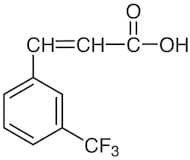
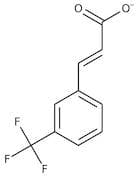
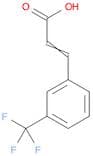
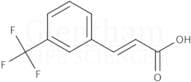
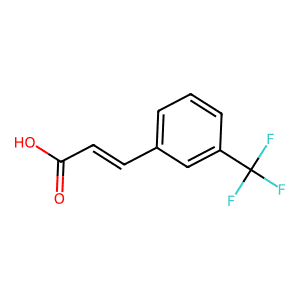
3-(Trifluormethyl)zimtsäure ist eine organische Verbindung, die durch ihre einzigartige Struktur gekennzeichnet ist, die eine Trifluormethylgruppe (-CF3) umfasst, die an den aromatischen Ring eines Derivats der Zimtsäure gebunden ist. Diese Verbindung weist eine trans-Konfiguration auf, die für ihre Stabilität und Reaktivität von Bedeutung ist. Das Vorhandensein der Trifluormethylgruppe erhöht die Lipophilie und verändert die elektronischen Eigenschaften des Moleküls, was es zu einem wertvollen Zwischenprodukt in der organischen Synthese und der medizinischen Chemie macht. Es erscheint typischerweise als weißer bis schmutzig-weißer Feststoff und ist in Wasser schlecht löslich, aber in organischen Lösungsmitteln besser löslich. Die Verbindung zeigt interessante Eigenschaften wie potenzielle antimikrobielle und entzündungshemmende Aktivitäten, was sie zu einem Forschungsobjekt in pharmazeutischen Anwendungen macht. Darüber hinaus kann ihre einzigartige fluorierte Struktur ihr Verhalten in verschiedenen chemischen Reaktionen beeinflussen, einschließlich elektrophiler aromatischer Substitution und Kreuzkopplungsreaktionen. Sicherheitsdaten zeigen, dass sie, wie viele fluorierte Verbindungen, mit Vorsicht behandelt werden sollte, da potenzielle Toxizität und Umweltbedenken bestehen.
Formel:C10H7F3O2
InChl:InChI=1S/C10H7F3O2/c11-10(12,13)8-3-1-2-7(6-8)4-5-9(14)15/h1-6H,(H,14,15)
InChI Key:InChIKey=KSBWHDDGWSYETA-UHFFFAOYSA-N
SMILES:C(F)(F)(F)C1=CC(C=CC(O)=O)=CC=C1
Synonyme:- (2E)-3-[3-(trifluoromethyl)phenyl]prop-2-enoate
- 2-Propenoic acid, 3-[3-(trifluoromethyl)phenyl]-
- 3-(3-Trifluoromethylphenyl)acrylic acid
- 3-(Trifluormethyl) cinnamic acid
- 3-[3-(Trifluoromethyl)phenyl]-2-propenoic acid
- Cinnamic acid, m-(trifluoromethyl)-
- m-(Trifluoromethyl)cinnamic acid
- 3-(Trifluoromethyl)cinnamic acid
Sortieren nach
Reinheit (%)
0
100
|
0
|
50
|
90
|
95
|
100
11 Produkte.
3-(Trifluoromethyl)cinnamic Acid
CAS:Formel:C10H7F3O2Reinheit:>99.0%(GC)(T)Farbe und Form:White to Almost white powder to crystalMolekulargewicht:216.163-(Trifluoromethyl)cinnamic acid, predominantly trans, 98+%
CAS:This Thermo Scientific Chemicals brand product was originally part of the Alfa Aesar product portfolio. Some documentation and label information may refer to the legacy brand. The original Alfa Aesar product / item code or SKU reference has not changed as a part of the brand transition to Thermo SciFormel:C10H6F3O2Reinheit:98+%Farbe und Form:White to pale cream, Crystals or powder or crystalline powderMolekulargewicht:215.153-(Trifluoromethyl)cinnamic acid, predominantly trans
CAS:Formel:C10H7F3O2Reinheit:98%Farbe und Form:SolidMolekulargewicht:216.15663-(Trifluoromethyl)cinnamic acid
CAS:3-(Trifluoromethyl)cinnamic acidReinheit:≥98%Molekulargewicht:216.157g/mol3-(Trifluoromethyl)cinnamic acid
CAS:3-(Trifluoromethyl)cinnamic acidFormel:C10H7F3O2Reinheit:98%Farbe und Form: white solidMolekulargewicht:216.16g/mol3-(Trifluoromethyl)cinnamic Acid
CAS:Kontrolliertes ProduktFormel:C10H7F3O2Farbe und Form:NeatMolekulargewicht:216.163-(Trifluoromethyl)cinnamic acid
CAS:3-(Trifluoromethyl)cinnamic acid (3-(3-(Trifluoromethyl)phenyl)acrylic acid) can be used to study drug-resistant bacterial infections.Formel:C10H7F3O2Reinheit:99.59%Farbe und Form:SolidMolekulargewicht:216.1573-(Trifluoromethyl)cinnamic acid
CAS:Formel:C10H7F3O2Reinheit:98%Farbe und Form:SolidMolekulargewicht:216.1593-(Trifluoromethyl)cinnamic acid
CAS:3-(Trifluoromethyl)cinnamic acid (3TCA) is a cinnamic acid derivative that has been synthesized and studied. It is a supramolecular chemistry that has been shown to inhibit the activity of dehydrogenases, which are enzymes involved in postprandial plasma glucose metabolism. 3TCA is also a peptidomimetic and can be used as an inhibitor for cancer cells. 3TCA binds to the active site of dehydrogenases, blocking the transfer of electrons from NADH to coenzyme A and disrupting electron transport. This inhibition leads to decreased levels of acetyl-CoA and ATP, resulting in cell death. 3TCA has also been found to be useful as an inhibitor for amide hydrolase, which is an enzyme involved in the breakdown of proteins into amino acids. 3TCA can be used in techniques such as molecular modeling, crystal x-ray diffraction, and clinical use.Formel:C10H7F3O2Reinheit:Min. 95%Farbe und Form:PowderMolekulargewicht:216.16 g/mol