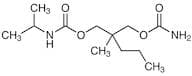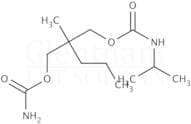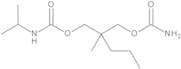
CAS 78-44-4
:Carisoprodol
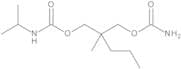
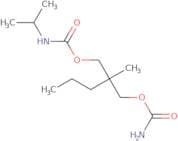
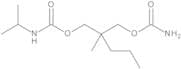
- 2-Carbamoyloxymethyl-2-methylpentyl isopropylcarbamate
- 2-Methyl-2-propyl-1,3-propanediol carbamate isopropylcarbamate
- Apesan
- Arusal
- Atonalyt
- Calenfa
- Caprodat
- Carbamic acid, N-(1-methylethyl)-, 2-[[(aminocarbonyl)oxy]methyl]-2-methylpentyl ester
- Carbamic acid, isopropyl-, 2-(hydroxymethyl)-2-methylpentyl ester carbamate (ester)
- Carbamic acid, isopropyl-, 2-(hydroxymethyl)-2-methylpentyl ester, carbamate
- Carisol
- Carisoma
- Carisoprodate
- Carisoprodatum
- Carisoprodol
- Domarax
- Flexal
- Flexartal
- Isobamate
- Isomeprobamate
- Isopropyl meprobamate
- Isoprotan
- Isoprotane
- Isoprothane
- Izoprotan
- Miolisodal
- Mioril
- N-Isopropyl-2-methyl-2-propyl-1,3-propanediol dicarbamate
- Nih 10966
- Nsc 172124
- Rela
- Rela (carbamic acid)
- Relasom
- Sanoma
- Skutamil
- Soma
- Somadril
- Somalgit
- Stialgin
- Weitere Synonyme anzeigen
Carisoprodol
CAS:Kontrolliertes ProduktFormel:C12H24N2O4Reinheit:>98.0%(HPLC)(N)Farbe und Form:White to Almost white powder to crystalMolekulargewicht:260.33Carisoprodol
CAS:Kontrolliertes ProduktFormel:C12H24N2O4Reinheit:≥ 98.0%Farbe und Form:White to almost white crystalline powderMolekulargewicht:260.33Carisoprodol
CAS:Kontrolliertes ProduktApplications Muscle relaxant (skeletal).
References Musso, D., et al.: J. Med. Chem. 46, 399 (2003), Newman, P., et al.: Eur. J. Clin. Pharm., 23, 31 (1982).Formel:C12H24N2O4Farbe und Form:White To Off-WhiteMolekulargewicht:260.33Carisoprodol
CAS:Kontrolliertes ProduktCarisoprodol is a synthetic compound that is used as a reaction component, reagent, and useful scaffold in the synthesis of pharmaceuticals. Carisoprodol has been shown to be a high-quality research chemical with versatile building blocks. It can be used as an intermediate in the synthesis of complex compounds such as anticonvulsants and muscle relaxants. Carisoprodol is also a fine chemical with CAS number 78-44-4.Formel:C12H24N2O4Reinheit:Min. 98 Area-%Molekulargewicht:260.33 g/mol2-Methyl-2-propyl-1,3-propanediol carbamate isopropylcarbamate
CAS:Kontrolliertes Produkt2-Methyl-2-propyl-1,3-propanediol carbamate isopropylcarbamate (2MPPC) is a prodrug that is metabolized to carisoprodol. It has been shown to have a high affinity for the neuronal death receptor, TNFRSF25, and can cause neuronal death in vitro. In vivo studies show that 2MPPC causes axonal growth and promotes locomotor activity. 2MPPC also inhibits the production of prostaglandin E2 and nitric oxide, which may be due to its inhibition of cyclooxygenase 1 and nitric oxide synthase 1. Clinical pathology studies reveal that 2MPPC does not cause toxicity at therapeutic doses. Histological analysis shows that 2MPPC does not affect the granule neurons in the dentate gyrus region of the hippocampus.
Formel:C12H24N2O4Reinheit:Min. 95%Farbe und Form:PowderMolekulargewicht:260.33 g/molCarisoprodol (1 mg/ml in Methanol)
CAS:Kontrolliertes ProduktFormel:C12H24N2O4Farbe und Form:ColourlessMolekulargewicht:260.33Carisoprodol CIV
CAS:Kontrolliertes ProduktAcyclic amides (including acyclic carbamates) and their derivatives and salts thereof, nesoiFormel:C12H24N2O4Farbe und Form:White PowderMolekulargewicht:260.33