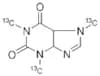
CAS 78072-66-9
:Koffein-trimethyl-13C3
Beschreibung:
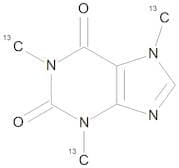
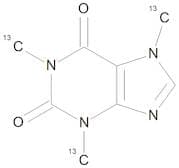
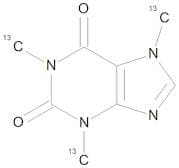
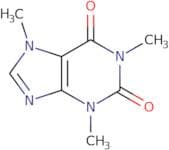
Koffein-trimethyl-13C3, mit der CAS-Nummer 78072-66-9, ist eine stabile isotopische Variante von Koffein, bei der drei Kohlenstoffatome im Koffeinmolekül durch das Kohlenstoffisotop 13 ersetzt werden. Diese Modifikation ermöglicht die Verwendung von Koffein-trimethyl-13C3 in verschiedenen analytischen Anwendungen, insbesondere in der Kernspinresonanzspektroskopie (NMR) und der Massenspektrometrie, wo isotopisches Labeling die Detektion und Quantifizierung von Verbindungen in komplexen Mischungen verbessern kann. Die chemische Struktur von Koffein-trimethyl-13C3 behält die charakteristischen Merkmale von Koffein bei, einschließlich seines Xanthin-Kerns und der Methylgruppen, die zu seinen stimulierenden Eigenschaften beitragen. Als psychoaktive Substanz wirkt Koffein hauptsächlich als Antagonist der Adenosinrezeptoren, was zu einer erhöhten Wachsamkeit und einer verringerten Müdigkeit führt. Die Anwesenheit des Kohlenstoffisotops 13 verändert die biologische Aktivität von Koffein nicht signifikant, was es zu einem wertvollen Werkzeug für die Forschung in der Pharmakokinetik und metabolischen Studien macht. Insgesamt dient Koffein-trimethyl-13C3 als eine wichtige Verbindung sowohl in der wissenschaftlichen Forschung als auch in der analytischen Chemie.
Formel:C513C3H10N4O2
InChl:InChI=1/C8H10N4O2/c1-10-4-9-6-5(10)7(13)12(3)8(14)11(6)2/h4H,1-3H3/i1+1,2+1,3+1
Synonyme:- 1,3,7-tris[(~13~C)methyl]-3,7-dihydro-1H-purine-2,6-dione
Sortieren nach
Reinheit (%)
0
100
|
0
|
50
|
90
|
95
|
100
5 Produkte.
Caffeine-13C3 (Pentoxifylline EP Impurity F-13C3, Theophylline EP Impurity A-13C3, Theophylline-Ethylenediamine EP Impurity A-13C3)
CAS:Formel:C513C3H10N4O2Farbe und Form:White To Off-White SolidMolekulargewicht:197.16Caffeine 13C3 (trimethyl 13C3) 100 µg/mL in Acetonitrile
CAS:Formel:C3C5H10N4O2Farbe und Form:Single SolutionMolekulargewicht:197.17Caffeine-13C3
CAS:<p>Applications Caffeine-13C3 is a labelled analogue of Caffeine (C080100), a bitter, white crystalline xanthine alkaloid that acts as a stimulant drug and a reversible acetylcholinesterase inhibitor. Caffeine is found in varying quantities in the seeds, leaves, and fruit of some plants, where it acts as a natural pesticide that paralyzes and kills certain insects feeding on the plants. In humans, caffeine acts as a central nervous system stimulant, temporarily warding off drowsiness and restoring alertness. Caffeine is a cardiac and respiratory stimulant; diuretic. Caffeine is toxic at sufficiently high doses.A study at Johns Hopkins University indicates that caffeine can improve pattern separation memory.<br>References Zubair, U.M., et al.: Anal. Profiles Drug Subs., 15, 71 (1986); Cherrah, Y., et al.: Biochem. Pharmacol., 37, 1311 (1988); Chem. and Eng. News p.34, Jan. 20, (2014)<br></p>Formel:C3C5H10N4O2Farbe und Form:White To Off-WhiteMolekulargewicht:197.17Caffeine-13C3
CAS:Kontrolliertes Produkt<p>The enantioselective method of caffeine-13C3 is a new technique to measure the amount of caffeine in wastewater. The method uses the enantioselective properties of the synthetic compound, caffeine-13C3, which has a chiral center that is not present in natural caffeine. The method relies on high performance liquid chromatography and mass spectrometry. It can be used to test wastewater samples for levels of caffeine over a period of time and compare them with different populations. This method can also be used to detect traces of other psychoactive substances such as amphetamines, cocaine, and ecstasy.</p>Formel:C8H10N4O2Reinheit:Min. 95%Molekulargewicht:197.17 g/mol