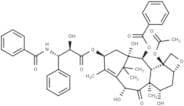
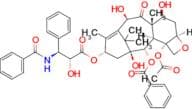
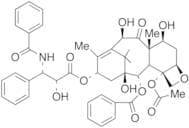
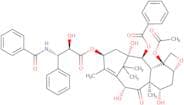
CAS 78432-77-6
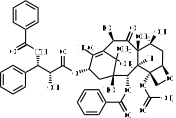
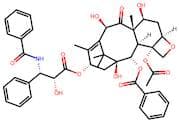
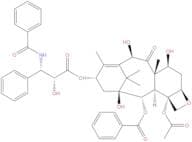
:10-Deacetyltaxol
Beschreibung:
10-Deacetyltaxol, mit der CAS-Nummer 78432-77-6, ist ein Derivat des Naturprodukts Taxol, das für seine krebsbekämpfenden Eigenschaften bekannt ist. Diese Verbindung zeichnet sich durch das Fehlen einer Acetylgruppe an der Position C10 aus, was sie vom Taxol unterscheidet. Sie weist eine komplexe polycyclische Struktur auf, die typisch für Taxane ist, mit einem Taxan-Kern, der zu ihrer biologischen Aktivität beiträgt. 10-Deacetyltaxol wird hauptsächlich für seine Fähigkeit anerkannt, Mikrotubuli zu stabilisieren, wodurch die Zellteilung gehemmt wird, was ein entscheidender Mechanismus in der Krebsbehandlung ist. Die Verbindung wird häufig auf ihre potenziellen therapeutischen Anwendungen untersucht und kann unterschiedliche Grade der Zytotoxizität gegen verschiedene Krebszelllinien aufweisen. Darüber hinaus können ihre Löslichkeit und Stabilität in biologischen Systemen ihre Wirksamkeit als therapeutisches Mittel beeinflussen. Insgesamt stellt 10-Deacetyltaxol eine wichtige Verbindung im Bereich der medizinischen Chemie dar, insbesondere bei der Entwicklung von chemotherapeutischen Mitteln.
Formel:C45H49NO13
InChl:InChI=1S/C45H49NO13/c1-24-29(57-41(54)35(50)33(26-15-9-6-10-16-26)46-39(52)27-17-11-7-12-18-27)22-45(55)38(58-40(53)28-19-13-8-14-20-28)36-43(5,37(51)34(49)32(24)42(45,3)4)30(48)21-31-44(36,23-56-31)59-25(2)47/h6-20,29-31,33-36,38,48-50,55H,21-23H2,1-5H3,(H,46,52)/t29-,30-,31+,33-,34+,35+,36-,38-,43+,44-,45+/m0/s1
InChI Key:InChIKey=TYLVGQKNNUHXIP-MHHARFCSSA-N
SMILES:O(C(C)=O)[C@]12[C@]3([C@H](OC(=O)C4=CC=CC=C4)[C@@]5(O)C(C)(C)C([C@@H](O)C(=O)[C@]3(C)[C@@H](O)C[C@]1(OC2)[H])=C(C)[C@@H](OC([C@@H]([C@@H](NC(=O)C6=CC=CC=C6)C7=CC=CC=C7)O)=O)C5)[H]
Synonyme:- (2alpha,5beta,7beta,10beta,13alpha)-4-(acetyloxy)-13-{[(2R,3S)-3-(benzoylamino)-2-hydroxy-3-phenylpropanoyl]oxy}-1,7,10-trihydroxy-9-oxo-5,20-epoxytax-11-en-2-yl benzoate
- 10-Deacetylpaclitaxel
- 10-Deacetyltaxol
- 10-Deacetyltaxol A
- 10-Desacetylpaclitaxel
- 10-Desacetyltaxol
- 10-O-Deacetyltaxol
- 7,11-Methano-1H-cyclodeca[3,4]benz[1,2-b]oxete, benzenepropanoic acid deriv.
- 7-Epi-10-deacetyl paclitaxel
- Benzenepropanoic acid, β-(benzoylamino)-α-hydroxy-, (2aR,4S,4aS,6R,9S,11S,12S,12aR,12bS)-12b-(acetyloxy)-12-(benzoyloxy)-2a,3,4,4a,5,6,9,10,11,12,12a,12b-dodecahydro-4,6,11-trihydroxy-4a,8,13,13-tetramethyl-5-oxo-7,11-methano-1H-cyclodeca[3,4]benz[1,2-b]oxet-9-yl ester, (αR,βS)-
- Benzenepropanoic acid, β-(benzoylamino)-α-hydroxy-, 12b-(acetyloxy)-12-(benzoyloxy)-2a,3,4,4a,5,6,9,10,11,12,12a,12b-dodecahydro-4,6,11-trihydroxy-4a,8,13,13-tetramethyl-5-oxo-7,11-methano-1H-cyclodeca[3,4]benz[1,2-b]oxet-9-yl ester, [2aR-[2aα,4β,4aβ,6β,9α(αR*,βS*),11α,12α,12aα,12bα]]-
- Weitere Synonyme anzeigen
Sortieren nach
Reinheit (%)
0
100
|
0
|
50
|
90
|
95
|
100
9 Produkte gefunden.
Paclitaxel EP Impurity G (10-Desacetyl Paclitaxel)
CAS:Formel:C45H49NO13Farbe und Form:Pink SolidMolekulargewicht:811.8810-Deacetyltaxol
CAS:Formel:C45H49NO13Reinheit:≥ 98.0%Farbe und Form:White to off-white powderMolekulargewicht:811.8810-Deacetyltaxol
CAS:10-Deacetyltaxol and cephalomannine have cytotoxicity in human glial and neuroblastoma cell-lines, the tumors of the central and peripheral nervous system are sensitive to 10-deacetyltaxol and cephalomannine and these drugs are less toxic than taxol but remain within a therapeutic range.Formel:C45H49NO13Reinheit:95%~99%Molekulargewicht:811.88110-Deacetyltaxol
CAS:10-Deacetyltaxol (10-DAT) is extracted from Taxus brevifolia barks.Formel:C45H49NO13Reinheit:94.63% - 99.93%Farbe und Form:SolidMolekulargewicht:811.8710-Desacetyl Paclitaxel
CAS:Impurity Paclitaxel - impurity G
Applications A semi-synthetic precursor of Paclitaxel. Paclitaxel - impurity G.Formel:C45H49NO13Farbe und Form:NeatMolekulargewicht:811.8710-Desacetyl paclitaxel
CAS:10-Desacetyl paclitaxel is a form of paclitaxel that has been modified chemically. It is soluble in water and can be injected intravenously. 10-Desacetyl paclitaxel is used to treat inflammatory diseases, such as rheumatoid arthritis and psoriasis. This drug binds to the hydroxyl groups on the surface of the bacterial cell wall and prevents the formation of covalent linkages with polysaccharides, which leads to its increased patency in bacterial cells. 10-Desacetyl paclitaxel has also been shown to inhibit the activity of certain enzymes that are involved in synthesis of DNA, RNA, and proteins. This inhibition results in cell death by apoptosis or necrosis. The increase in viability after treatment with 10-desacetyl paclitaxel was observed for both gram-positive bacteria (e.g., Bacillus subtilis) and gram-negative bacteria (e.g., EscherFormel:C45H49NO13Reinheit:Min. 95%Farbe und Form:White PowderMolekulargewicht:811.87 g/mol