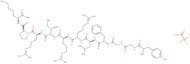
CAS 79985-48-1
:1-11-Dynorphin A (Schwein), 11-L-Lysinamid-
Beschreibung:
1-11-Dynorphin A (Schwein), 11-L-Lysinamid, mit der CAS-Nummer 79985-48-1, ist ein Peptid, das zur Dynorphin-Familie gehört, die endogene Opioidpeptide sind, die aus Proenkephalin abgeleitet werden. Diese Substanz zeichnet sich durch ihre spezifische Aminosäuresequenz aus, die zu ihrer biologischen Aktivität beiträgt, insbesondere bei der Modulation von Schmerz- und Stressreaktionen. Dynorphine, einschließlich dieser Variante, interagieren hauptsächlich mit den Kappa-Opioid-Rezeptoren im zentralen Nervensystem und beeinflussen verschiedene physiologische Prozesse wie Analgesie, Stimmungregulation und neuroendokrine Funktionen. Das Vorhandensein der L-Lysinamid-Modifikation kann die Stabilität des Peptids, die Rezeptoraffinität und das allgemeine pharmakologische Profil beeinflussen. Typischerweise sind Dynorphine an komplexen Signalwegen beteiligt und können je nach Kontext ihrer Wirkung sowohl analgetische als auch dysphorische Effekte zeigen. Die Forschung zu Dynorphinen untersucht weiterhin ihre potenziellen therapeutischen Anwendungen, insbesondere im Schmerzmanagement und in der Behandlung von Stimmungserkrankungen.
Formel:C63H104N22O12
Synonyme:- a-Neoendorphin (pig),7-L-arginine-8-L-isoleucine-8a-endo-L-arginine-10-L-lysinamide-
- DynorphinA(1-11)-NH2
- Dynorphin A (1-11) Amide
Sortieren nach
Reinheit (%)
0
100
|
0
|
50
|
90
|
95
|
100
1 Produkte.
Dynorphin A (1-11) amide trifluoroacetate salt
CAS:Dynorphin A (1-11) amide trifluoroacetate salt is a modified form of the opioid peptide dynorphin, which is a natural ligand for kappa-opioid receptors. It has affinity for the surface receptors and can be used to study the modifications that occur in cell function. Dynorphin A (1-11) amide trifluoroacetate salt has been shown to decrease cell function when it interacts with these surface receptors, which are found in brain homogenates and other tissues. Dynorphin A (1-11) amide trifluoroacetate salt also has an effect on brain cells, which may be due to its ability to alter conformational changes in proteins by binding to them. This can lead to alterations in the structure of certain enzymes or receptor proteins.Formel:C63H104N22O12Reinheit:Min. 95%Molekulargewicht:1,361.64 g/mol