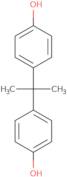
CAS 80-05-7
:2,2-Bis(4-hydroxyphenyl)propan
Beschreibung:
2,2-Bis(4-hydroxyphenyl)propan, allgemein bekannt als Bisphenol A (BPA), ist eine organische Verbindung, die durch ihre Struktur gekennzeichnet ist, die zwei phenolische Hydroxylgruppen an einem Propan-Rückgrat aufweist. Diese Verbindung ist bei Raumtemperatur ein farbloser Feststoff und in organischen Lösungsmitteln löslich, hat jedoch eine begrenzte Löslichkeit in Wasser. BPA wird hauptsächlich in der Herstellung von Polycarbonat-Kunststoffen und Epoxidharzen verwendet, die in einer Vielzahl von Anwendungen eingesetzt werden, einschließlich Lebensmittelbehältern, Wasserflaschen und Beschichtungen. Es zeigt thermische Stabilität und Widerstandsfähigkeit gegen chemische Zersetzung, was es für Hochleistungsmaterialien geeignet macht. BPA ist jedoch auch für seine endokrinen störenden Eigenschaften bekannt, was Bedenken hinsichtlich seiner potenziellen Auswirkungen auf die menschliche Gesundheit und die Umwelt aufwirft. Regulierungsbehörden haben seine Verwendung überprüft, was zu Einschränkungen in bestimmten Anwendungen geführt hat, insbesondere in solchen, die mit Lebensmittelkontakt zu tun haben. Insgesamt ist BPA zwar eine wertvolle industrielle Chemikalie, aber sein Sicherheitsprofil bleibt ein Thema intensiver Forschung und Debatte.
Formel:C15H16O2
InChl:InChI=1S/C15H16O2/c1-15(2,11-3-7-13(16)8-4-11)12-5-9-14(17)10-6-12/h3-10,16-17H,1-2H3
InChI Key:InChIKey=IISBACLAFKSPIT-UHFFFAOYSA-N
SMILES:C(C)(C)(C1=CC=C(O)C=C1)C2=CC=C(O)C=C2
Synonyme:- (4,4'-Dihydroxydiphenyl)dimethylmethane
- 2,2-Bis(4-hydroxyphenyl)propane
- 2,2-Bis(p-hydroxyphenyl)propane
- 2,2-Bis-(4-Hydroxy-Phenyl)-Propane
- 2,2-Di(4-Hydroxyphenyl) Propane
- 2,2-Di(4-phenylol)propane
- 4,4'-(1-Methylethylidene)bisphenol
- 4,4'-Bisphenol A
- 4,4'-Dihydroxyphenyl-2,2-Propane
- 4,4'-Isopropilidendifenol
- 4,4'-Isopropylidendiphenol
- 4,4'-Isopropylidene bisphenol
- 4,4'-Isopropylidenebis[phenol]
- 4,4'-Methylethylidenebisphenol
- 4,4-Isopropylidene Diphenyl
- 4,4′-(1-Methylethylidene)bis[phenol]
- 4,4′-(Propane-2,2-diyl)diphenol
- B 0494
- BPA
- Bis(4-hydroxyphenyl)dimethylmethane
- Bis(p-hydroxyphenyl)propane
- Bis[Phenol], 4,4'-(1-Methylethylidene)-
- Bisphenol A
- Bisphenol, 4,4'-(1-Methylethylidene)-
- Bpa 154
- Bpa 157
- Bpa-M
- Dian
- Diano
- Diphenol methylethylidene
- Diphenylolpropane
- Hg 3876
- Hidorin F 285
- Hidorin F 568
- Ht 3082
- Ipognox 88
- Isopropylidenebis(4-hydroxybenzene)
- Nsc 1767
- Nsc 17959
- Nupole BPE-60
- P,P'-Isopropylidene Diphenol
- Parabis
- Parabis A
- Phenol, 4,4'-(1-methylethylidene)bis-
- Phenol, 4,4'-isopropylidenedi-
- Pluracol 245
- Rikabanol
- Tetrabromobisphenol A Allyl Ether
- p,p'-Bisphenol A
- p,p'-Dihydroxydiphenylpropane
- p,p'-Isopropylidenebisphenol
- p,p'-Isopropylidenediphenol
- Weitere Synonyme anzeigen
Sortieren nach
Reinheit (%)
0
100
|
0
|
50
|
90
|
95
|
100
Bisphenol A
CAS:Kontrolliertes ProduktBisphenol A is a chemical compound used to make polycarbonate plastics and epoxy resins. It is also used in the production of some dental sealants and composites. Bisphenol A has been shown to have an adverse effect on human health, as it has been linked to various diseases such as coronary heart disease, type 2 diabetes, and breast cancer. The most sensitive route of exposure is through the maternal blood during pregnancy. This chemical can be found in some common food containers, including baby bottles and food cans. Bisphenol A binds to estrogen receptors and alters their activity levels by mimicking the natural hormone estradiol. The optimum concentration for binding varies depending on the cell type and receptor present. Bisphenol A can also increase or decrease certain enzyme activities in vitro depending on the concentrations used. Bisphenol A is also an analytical reagent that can be used for polymerase chain reactions (PCR) to identify genes from specificFormel:C15H16O2Reinheit:Min. 95%Farbe und Form:PowderMolekulargewicht:228.29 g/mol