CAS 80-59-1
:Tiglinsäure
Beschreibung:
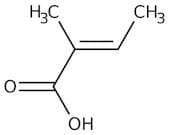
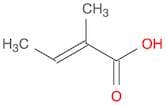
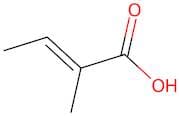
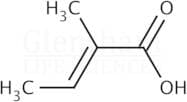
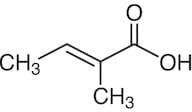
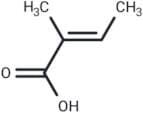
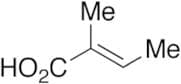
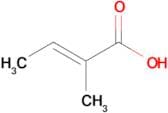
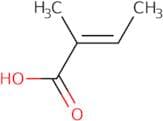
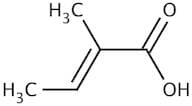
Tiglinsäure, auch bekannt als 2-Methyl-2-butensäure, ist eine ungesättigte Carbonsäure, die durch ihre verzweigte Struktur und das Vorhandensein einer Doppelbindung in ihrer Kohlenstoffkette gekennzeichnet ist. Sie hat die chemische Formel C5H8O2 und weist eine Carboxylgruppe (-COOH) auf, die saure Eigenschaften verleiht. Tiglinsäure ist bei Raumtemperatur eine farblose Flüssigkeit und hat einen charakteristischen, stechenden Geruch. Sie ist in organischen Lösungsmitteln wie Ethanol und Ether löslich, hat jedoch eine begrenzte Löslichkeit in Wasser aufgrund ihrer hydrophoben Alkylgruppen. Diese Verbindung wird hauptsächlich in der organischen Synthese und als Zwischenprodukt bei der Herstellung verschiedener Chemikalien, einschließlich Duftstoffen und Arzneimitteln, verwendet. Darüber hinaus kann Tiglinsäure aus natürlichen Quellen wie bestimmten ätherischen Ölen gewonnen werden. Ihre Reaktivität wird durch das Vorhandensein der Doppelbindung beeinflusst, was sie zu einem nützlichen Baustein in verschiedenen chemischen Reaktionen, einschließlich Polymerisation und Veresterung, macht. Sicherheitsvorkehrungen sollten beim Umgang mit Tiglinsäure getroffen werden, da sie reizend für Haut und Augen sein kann.
Formel:C5H8O2
InChl:InChI=1S/C5H8O2/c1-3-4(2)5(6)7/h3H,1-2H3,(H,6,7)/b4-3+
InChI Key:InChIKey=UIERETOOQGIECD-ONEGZZNKSA-N
SMILES:C(\C(O)=O)(=C/C)/C
Synonyme:- (2E)-2-Methyl-2-butenoic acid
- (E)-2,3-Dimethylacrylic acid
- (E)-2-Methyl-2-butenoic acid
- (E)-2-Methylcrotonic acid
- (E)-α-Methylcrotonic acid
- 2-Butenoic acid, 2-methyl-, (2E)-
- 2-Butenoic acid, 2-methyl-, (E)-
- Cevadic acid
- Crotonic acid, 2-methyl-, (E)-
- NSC 44235
- NSC 8999
- Tiglic acid
- Tiglinic acid
- trans-2-Methyl-2-butenoic acid
- trans-2-Methylcrotonic acid
- Weitere Synonyme anzeigen
Sortieren nach
Reinheit (%)
0
100
|
0
|
50
|
90
|
95
|
100
11 Produkte.
Tiglic acid, 97+%
CAS:This Thermo Scientific Chemicals brand product was originally part of the Alfa Aesar product portfolio. Some documentation and label information may refer to the legacy brand. The original Alfa Aesar product / item code or SKU reference has not changed as a part of the brand transition to Thermo SciFormel:C5H8O2Reinheit:97+%Farbe und Form:White to cream to pale brown, Crystals or powder or crystalline powderMolekulargewicht:100.12Ref: IN-DA0035P7
5kgNachfragen1g21,00€5g21,00€10g24,00€25g25,00€50g31,00€100g50,00€250g80,00€500g120,00€1kg160,00€trans-2,3-Dimethylacrylic acid
CAS:Formel:C5H8O2Reinheit:≥ 98.0%Farbe und Form:White to off-white crystalline powder or crystalsMolekulargewicht:100.12Tiglic Acid
CAS:Formel:C5H8O2Reinheit:>98.0%(GC)(T)Farbe und Form:White to Almost white powder to crystalMolekulargewicht:100.12Tiglic acid
CAS:Tiglic acid (Cevadic acid) is a thick, syrupy poisonous liquid, C5H8O2, derived from croton oil, having a spicy odor and used in making perfumes and flavoringFormel:C5H8O2Reinheit:99.99%Farbe und Form:Triclinic Plates Rods From Water Density As Water And Slightly Soluble In Water May Burn If Heated To High Temperatures May SeverelyMolekulargewicht:100.12Tiglic Acid
CAS:Applications Tiglic acid is the stable isomer of angelic acid. Tiglic acid was found as glyceride in croton oil, as butyl ester in the oil of the Roman camomile, and as geranyl tiglate in oil of geranium. Tiglic acid is formed during the charcoaling of maple wood.
Not a dangerous good if item is equal to or less than 1g/ml and there is less than 100g/ml in the package
References Bueding, et al.: J. Biol. Chem., 202, 505 (1953),Formel:C5H8O2Farbe und Form:NeatMolekulargewicht:100.12Tiglic Acid
CAS:Formel:C5H8O2Reinheit:98%Farbe und Form:Liquid, No data available.Molekulargewicht:100.117Tiglic acid
CAS:Tiglic acid is a sodium salt that can be synthesized in an asymmetric synthesis. It is a white crystalline powder with a melting point of 190-191°C. Tiglic acid has been shown to increase the activity of cinchonidine, which is a compound often used to treat eye disorders and chronic arthritis. Tiglic acid also has the ability to bind to fatty acids, which may be due to hydrogen bonding interactions. In vitro assays have shown that tiglic acid's antimicrobial properties are related to its ability to cause cell lysis by interacting with fatty acids on the cell membrane.Formel:C5H8O2Reinheit:Min. 95%Farbe und Form:PowderMolekulargewicht:100.12 g/molTiglic Acid extrapure, 98%
CAS:Formel:C5H8O2Reinheit:min. 98%Farbe und Form:White to beige, Powder, ClearMolekulargewicht:100.12