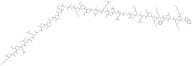
CAS 80451-04-3
:Cecropin A
Beschreibung:
Cecropin A ist ein Peptid, das zu einer Klasse von antimikrobiellen Peptiden gehört, die als Cecropine bekannt sind und von verschiedenen Insekten als Teil ihrer angeborenen Immunantwort produziert werden. Es ist durch seine amphipathische Struktur gekennzeichnet, die es ihm ermöglicht, mit mikrobiellen Membranen zu interagieren und diese zu stören, was zu seiner antimikrobiellen Aktivität gegen eine Vielzahl von Bakterien und Pilzen führt. Cecropin A besteht typischerweise aus etwa 37 Aminosäuren und weist einen hohen Anteil an positiv geladenen Resten auf, was zu seiner Fähigkeit beiträgt, an negativ geladene bakterielle Membranen zu binden. Dieses Peptid zeigt ein breites Spektrum an Aktivitäten, was es zu einem interessanten Thema für potenzielle therapeutische Anwendungen macht, insbesondere bei der Entwicklung neuer Antibiotika. Darüber hinaus wurde Cecropin A auf seine potenziellen Rollen in der Immunmodulation und als Modell zur Gestaltung synthetischer antimikrobieller Mittel untersucht. Seine Stabilität und Wirksamkeit unter verschiedenen Bedingungen erhöhen zusätzlich seine Attraktivität in der biomedizinischen Forschung.
Formel:C184H313N53O46
InChl:InChI=1/C184H313N53O46/c1-27-98(16)145(182(282)235-149(102(20)31-5)181(281)218-115(59-39-46-76-187)159(259)206-103(21)152(252)205-92-138(246)237-82-52-65-130(237)173(273)208-106(24)154(254)228-143(96(12)13)176(276)209-107(25)155(255)229-144(97(14)15)177(277)231-142(95(10)11)175(275)204-89-135(243)211-121(66-70-131(193)239)160(260)207-105(23)156(256)236-150(108(26)238)183(283)221-123(68-72-133(195)241)168(268)232-146(99(17)28-2)178(278)210-104(22)153(253)213-114(151(197)251)58-38-45-75-186)227-137(245)91-202-158(258)129(87-140(249)250)226-163(263)120(64-51-81-200-184(198)199)219-179(279)148(101(19)30-4)234-172(272)128(86-134(196)242)225-164(264)122(67-71-132(194)240)212-136(244)90-203-174(274)141(94(8)9)230-166(266)118(62-42-49-79-190)215-165(265)124(69-73-139(247)248)220-180(280)147(100(18)29-3)233-167(267)119(63-43-50-80-191)214-161(261)116(60-40-47-77-188)216-170(270)126(84-109-53-33-32-34-54-109)224-169(269)125(83-93(6)7)223-162(262)117(61-41-48-78-189)217-171(271)127(222-157(257)112(192)56-37-44-74-185)85-110-88-201-113-57-36-35-55-111(110)113/h32-36,53-55,57,88,93-108,112,114-130,141-150,201,238H,27-31,37-52,56,58-87,89-92,185-192H2,1-26H3,(H2,193,239)(H2,194,240)(H2,195,241)(H2,196,242)(H2,197,251)(H,202,258)(H,203,274)(H,204,275)(H,205,252)(H,206,259)(H,207,260)(H,208,273)(H,209,276)(H,210,278)(H,211,243)(H,212,244)(H,213,253)(H,214,261)(H,215,265)(H,216,270)(H,217,271)(H,218,281)(H,219,279)(H,220,280)(H,221,283)(H,222,257)(H,223,262)(H,224,269)(H,225,264)(H,226,263)(H,227,245)(H,228,254)(H,229,255)(H,230,266)(H,231,277)(H,232,268)(H,233,267)(H,234,272)(H,235,282)(H,236,256)(H,247,248)(H,249,250)(H4,198,199,200)/t98-,99-,100-,101-,102-,103-,104-,105-,106-,107-,108+,112-,114-,115-,116-,117-,118-,119-,120-,121-,122-,123-,124-,125-,126-,127-,128-,129-,130-,141-,142-,143-,144-,145-,146-,147-,148-,149-,150-/m0/s1
Synonyme:- H-Lys-Trp-Lys-Leu-Phe-Lys-Lys-Ile-Glu-Lys-Val-Gly-Gln-Asn-Ile-Arg-Asp-Gly-Ile-Ile-Lys-Ala-Gly-Pro-Ala-Val-Ala-Val-Val-Gly-Gln-Ala-Thr-Gln-Ile-Ala-Lys-NH2
Sortieren nach
Reinheit (%)
0
100
|
0
|
50
|
90
|
95
|
100
4 Produkte.
Cecropin A
CAS:Cecropin A is a 37-residue peptide with antibacterial activity against Escherichia coli, Pseudomonas aeruginosa, Bacillus megaterium and Micrococcus luteus, at micromolar concentrations.Formel:C184H313N53O46Reinheit:95.1%Farbe und Form:WhiteMolekulargewicht:4003.84Cecropin A
CAS:Formel:C184H313N53O46Reinheit:≥ 95%Farbe und Form:White powderMolekulargewicht:4003.78Cecropin A
CAS:Cecropin A, a linear 37-residue antimicrobial polypeptide produced by the cecropia moth, has exhibited cytotoxicity in various human cancer cell lines andFormel:C184H313N53O46Reinheit:96.78%Farbe und Form:SolidMolekulargewicht:4003.78Cecropin A
CAS:Cecropin A is an antimicrobial peptide, which is derived from the immune systems of insects, specifically moths. It displays potent antimicrobial properties through its ability to disrupt bacterial cell membranes, leading to cell lysis and death. This peptide primarily targets Gram-negative bacteria but is also effective against some Gram-positive strains. Cecropin A has garnered significant scientific interest due to its potential applications in developing new antimicrobial agents, particularly in the face of increasing antibiotic resistance. By integrating Cecropin A into therapeutic strategies, researchers aim to broaden the spectrum of antimicrobial options available for use in both clinical and agricultural settings, offering a promising avenue for future drug development.Formel:C184H313N53O46Reinheit:Min. 95%Molekulargewicht:4,003.78 g/mol