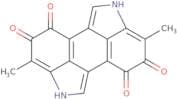
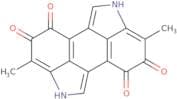
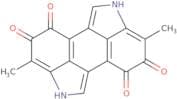
CAS 8049-97-6
:Melanine
Beschreibung:
Melanine sind eine Gruppe komplexer Biopolymere, die hauptsächlich für die Pigmentierung in verschiedenen Organismen, einschließlich Menschen, verantwortlich sind. Sie werden durch die oxidative Polymerisation von phenolischen Verbindungen, insbesondere Tyrosin, produziert und zeichnen sich durch ihre dunkelbraune bis schwarze Farbe aus. Melanine sind unlöslich in Wasser und organischen Lösungsmitteln, was zu ihrer Stabilität und Widerstandsfähigkeit gegen Abbau beiträgt. Sie weisen einen hohen Grad an struktureller Heterogenität auf, mit Variationen in Molekulargewicht und Zusammensetzung, abhängig von der Quelle und den Umweltbedingungen. Melanine spielen eine entscheidende Rolle in biologischen Systemen, einschließlich Schutz vor UV-Strahlung, Abfangen von freien Radikalen und Beitrag zur Färbung von Haut, Haaren und Augen. Darüber hinaus haben sie potenzielle Anwendungen in verschiedenen Bereichen, einschließlich Medizin, Kosmetik und Materialwissenschaft, aufgrund ihrer einzigartigen Eigenschaften wie Biokompatibilität und antioxidative Aktivität. Die CAS-Nummer 8049-97-6 bezieht sich spezifisch auf eine Art von Melanin und hebt ihre Bedeutung sowohl in biologischen als auch in industriellen Kontexten hervor.
Formel:Unspecified
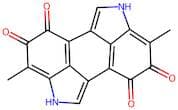
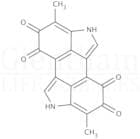
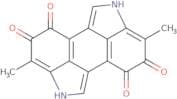
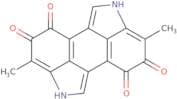
InChl:InChI=1/C18H10N2O4/c1-5-13-9-7(3-19-13)12-10-8(11(9)17(23)15(5)21)4-20-14(10)6(2)16(22)18(12)24/h3-4,19-20H,1-2H3
SMILES:Cc1c2c3c(c[nH]2)c2c4c(c[nH]c4c(C)c(=O)c2=O)c3c(=O)c1=O
Synonyme:- 3,8-Dimethyl-2,7-Dihydrobenzo[1,2,3-Cd:4,5,6-C'D']Diindole-4,5,9,10-Tetrone
- Melanin
- Melanin From Sepia Officinalis
- Melanins
- Melanoids
- MeSH ID: D008543
- Melanines
Sortieren nach
Reinheit (%)
0
100
|
0
|
50
|
90
|
95
|
100
8 Produkte.
Melanin
CAS:Melanin is a multifunctional biotin and a powerful cation chelator with antimicrobial, antioxidant and antiradiation activities.Formel:C18H10N2O4Farbe und Form:SolidMolekulargewicht:318.288Melanin - fungal (Ganoderma lucidum)
CAS:Melanin - fungal (Ganoderma lucidum) is a high-molecular-weight polymer, which is derived from the fruiting body and mycelium of the Ganoderma lucidum mushroom. This compound is a biopolymer formed through the oxidative polymerization of phenolic and/or indolic compounds, a process catalyzed by tyrosinase. The mode of action of this melanin involves its ability to absorb harmful ultraviolet (UV) radiation and scavenge reactive oxygen species (ROS), thereby acting as a potent antioxidant and protective agent.Formel:C18H10N2O4Farbe und Form:PowderMolekulargewicht:318.28 g/molMelanin, from Sepia officinalis
CAS:Melanin is a natural pigment, which is derived from Sepia officinalis, commonly known as the common cuttlefish. This pigment is a complex biopolymer sourced from the ink sac of the cuttlefish, a cephalopod that produces ink as a defense mechanism. The mode of action of melanin involves its unique ability to absorb a broad range of the electromagnetic spectrum, providing effective protection against ultraviolet radiation. Additionally, it exhibits remarkable antioxidant properties due to its free radical scavenging abilities.Formel:C18H10N2O4Molekulargewicht:318.28 g/molMelanin - insect (Hermetia illucens)
CAS:Melanin is a substance that plays a crucial role in the human body. It is responsible for the color of our hair, skin, and eyes. Melanin acts as a natural sunscreen, protecting our skin from harmful UV radiation. It also helps in the synthesis of vitamin D and acts as an antioxidant, protecting our cells from damage caused by free radicals. Gadolinium-based synthetic melanin has been developed to mimic the natural melanin pigment. This synthetic melanin has various applications in industries such as cosmetics, paints, and plastics. It can be used to create vibrant colors and provide UV protection in these products. Researchers have also discovered that certain natural products can enhance melanogenesis, the process of melanin production in the body. These natural pigments have shown antioxidant properties and can inhibit tyrosinase, an enzyme involved in melanin synthesis. By promoting the production of eumelanin (dark brown/black pigment) and inhibiting pheomelanin (yellow/red pigmentFormel:C18H10N2O4Molekulargewicht:318.28 g/molMelanin - plant (Osmanthus fragrans)
CAS:Melanin is a substance that plays a crucial role in the human body. It is responsible for the color of our hair, skin, and eyes. Melanin acts as a natural sunscreen, protecting our skin from harmful UV radiation. It also helps in the synthesis of vitamin D and acts as an antioxidant, protecting our cells from damage caused by free radicals. Gadolinium-based synthetic melanin has been developed to mimic the natural melanin pigment. This synthetic melanin has various applications in industries such as cosmetics, paints, and plastics. It can be used to create vibrant colors and provide UV protection in these products. Researchers have also discovered that certain natural products can enhance melanogenesis, the process of melanin production in the body. These natural pigments have shown antioxidant properties and can inhibit tyrosinase, an enzyme involved in melanin synthesis. By promoting the production of eumelanin (dark brown/black pigment) and inhibiting pheomelanin (yellow/red pigmentFormel:C18H10N2O4Molekulargewicht:318.28 g/molMelanin, synthetic
CAS:Melanin, synthetic, is a bioengineered pigment that mimics the natural biopolymer found in organisms. It is derived from controlled chemical synthesis or microbial processes, designed to replicate the structure and properties of naturally occurring melanin.
Formel:C18H10N2O4Farbe und Form:PowderMolekulargewicht:318.28 g/mol