CAS 80914-37-0
:3-Aminopentansäurehydrochlorid
Beschreibung:
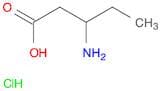
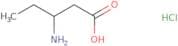
3-Aminopentansäurehydrochlorid, auch bekannt als 3-Aminopentansäure oder β-Aminovaleriansäurehydrochlorid, ist eine organische Verbindung, die durch ihre Aminosäurestruktur gekennzeichnet ist, die sowohl eine Aminogruppe als auch eine Carbonsäurefunktionalgruppe umfasst. Es handelt sich um einen weißen bis schmutzig-weißen kristallinen Feststoff, der in Wasser löslich ist, was ihn für verschiedene Anwendungen in der Biochemie und Pharmazie geeignet macht. Die Anwesenheit der Hydrochlorid-Salzform verbessert seine Stabilität und Löslichkeit in wässrigen Lösungen. Diese Verbindung wird häufig in der Synthese von Peptiden und als Baustein in der organischen Synthese verwendet. Seine molekulare Struktur umfasst eine fünf Kohlenstoff lange Kette mit einer Aminogruppe, die am dritten Kohlenstoff lokalisiert ist, was zu seiner Klassifizierung als β-Aminosäure beiträgt. Darüber hinaus zeigt es Eigenschaften, die typisch für Aminosäuren sind, wie die Fähigkeit, an Wasserstoffbrückenbindungen teilzunehmen und Zwitterionen in Lösung zu bilden. Wie viele Aminosäuren kann es auch eine Rolle in Stoffwechselprozessen spielen und an der Synthese von Neurotransmittern oder anderen biologisch relevanten Molekülen beteiligt sein.
Formel:C5H12ClNO2
InChl:InChI=1/C5H11NO2.ClH/c1-2-4(6)3-5(7)8;/h4H,2-3,6H2,1H3,(H,7,8);1H
SMILES:CCC(CC(=O)O)N.Cl
Synonyme:- 3-Aminopentanoic acid hydrochloride (1:1)
- Pentanoic acid, 3-amino-, hydrochloride (1:1)
Sortieren nach
Reinheit (%)
0
100
|
0
|
50
|
90
|
95
|
100
2 Produkte.
3-Amino-pentanoic acid hydrochloride
CAS:3-Amino-pentanoic acid hydrochloride is a glycine analog, which blocks the glycine receptor of the NMDA type and inhibits glutamate binding. 3-Amino-pentanoic acid hydrochloride has been shown to have synergistic interaction with aminooxyacetic acid, an inhibitor of the glycine transporter. This increases the concentration of glycine in the synapse and leads to an anticonvulsant effect. 3-Amino-pentanoic acid hydrochloride also interacts with γ-aminobutyric acid (GABA) receptors and taurine receptors, which may be due to its structural similarity to these compounds.Formel:C5H12ClNO2Reinheit:Min. 95%Molekulargewicht:153.61 g/mol