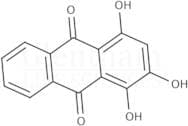
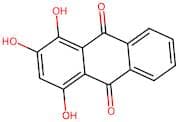
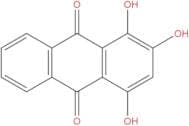
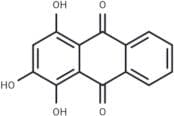
CAS 81-54-9
:Purpur
Beschreibung:
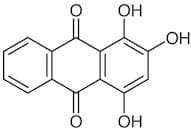
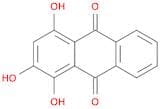
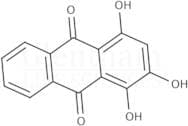
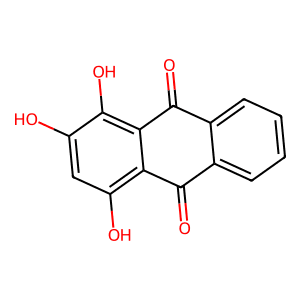
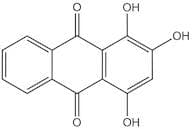
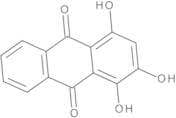
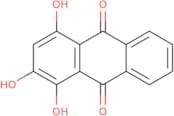
Purpur, mit der CAS-Nummer 81-54-9, ist eine organische Verbindung, die zur Klasse der Anthrachinone gehört, die sich durch ihre aromatische Struktur und umfangreiche Konjugation auszeichnen. Es handelt sich um einen roten Farbstoff, der hauptsächlich aus der Färberröte gewonnen wird, die historisch in Textilien verwendet wurde. Purpur zeigt eine starke Absorption im sichtbaren Spektrum, was zu seiner lebhaften Farbe beiträgt, und ist bekannt für seine Fähigkeit, Komplexe mit Metallionen zu bilden, was seine Farb- und Anwendungsstabilität in verschiedenen Bereichen verbessern kann. Die Verbindung ist in organischen Lösungsmitteln löslich, hat jedoch eine begrenzte Löslichkeit in Wasser. Purpur wurde auf seine potenziellen Anwendungen in farbstoffsensibilisierten Solarzellen sowie in der Biochemie aufgrund seiner fluoreszierenden Eigenschaften untersucht. Darüber hinaus hat es einige biologische Aktivitäten gezeigt, einschließlich antimikrobieller Eigenschaften. Wie viele organische Farbstoffe sind jedoch auch die Umweltauswirkungen und die Stabilität bei Lichteinwirkung wichtige Überlegungen bei seiner Verwendung. Insgesamt ist Purpur eine bedeutende Verbindung sowohl in historischen als auch in modernen Kontexten, insbesondere in der Farbstoffchemie und Materialwissenschaft.
Formel:C14H8O5
InChl:InChI=1S/C14H8O5/c15-8-5-9(16)14(19)11-10(8)12(17)6-3-1-2-4-7(6)13(11)18/h1-5,15-16,19H
InChI Key:InChIKey=BBNQQADTFFCFGB-UHFFFAOYSA-N
SMILES:O=C1C=2C(C(=O)C=3C1=CC=CC3)=C(O)C=C(O)C2O
Synonyme:- 1,2,4-Trihydroxy-9,10-anthracenedione
- Purpurin
- Anthraquinone, 1,2,4-trihydroxy-
- C.I. 58205
- 9,10-Anthracenedione, 1,2,4-trihydroxy-
Sortieren nach
Reinheit (%)
0
100
|
0
|
50
|
90
|
95
|
100
12 Produkte.
Purpurin
CAS:Formel:C14H8O5Reinheit:>95.0%(HPLC)Farbe und Form:Orange to Amber to Dark red powder to crystalMolekulargewicht:256.211,2,4-Trihydroxyanthracene-9,10-dione
CAS:Formel:C14H8O5Reinheit:85%Farbe und Form:SolidMolekulargewicht:256.2103Purpurin (C.I. 58205)
CAS:Formel:C14H8O5Reinheit:(HPLC) ≥ 94.0%Farbe und Form:Dark-red to orange-brown or brown powderMolekulargewicht:256.21Purpurin (C.I. 58205), 90%
CAS:Formel:C14H8O5Reinheit:≥ 85.0%Farbe und Form:Dark-red to orange-brown or brown powderMolekulargewicht:256.21Purpurin
CAS:Purpurin (Verantin), a MAO-A inhibitor (Ki: 0.422μM), has anti-angiogenic, antifungal, antibiotic, and antioxidative properties.Formel:C14H8O5Reinheit:97.53% - 98.45%Farbe und Form:SolidMolekulargewicht:256.21Purpurin
CAS:QuinoneFormel:C14H8O5Reinheit:≥ 85.0 % (HPLC)Farbe und Form:PowderMolekulargewicht:256.21Purpurin (85%)
CAS:Kontrolliertes ProduktApplications Purpurin is an anthraquinone derivative and is well known as a colour pigment derived from madder plants. Purpurin was extensively utilized in herbal remedies, in food colouring and dyes for cotton printing. Due to the high antioxidant activity exhibited by anthraquinone compounds, purpurin was determined through studies to possess potential radical scavenging effects. Purprin has also been shown to have inhibitory effects towards serine protease. Dyes and metabolites.
References Baghiani, A., et al.: Med. Chem., 7. 639 (2011); Drivas, I., et al.: Dyes. Pigments., 88. 7 (2010); Nishimura, N., et al.: Bio. Pharm. Bull., 33. 1430 (2010);Formel:C14H8O5Reinheit:85%Farbe und Form:Dark RedMolekulargewicht:256.21Purpurin
CAS:Purpurin is a natural compound that belongs to the group of sodium salts. It has been shown to have antimicrobial activity against many Gram-positive and Gram-negative bacteria, including methicillin-resistant Staphylococcus aureus (MRSA). Purpurin also has antioxidant properties and can be used for the treatment of infectious diseases. The photochemical properties of purpurin have been studied extensively. The matrix effect of purpurin on the cytochrome P450 enzyme system in human serum is well established. Purpurin has been shown to inhibit mitochondrial membrane potential and increase electron transfer resistance in mitochondria from rat liver cells. Purpurin has not been found to be toxic to humans after oral administration, but toxicity studies are still ongoing.Formel:C14H8O5Reinheit:Min. 95%Farbe und Form:Red PowderMolekulargewicht:256.21 g/mol1,2,4-Trihydroxy-9,10-anthracenedione
CAS:Formel:C14H8O5Reinheit:≥85%(HPLC)Farbe und Form:SolidMolekulargewicht:256.213