CAS 81-64-1
:Chinizarin
Beschreibung:
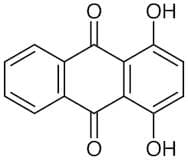
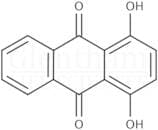
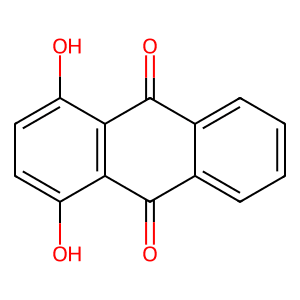
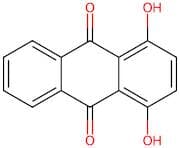
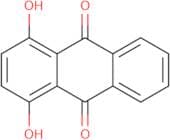
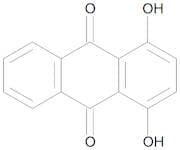
Chinizarin, auch bekannt als 1,4-Dihydroxyanthrachinon, ist eine organische Verbindung mit der chemischen Formel C14H8O2. Sie zeichnet sich durch ihre tiefrote Farbe aus und wird hauptsächlich als Farbstoff und Pigment in verschiedenen Anwendungen, einschließlich Textilien und Kunststoffen, verwendet. Chinizarin weist eine hervorragende Lichtbeständigkeit und Stabilität auf, was sie für Produkte geeignet macht, die Haltbarkeit erfordern. Die Verbindung ist in Wasser unlöslich, aber in organischen Lösungsmitteln wie Ethanol und Aceton löslich. Chinizarin hat eine planare Struktur, die zu ihrer Fähigkeit beiträgt, Licht im sichtbaren Spektrum zu absorbieren, was zu ihrer lebhaften Färbung führt. Darüber hinaus wurde sie auf ihre potenziellen Anwendungen in der organischen Elektronik und als pH-Indikator untersucht, da sie in der Lage ist, ihre Farbe als Reaktion auf pH-Änderungen zu ändern. Sicherheitsdaten zeigen, dass Chinizarin zwar allgemein als wenig giftig gilt, jedoch geeignete Handhabungs- und Sicherheitsmaßnahmen beachtet werden sollten, um die Exposition zu minimieren.
Formel:C14H8O4
InChl:InChI=1S/C14H8O4/c15-9-5-6-10(16)12-11(9)13(17)7-3-1-2-4-8(7)14(12)18/h1-6,15-16H
InChI Key:InChIKey=GUEIZVNYDFNHJU-UHFFFAOYSA-N
SMILES:O=C1C=2C(C(=O)C=3C1=CC=CC3)=C(O)C=CC2O
Synonyme:- 1,4-Dihidroxiantraquinona
- 1,4-Dihydroxy-9,10-anthracenedione
- 1,4-Dihydroxy-9,10-anthraquinone
- 1,4-Dihydroxy-anthraquinone:
- 1,4-Dihydroxyanthrachinon
- 9,10-Anthracenedione, 1,4-dihydroxy-
- Anthraquinone, 1,4-Dihydroxy-
- Chinizarin
- DAQ
- Macrolex Orange GG
- Nsc 15367
- Nsc 229036
- Nsc 40899
- Nsc 646569
- Quinizarin
- Quinizarine
- Smoke Orange 18
- Smoke Orange R
- Solvent Orange 100
- Solvent Orange 86
- 1,4-Dihydroxy-anthraquinone:C.I.Solvent Orange 86
- C.I. 58050
- CI NO 58050
- LABOTEST-BB LT00052844
- 1,4-Dioxyanthraquinone
- 1,4-dihydroxy-anthraquinon
- DSD ACID
- 1,4-dihydroxy-10-anthracenedione
- CI 58050
- 1,4 DIHYROXY AQ
- QUINAZARIN
- 1,4-dihydroxyanthrachinon(czech)[qr]
- 1,4-Dihydroxyanthra-9,10-quinone
- 1,4-dihydroxy-9,10(9H,10H)anthracenedione
- 1,4-DIHYDROXYANTHRAQUINONE
- Weitere Synonyme anzeigen
Sortieren nach
Reinheit (%)
0
100
|
0
|
50
|
90
|
95
|
100
12 Produkte.
Quinizarin
CAS:Formel:C14H8O4Reinheit:>97.0%(HPLC)Farbe und Form:Light yellow to Brown powder to crystalMolekulargewicht:240.211,4-Dihydroxyanthraquinone, 95%
CAS:1,4-Dihydroxyanthraquinone is used to color gasoline and some heating oils. It is used as an intermediate for the synthesis of indanthrene- and alizarin-derived dyes. It is also used to form lake pigments with calcium, barium and lead. It may be used in the synthesis of cyclopentanoids by cyclizatiFormel:C14H8O4Reinheit:95%Farbe und Form:Orange to red to brown, PowderMolekulargewicht:240.211,4-Dihydroxyanthracene-9,10-dione
CAS:Formel:C14H8O4Reinheit:95%Farbe und Form:SolidMolekulargewicht:240.2109Quinizarin
CAS:Quinizarin (1,4-Dihydroxyanthraquinone) is a natural productFormel:C14H8O4Reinheit:95.02%Farbe und Form:Leaves Yellow Red And Needles Dark Red Solid Leaves Or NeedlesMolekulargewicht:240.211,4-Dihydroxyanthraquinone
CAS:Formel:C14H8O4Reinheit:95%Farbe und Form:SolidMolekulargewicht:240.2141,4-Dihydroxyanthraquinone
CAS:1,4-Dihydroxyanthraquinone is a chemical compound that is stable in the presence of oxygen and has been used as an optical sensor. It has been shown to be able to detect glucose in human serum. 1,4-Dihydroxyanthraquinone has also been shown to have a number of biochemical properties, including its ability to inhibit energy metabolism by binding with NAD+ and inhibiting the formation of ATP. This compound binds with sodium carbonate or acid complex, which leads to the formation of an intramolecular hydrogen bond. The redox potential for this compound is -0.14 V (in acidic solution). 1,4-Dihydroxyanthraquinone shows apoptosis pathway activity in vitro and has shown bacterial strain specificity when tested against Staphylococcus aureus isolates.Formel:C14H8O4Reinheit:Min. 95%Farbe und Form:Red PowderMolekulargewicht:240.21 g/mol1,4-Dihydroxyanthraquinone
CAS:Applications 1,4-Dihydroxyanthraquinone is a bioactive compound from a phytochemical extract which may confer antimicrobial, antioxidant or anti-cancer activity.
References Balachandran, P. et al.: Molecules, 26, 735 (2021);Formel:C14H8O4Farbe und Form:NeatMolekulargewicht:240.21