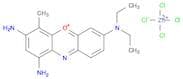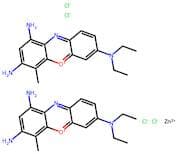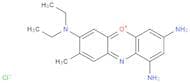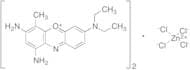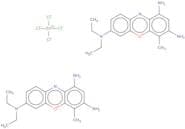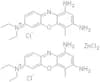
CAS 81029-05-2
:Brillantkresylblau
Beschreibung:
Brillantkresylblau ist ein synthetischer Farbstoff, der zur Klasse der Triphenylmethanfarbstoffe gehört und durch seine lebendige blaue Farbe gekennzeichnet ist. Er wird hauptsächlich als biologischer Farbstoff in der Histologie und Zytologie verwendet, insbesondere zur Identifizierung von lebensfähigen und nicht lebensfähigen Zellen. Der Farbstoff wirkt, indem er selektiv zelluläre Komponenten färbt, was die Visualisierung der Zellmorphologie und der Lebensfähigkeit unter einem Mikroskop ermöglicht. Brillantkresylblau ist in Wasser löslich und zeigt eine pH-abhängige Farbänderung, die in verschiedenen analytischen Anwendungen nützlich sein kann. Seine chemische Struktur umfasst mehrere aromatische Ringe, die zu seiner Stabilität und Farbgebung beitragen. Darüber hinaus hat er Anwendungen in biochemischen Tests, insbesondere bei der Bewertung der Zellproliferation und Zytotoxizität. Obwohl er im Allgemeinen als sicher für die Laboranwendung gilt, sollten angemessene Sicherheitsmaßnahmen getroffen werden, um den Farbstoff zu handhaben, wie bei jedem chemischen Reagenz. Insgesamt dient Brillantkresylblau als wertvolles Werkzeug sowohl in der Forschung als auch in klinischen Umgebungen zur Untersuchung zellulärer Eigenschaften.
Formel:C34H42Cl4N8O2Zn
InChl:InChI=1/C17H20N4O/c1-4-21(5-2)11-6-7-14-15(8-11)22-17-10(3)12(18)9-13(19)16(17)20-14/h6-9H,4-5H2,1-3H3,(H3,18,19)/p+1
InChI Key:InChIKey=MJQMEHNJPRMZLG-UHFFFAOYSA-J
SMILES:NC=1C2=C([O+]=C3C(=N2)C=CC(N(CC)CC)=C3)C(C)=C(N)C1.[Zn+2]([Cl-])([Cl-])([Cl-])[Cl-]
Synonyme:- 1,3-Diamino-7-(diethylamino)-4-methyl-phenoxazin-5-ium (T-4)-tetrachlorozincate(2-) (2:1)
- 1,3-Diamino-7-(diethylamino)-4-methylphenoxazin-5-ium tetrachlorozincate (2:1)
- N-(7,9-diamino-6-methyl-3H-phenoxazin-3-ylidene)-N-ethylethanaminium
- N-(7,9-diamino-6-methyl-5a,9a-dihydro-3H-phenoxazin-3-ylidene)-N-ethylethanaminium chloride
- Phenoxazin-5-ium, 1,3-diamino-7-(diethylamino)-4-methyl-, (T-4)-tetrachlorozincate(2-) (2:1)
- Zincate(2-), tetrachloro-, (T-4)-, bis[1,3-diamino-7-(diethylamino)-4-methylphenoxazin-5-ium]
- Brilliant Cresyl Blue
- BRILLIANT CRESYL BLUE ALD, INDICATOR GRA DE
- Brilliant crysyl blue ALD
- Brilliant Blue C
- brillant
- FORMERLY LISTED AS BRILLIANT CRESYL BLUE
- Brilliant BlueC, Brilliant Cresyl blue
- BRILLIANT BLUE C
- CI 51010
- Brilliant Cresyl blu
- BRILLIANT CRESYL BLUE ZINC CHLORIDE DOUBLE SALT
- BRILLIANT CRESYL BLUE C.I.No 51010
- BRILLIANT CRESYL BLUE ALD, CERTIFIED
- 5-[(dimethylphenyl)azo]-6-hydroxy-2-naphthalenesulfonicacimonosodiumsalt
- Brilliant cresyl Blue, high purity biological stain, pure
- (7,9-Diamino-6-methyl-5a,9a-dihydrophenoxazin-3-ylidene)-diethyl-azanium chloride
- BRILLIANT CRESYL BLUE ALD
- Brilliant Crystal Blue
- Brilliant Cresyl Blue ALD
- 3-AMino-9-diethylaMino-10-Methyl diphenazoxoniuM chloride
- Brilliant Cresyl Blue Certified
- BRILLLIANT BLUE C
- Brilliant cresyl bulue
- Brilliant cresyl Blue,pure,high purity biological stain
- brillantcresylblueadl
- Cresyl blue BBS or 2RN
- BRILLIANT CRESYL BLUE ALD INDICATOR GR&
- Brilliant cresy blue
- Weitere Synonyme anzeigen
Sortieren nach
Reinheit (%)
0
100
|
0
|
50
|
90
|
95
|
100
6 Produkte.
Brilliant Cresyl Blue certified
CAS:Formel:C34H42Cl4N8O2ZnReinheit:65%Farbe und Form:SolidMolekulargewicht:801.9417Brilliant Cresyl Blue (C.I. 51010)
CAS:Formel:C17H20N3OClZnCl2Reinheit:≥ 65.0% (spectrophotometry)Farbe und Form:Green to dark green powderMolekulargewicht:385.96Brilliant Cresyl Blue
CAS:Formel:C17H20N3OClZnCl2Farbe und Form:Green, Powder, Clear, BlueMolekulargewicht:385.96Brilliant Cresyl blue (Technical Grade)
CAS:Kontrolliertes ProduktApplications Brilliant Cresyl blue is a useful electroactive indicator dye.Dyes and metabolites.
Formel:C17H21N4O·Cl4ZnFarbe und Form:NeatMolekulargewicht:801.97068Brilliant cresyl blue
CAS:Brilliant cresyl blue is a reactive dye that is used as a model system for mitochondrial membrane potential. It is injected into the oocyte and polymerase chain reaction (PCR) is performed to detect mitochondrial functions. The dye can be detected with optical sensors, which are sensitive to UV light. When the dye migrates from the mitochondria to the cytoplasm, it can be detected by UV-sensitive sensors. This process can help scientists determine if there are any defects in mitochondrial membrane potential.
Formel:(C17H21N4O)2•ZnCl4Farbe und Form:Green PowderMolekulargewicht:400.97 g/mol