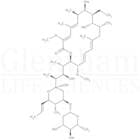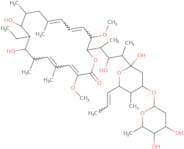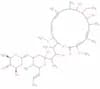
CAS 81552-34-3
:Concanamycin C
Beschreibung:
Concanamycin C ist ein Naturprodukt, das zur Klasse der Makrolid-Antibiotika gehört und spezifisch aus der Fermentation des Bakteriums *Streptomyces griseus* gewonnen wird. Es ist bekannt für seine starken hemmenden Wirkungen auf die vakuoläre ATPase (V-ATPase), ein Enzym, das für verschiedene zelluläre Prozesse, einschließlich der pH-Regulation und des Nährstofftransports, entscheidend ist. Diese Hemmung führt zu signifikanten biologischen Effekten, was Concanamycin C zu einer wertvollen Verbindung in der Forschung macht, insbesondere in Studien, die sich mit dem Zellstoffwechsel und der Apoptose befassen. Die Substanz weist eine komplexe molekulare Struktur auf, die durch mehrere Ringe und funktionelle Gruppen gekennzeichnet ist, was zu ihrer biologischen Aktivität beiträgt. Concanamycin C wird typischerweise in Laborumgebungen verwendet, um die Mechanismen des Zelltods zu erforschen und potenzielle therapeutische Anwendungen bei Krebs und anderen Krankheiten zu untersuchen. Ihre Stabilität und Löslichkeit in organischen Lösungsmitteln machen sie für verschiedene experimentelle Bedingungen geeignet. Wie bei vielen bioaktiven Verbindungen ist jedoch eine sorgfältige Handhabung und Berücksichtigung der Sicherheitsprotokolle aufgrund ihrer starken biologischen Wirkungen unerlässlich.
Formel:C45H74O13
InChl:InChI=1/C45H74O13/c1-13-16-34-28(7)37(56-38-22-33(46)42(50)31(10)55-38)23-45(52,58-34)30(9)41(49)29(8)43-35(53-11)18-15-17-24(3)19-26(5)39(47)32(14-2)40(48)27(6)20-25(4)21-36(54-12)44(51)57-43/h13,15-18,20-21,26-35,37-43,46-50,52H,14,19,22-23H2,1-12H3/b16-13+,18-15-,24-17-,25-20-,36-21+/t26?,27?,28?,29?,30?,31-,32?,33-,34?,35?,37?,38-,39?,40?,41?,42-,43?,45?/m1/s1
InChI Key:InChIKey=XKYYLWWOGLVPOR-GKJVGUBMSA-N
SMILES:[C@@H]([C@@H]([C@H](C)[C@@]1([C@@H](OC)/C=C/C=C(\C)/C[C@@H](C)[C@H](O)[C@H](CC)[C@H](O)[C@H](C)/C=C(\C)/C=C(\OC)/C(=O)O1)[H])O)(C)[C@@]2(O)C[C@@H](O[C@H]3C[C@@H](O)[C@H](O)[C@@H](C)O3)[C@H](C)[C@@H](/C=C/C)O2
Synonyme:- (3Z,5E,7R,8R,9S,10S,11R,13E,15E,17S,18R)-18-[(1S,2R,3S)-3-[(2R,4R,5S,6R)-4-[(2,6-Dideoxy-β-<span class="text-smallcaps">D</span>-arabino-hexopyranosyl)oxy]tetrahydro-2-hydroxy-5-methyl-6-(1E)-1-propen-1-yl-2H-pyran-2-yl]-2-hydroxy-1-methylbutyl]-9-ethyl-8,10-dihydroxy-3,17-dimethoxy-5,7,11,13-tetramethyloxacyclooctadeca-3,5,13,15-tetraen-2-one
- 2,4-dideoxy-3-O-(2,6-dideoxy-α-D-arabino-hexopyranosyl)-1-C-{3-[(16E)-11-ethyl-10,12-dihydroxy-3,17-dimethoxy-7,9,13,15-tetramethyl-18-oxooxacyclooctadeca-4,6,14,16-tetraen-2-yl]-2-hydroxy-1-methylbutyl}-4-methyl-5-[(1E)-prop-1-en-1-yl]pentopyranose
- 4'-O-De(aminocarbonyl)concanamycin A
- Concanamycin A, 4'-O-de(aminocarbonyl)-
- Concanamycin C
- Oxacyclooctadeca-3,5,13,15-tetraen-2-one, 18-[(1S,2R,3S)-3-[(2R,4R,5S,6R)-4-[(2,6-dideoxy-β-<span class="text-smallcaps">D</span>-arabino-hexopyranosyl)oxy]tetrahydro-2-hydroxy-5-methyl-6-(1E)-1-propen-1-yl-2H-pyran-2-yl]-2-hydroxy-1-methylbutyl]-9-ethyl-8,10-dihydroxy-3,17-dimethoxy-5,7,11,13-tetramethyl-, (3Z,5E,7R,8R,9S,10S,11R,13E,15E,17S,18R)-
- Oxacyclooctadeca-3,5,13,15-tetraen-2-one, 18-[(1S,2R,3S)-3-[(2R,4R,5S,6R)-4-[(2,6-dideoxy-β-<span class="text-smallcaps">D</span>-arabino-hexopyranosyl)oxy]tetrahydro-2-hydroxy-5-methyl-6-(1E)-1-propenyl-2H-pyran-2-yl]-2-hydroxy-1-methylbutyl]-9-ethyl-8,10-dihydroxy-3,17-dimethoxy-5,7,11,13-tetramethyl-, (3Z,5E,7R,8R,9S,10S,11R,13E,15E,17S,18R)-
- Oxacyclooctadecane, concanamycin A deriv.
- (3Z,5E,7R,8R,9S,10S,11R,13E,15E,17S,18R)-18-[(1S,2R,3S)-3-[(2R,4R,5S,6R)-4-[(2,6-Dideoxy-β-D-arabino-hexopyranosyl)oxy]tetrahydro-2-hydroxy-5-methyl-6-(1E)-1-propen-1-yl-2H-pyran-2-yl]-2-hydroxy-1-methylbutyl]-9-ethyl-8,10-dihydroxy-3,17-dimethoxy-5,7,11,13-tetramethyloxacyclooctadeca-3,5,13,15-tetraen-2-one
- Oxacyclooctadeca-3,5,13,15-tetraen-2-one, 18-[(1S,2R,3S)-3-[(2R,4R,5S,6R)-4-[(2,6-dideoxy-β-D-arabino-hexopyranosyl)oxy]tetrahydro-2-hydroxy-5-methyl-6-(1E)-1-propen-1-yl-2H-pyran-2-yl]-2-hydroxy-1-methylbutyl]-9-ethyl-8,10-dihydroxy-3,17-dimethoxy-5,7,11,13-tetramethyl-, (3Z,5E,7R,8R,9S,10S,11R,13E,15E,17S,18R)-
- Oxacyclooctadeca-3,5,13,15-tetraen-2-one, 18-[(1S,2R,3S)-3-[(2R,4R,5S,6R)-4-[(2,6-dideoxy-β-D-arabino-hexopyranosyl)oxy]tetrahydro-2-hydroxy-5-methyl-6-(1E)-1-propenyl-2H-pyran-2-yl]-2-hydroxy-1-methylbutyl]-9-ethyl-8,10-dihydroxy-3,17-dimethoxy-5,7,11,13-tetramethyl-, (3Z,5E,7R,8R,9S,10S,11R,13E,15E,17S,18R)-
Sortieren nach
Reinheit (%)
0
100
|
0
|
50
|
90
|
95
|
100
3 Produkte.
Concanamycin C
CAS:Concanamycin C, a natural macrolide antibiotic, was initially isolated from Streptomyces and identified as an inhibitor of T-cell proliferation in response to concanavalin A (1,2). It exhibits cytotoxicity to fungi, including yeasts, by inhibiting vacuolar-type ATPases (3,4).Formel:C45H74O13Farbe und Form:SolidMolekulargewicht:823.1Concanamycin C
CAS:Concanamycin C is an analog of the human kinase inhibitor that has been shown to have potent anticancer activity. This compound induces apoptosis in cancer cells by inhibiting the activity of protein kinases involved in cell cycle regulation and tumor growth. Concanamycin C is a medicinal compound that has been used as a research tool in the development of novel kinase inhibitors for cancer therapy. This potent inhibitor has been shown to be effective against various types of cancer, making it a promising candidate for further investigation as an anticancer drug. Its unique properties make it an attractive target for the development of new and more effective kinase inhibitors.
Formel:C45H74O13Reinheit:Min. 95%Molekulargewicht:823.1 g/mol