CAS 82198-76-3
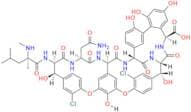
:(1S,2R,18R,19R,22S,25R,28R,40S)-22-(2-amino-2-oxoethyl)-5,15-dichlor-2,18,32,35,37,48-hexahydroxy-19-{[(2R)-4-methyl-2-(methylamino)pentanoyl]amino}-20,23,26,42,44-pentaoxo-7,13-dioxa-21,24,27,41,43-pentaazaoctacyclo[26.14.2.2~3,6~.2~14,17~.1~8,12~.1~29,
Beschreibung:
Die chemische Substanz mit dem Namen "(1S,2R,18R,19R,22S,25R,28R,40S)-22-(2-amino-2-oxoethyl)-5,15-dichlor-2,18,32,35,37,48-hexahydroxy-19-{[(2R)-4-methyl-2-(methylamino)pentanoil]amino}-20,23,26,42,44-pentaoxo-7,13-dioxa-21,24,27,41,43-pentaazaoctacyclo[26.14.2.2~3,6~.2~14,17~.1~8,12~.1~29" und CAS-Nummer "82198-76-3" ist eine komplexe organische Verbindung, die durch mehrere funktionelle Gruppen und eine hochkomplexe polycyclische Struktur gekennzeichnet ist. Sie weist mehrere chirale Zentren auf, was auf stereochemische Spezifität hinweist, die ihre biologische Aktivität und Wechselwirkungen beeinflussen kann. Das Vorhandensein von Dichlor- und Aminogruppen deutet auf potenzielle Reaktivität und biologische Bedeutung hin, möglicherweise in pharmazeutischen Anwendungen. Die umfangreichen Hydroxy- und Oxofunktionalitäten des Verbindungsimplikats starke Wasserstoffbindungsfähigkeiten, die die Löslichkeit und Stabilität in verschiedenen Umgebungen beeinflussen könnten. Darüber hinaus deuten die Pentaaza- und Dioxa-Komponenten auf einen hohen Stickstoff- und Sauerstoffgehalt hin, der zu ihrer Gesamtpolarität und Reaktivität beitragen kann. Insgesamt veranschaulicht diese Substanz die Komplexität, die oft in bioaktiven Molekülen zu finden ist, insbesondere in solchen mit potenziellen therapeutischen Anwendungen.
Formel:C53H52Cl2N8O17
InChl:InChI=1/C53H52Cl2N8O17/c1-19(2)10-29(57-3)47(71)62-42-44(68)21-5-8-33(27(54)12-21)79-35-14-23-15-36(46(35)70)80-34-9-6-22(13-28(34)55)45(69)43-52(76)61-41(53(77)78)26-16-24(64)17-32(66)38(26)25-11-20(4-7-31(25)65)39(49(73)63-43)60-50(74)40(23)59-48(72)30(18-37(56)67)58-51(42)75/h4-9,11-17,19,29-30,39-45,57,64-66,68-70H,10,18H2,1-3H3,(H2,56,67)(H,58,75)(H,59,72)(H,60,74)(H,61,76)(H,62,71)(H,63,73)(H,77,78)/t29-,30+,39-,40-,41+,42-,43+,44-,45-/m1/s1
Synonyme:- (1S,2R,18R,19R,22S,25R,28R,40S)-22-(2-amino-2-oxoethyl)-5,15-dichloro-2,18,32,35,37,48-hexahydroxy-19-{[(2R)-4-methyl-2-(methylamino)pentanoyl]amino}-20,23,26,42,44-pentaoxo-7,13-dioxa-21,24,27,41,43-pentaazaoctacyclo[26.14.2.2~3,6~.2~14,17~.1~8,12~.1~29,33~.0~10,25~.0~34,39~]pentaconta-3,5,8(48),9,11,14,16,29(45),30,32,34,36,38,46,49-pentadecaene-40-carboxylic acid (non-preferred name)
Sortieren nach
Reinheit (%)
0
100
|
0
|
50
|
90
|
95
|
100
3 Produkte.
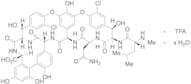
Vancomycin Aglycon Trifluoroacetic Acid Salt Hydrate
CAS:Kontrolliertes ProduktFormel:C53H52Cl2N8O17•C2HF3O2•xH2OReinheit:>90%Farbe und Form:NeatMolekulargewicht:1143.941140218Vancomycin aglycon
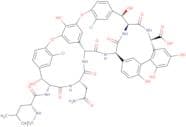
CAS:Vancomycin aglycon is a glycopeptide antibiotic, which is a derivative of vancomycin. It is sourced from the fermentation products of certain Amycolatopsis species, a genus of actinobacteria. The mode of action of vancomycin aglycon involves the inhibition of bacterial cell wall synthesis. It specifically binds to the D-Ala-D-Ala terminus of nascent peptidoglycan chains, thereby preventing the cross-linking that is crucial for maintaining cell wall integrity.
Formel:C53H52Cl2N8O17Reinheit:Min. 95%Molekulargewicht:1,143.93 g/mol