CAS 82257-15-6
:4-Methoxy-3-pyridincarbaldehyd
Beschreibung:
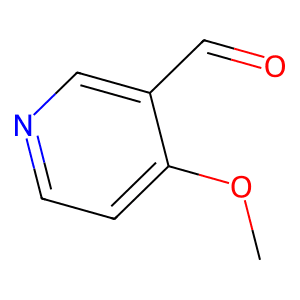
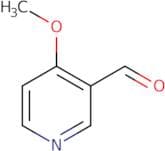
4-Methoxy-3-pyridincarbaldehyd, mit der CAS-Nummer 82257-15-6, ist eine organische Verbindung, die durch ihre Pyridinringstruktur gekennzeichnet ist, die mit einer Methoxygruppe und einer Aldehydfunktionalität substituiert ist. Diese Verbindung erscheint typischerweise als eine blassgelbe bis hellbraune Flüssigkeit oder Feststoff, abhängig von ihrer Reinheit und Form. Sie ist bekannt für ihre aromatischen Eigenschaften, die zu ihrer Verwendung in verschiedenen chemischen Synthesen und Anwendungen in der Pharmazie und Agrochemie beitragen können. Die Anwesenheit der Methoxygruppe verbessert ihre Löslichkeit in organischen Lösungsmitteln, während die Aldehydgruppe sie reaktiv macht und weitere chemische Modifikationen ermöglicht. Darüber hinaus kann 4-Methoxy-3-pyridincarbaldehyd biologische Aktivität zeigen, was es in der medizinischen Chemie von Interesse macht. Ihre Synthese umfasst oft die Funktionalisierung von Pyridinge-nervativen, und sie kann mit Techniken wie NMR und Massenspektrometrie analysiert werden, um ihre Struktur und Reinheit zu bestätigen. Sicherheitsdaten sollten für den Umgang und die Lagerung konsultiert werden, wie bei jeder chemischen Substanz.
Formel:C7H7NO2
InChl:InChI=1/C7H7NO2/c1-10-7-2-3-8-4-6(7)5-9/h2-5H,1H3
SMILES:COc1ccncc1C=O
Synonyme:- 3-Formyl-4-methoxypyridine
- 4-Methoxypyridine-3-Carbaldehyde
Sortieren nach
Reinheit (%)
0
100
|
0
|
50
|
90
|
95
|
100
3 Produkte.
3-Formyl-4-methoxypyridine
CAS:3-Formyl-4-methoxypyridine is a synthetic compound that belongs to the group of pyrimidine ring compounds. It is synthesized by the reaction of triflic acid with 2,6-dichloropyridine and has been shown to have antiviral and antitumour properties. The compound has also been synthetized as a potential drug for the treatment of malaria. 3-Formyl-4-methoxypyridine is an analog of variolin, which is an alkaloid that can be found in marine organisms such as sponges and tunicates. 3-Formyl-4-methoxypyridine has been shown to inhibit protein synthesis by inhibiting the enzyme RNA polymerase II, which leads to cell death by apoptosis or necrosis.Formel:C7H7NO2Reinheit:Min. 95%Farbe und Form:PowderMolekulargewicht:137.14 g/mol4-Methoxy-3-pyridinecarboxaldehyde
CAS:Formel:C7H7NO2Reinheit:95%Farbe und Form:SolidMolekulargewicht:137.138